Trusted by 100+ Global Startups and Enterprises
Our Cloud Application Development Services
Our cloud application development services help teams build scalable, reliable platforms engineered for real-world growth, ensuring systems evolve smoothly.

Cloud Platform Architecture & Strategy Consulting
Define a cloud foundation aligned to your business model, scale goals, and regulatory needs. Architecture decisions are made early to reduce risk and support integrations, ensuring the platform grows predictably instead of compounding complexity as data increases. This includes feasibility analysis, architecture reviews, and clear roadmaps to guide cloud investment decisions.

Cloud-Native Application Development
Build cloud-native applications engineered for real-world usage, not ideal conditions. Systems support scalability and resilience, enabling faster releases and stable performance as demand grows. This approach is well-suited for SaaS platforms needing multi-tenant architecture, secure data isolation, and predictable scaling.

Cloud Application Migration
Migrate existing applications to the cloud using controlled, low-risk approaches that preserve business continuity. Systems are assessed to determine the right migration path: rehost, replatform, or partial refactor, ensuring minimal disruption while maintaining a stable foundation.

Application Integration Services
Enable scalable ecosystems using well-defined APIs, event-driven systems, and modular services. Applications are structured to support integrations, partner platforms, and independent feature evolution, helping teams expand functionality without destabilizing core systems as usage increases.

DevOps-Driven Cloud Delivery
Achieve reliable cloud delivery through automated pipelines, infrastructure workflows, and embedded observability. Releases become faster, and environments remain consistent, allowing you to focus on product development while the platform scales. Delivery workflows support modern containerized and cloud-native deployment models without locking you into specific tools.

Cloud Security & Compliance Services
Embed security and compliance into cloud architecture from the outset. Access control and data protection are built early, enabling platforms to meet regulatory requirements while maintaining performance without last-minute security compromises. Architectures commonly support HIPAA, SOC 2, and PCI-aligned securityrequirements.

Cloud Data Engineering
Support data-driven operations with cloud platforms designed for high-volume data processing, analytics, and intelligence. Systems reliably handle data across services and regions, enabling reporting, insights, and AI-driven capabilities as part of the core platform rather than as disconnected add-ons.

Cloud Cost Optimization
Optimize cloud platforms for performance, reliability, and cost efficiency as they scale. Architectures are continuously evaluated to address bottlenecks and control spend, ensuring the system delivers consistent value without increasing resource usage as demand patterns change.

Site Reliability Engineering Services
Strengthen cloud platform reliability through incident response and performance engineering practices. Systems are monitored against defined service objectives, enabling proactive issue detection and stability improvements. Reliability processes are embedded into delivery workflows, helping you reduce operational risk.
How Our Cloud Applications Deliver Business Value

Build scalable cloud platforms
Design scalable cloud applications that grow with users, data, and traffic. Use cloud-native architecture, auto-scaling, and resilient infrastructure to ensure consistent performance as demand increases, without frequent rework or infrastructure bottlenecks.
Prevent technical debt through architecture
Apply clean cloud architecture and proven system design patterns to avoid fragile codebases. This enables faster development cycles, easier onboarding, and maintainability across cloud-native and microservices-based applications.
Accelerate delivery with cloud-native workflows
Ship faster using cloud-native development, DevOps automation, and continuous delivery practices. Release new features frequently while maintaining reliability, security, and operational stability in production cloud environments.
Build for real-world cloud complexity
Engineer applications that handle compliance, data integrity, third-party integrations, and distributed systems. Create cloud solutions that perform reliably under real operating conditions, not just controlled test scenarios.
Align cloud architecture with business models
Design cloud application architecture that supports revenue models, user behavior, and future growth. Ensure technical decisions strengthen the product strategy rather than limit scale, performance, or adaptability over time.
Retain ownership and cloud flexibility
Develop cloud applications without vendor lock-in by leveraging portable architectures and open standards. Maintain full ownership of code, infrastructure, and deployment pipelines across AWS, Azure, or Google Cloud environments.
Cloud Application Development Success Stories

Cloud Application Development Across Service Models
Cloud application development delivered across SaaS, PaaS, and IaaS models, designed to support scale, flexibility, and platform evolution.

SaaS Platform Engineering
Design and engineer SaaS platforms that support multi-tenant architectures, secure data isolation, and predictable scaling. Systems are built to handle onboarding and feature expansion while maintaining performance, compliance, and architectural clarity. This ensures that your SaaS product can evolve confidently.

IaaS-Based Cloud Foundations
Build cloud applications on IaaS models with architectures designed for reliability, flexibility, and cost control. Platforms are structured to support automation and scalability, enabling teams to manage workloads efficiently as usage patterns, performance requirements, and business priorities change.

PaaS Model Development
Leverage PaaS environments to streamline development, testing, and deployment workflows. Applications are designed to take advantage of managed services while maintaining architectural control, enabling faster iteration and consistent performance as you focus on building product capabilities.
Cloud Platforms We Migrate and Modernize On
Migrate and modernize critical systems on leading cloud platforms with seamless integration and scalable architecture that support business growth.

Amazon Web Services (AWS)
Design and operate cloud-native platforms on AWS with a focus on scalability, resilience, and cost awareness. AWS enables flexible infrastructure, global reach, and automation-first architectures that support high-growth applications and evolving workloads.

Google Cloud
Build modern cloud applications using Google Cloud’s data, AI, and infrastructure capabilities. The platform supports rapid development, high-performance workloads, and secure, distributed systems, enabling you to design scalable solutions.

Microsoft Azure
Architect cloud solutions on Azure to support enterprise integration, hybrid environments, and long-term modernization. Azure enables secure, compliant platforms that integrate seamlessly with existing systems, helping you transition to cloud-native models.

Salesforce
Integrate Salesforce into cloud platforms to support customer engagement, sales operations, and service workflows. Salesforce partnerships enable reliable system integrations and data flows, helping you build connected platforms that improve visibility, automation, and customer experience.

Oracle Cloud
Leverage Oracle cloud to build data-intensive and transaction-heavy cloud systems. Oracle platforms support high availability, data integrity, and enterprise-grade performance, helping you run mission-critical workloads securely.

Adobe Creative Cloud
Deliver digital platforms that combine robust cloud architecture with advanced experience management. Adobe Clouds enables scalable content, commerce, and data-driven personalization solutions, helping you build customer-centric systems
Amazon Web Services (AWS)
Design and operate cloud-native platforms on AWS with a focus on scalability, resilience, and cost awareness. AWS enables flexible infrastructure, global reach, and automation-first architectures that support high-growth applications and evolving workloads.
Google Cloud
Build modern cloud applications using Google Cloud’s data, AI, and infrastructure capabilities. The platform supports rapid development, high-performance workloads, and secure, distributed systems, enabling you to design scalable solutions.
Microsoft Azure
Architect cloud solutions on Azure to support enterprise integration, hybrid environments, and long-term modernization. Azure enables secure, compliant platforms that integrate seamlessly with existing systems, helping you transition to cloud-native models.
Salesforce
Integrate Salesforce into cloud platforms to support customer engagement, sales operations, and service workflows. Salesforce partnerships enable reliable system integrations and data flows, helping you build connected platforms that improve visibility, automation, and customer experience.
Oracle Cloud
Leverage Oracle cloud to build data-intensive and transaction-heavy cloud systems. Oracle platforms support high availability, data integrity, and enterprise-grade performance, helping you run mission-critical workloads securely.
Adobe Creative Cloud
Deliver digital platforms that combine robust cloud architecture with advanced experience management. Adobe Clouds enables scalable content, commerce, and data-driven personalization solutions, helping you build customer-centric systems
Types of Cloud App Development Services We Specialize In
Cloud-Native Application Development
Design applications specifically for cloud environments using distributed systems and cloud-native patterns. Architect platforms to support elasticity and continuous delivery, enabling applications to scale and adapt to change without relying on legacy constraints or monolithic structures.
Hybrid Cloud Application Development
Build applications that operate seamlessly across on-premise and cloud environments. Architect systems to balance compliance, performance, and control, enabling you to modernize selectively while maintaining interoperability and supporting gradual cloud adoption.
Multi-Cloud Application Development
Develop applications designed to run across multiple cloud providers without fragmentation. Architect systems to avoid vendor lock-in while maintaining consistency and performance, enabling you to leverage different cloud capabilities.
Serverless & Event-Driven Applications
Create applications using serverless and event-driven architectures to support rapid scaling and efficient resource usage. Design systems that respond dynamically to demand, reduce operational overhead, and enable faster feature development while maintaining reliability.
Why Businesses Are Choosing Cloud Platforms
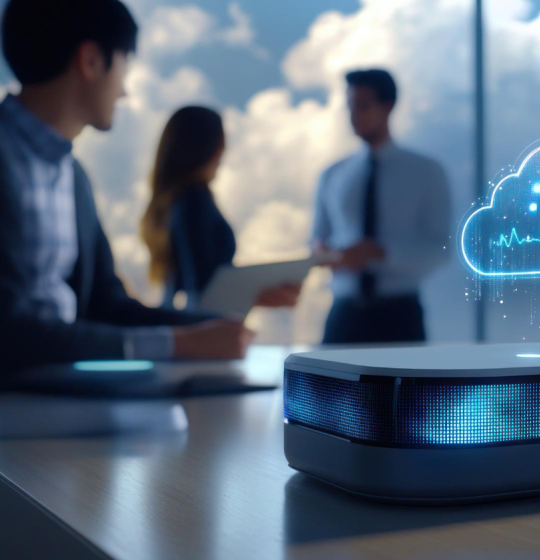
Cloud adoption is no longer exploratory, rather it’s a practical response to growing system complexity, faster delivery expectations, and the need to scale without rewriting everything.
- Scaling without friction: Cloud platforms enable businesses to scale users and transactions without repeated re-architecture. Companies report up to 3–4× faster feature releases as systems handle growth under fluctuating demand and expanding geographic reach.
- Faster delivery: Teams using cloud-native delivery models move from quarterly to frequent releases, reducing deployment effort by 30–40%. Automated environments help them to respond faster to market change.
- Reliability at scale: Cloud architectures are designed for high availability, with enterprises targeting 99.9%+ uptime through automated recovery. This resilience supports mission-critical applications as platforms grow more interconnected.
Cloud Solutions Designed for Your Industry Needs
Modern cloud platforms must reflect the realities of the industries they serve. Each solution below shows how our cloud application development is applied to specific industry challenges.

Healthcare Cloud Platforms
Design cloud applications that support telehealth, patient engagement, clinical workflows, and data interoperability. Platforms are architected to meet regulatory requirements, ensure data security, and maintain high availability, enabling you to scale your software solution.

SaaS & Technology Product Platforms
Build cloud platforms for SaaS and technology products that support frequent releases, growing user bases, and integrations. Architect systems for multi-tenant scalability, reliability, and change, enabling teams to iterate quickly while maintaining stability.

E-commerce & Omnichannel Retail Systems
Develop cloud applications that connecte-commercee platforms, inventory systems, fulfillment, and customer experiences. Architect solutions to handle traffic spikes, real-time data, and cross-channel workflows, allowing retailers to scale operations, improve order accuracy, and adapt quickly.

Fintech & Financial Services Platforms
Create cloud platforms that support payments, lending, reporting, and financial workflows while meeting strict security and compliance requirements. Systems are designed for auditability, data protection, and resilience, enabling financial organizations to scale services safely without introducing operational or regulatory risk.

Enterprise & Public Sector Systems
Design cloud applications for enterprise and public sector environments where reliability, accessibility, and long-term stability are critical. Architect systems to support large user bases, complex integrations, and changing policy requirements while maintaining predictable performance and operational control.

Travel & Transport Platforms
Design cloud applications that power booking engines, fleet management systems, route optimization, and real-time tracking platforms. Architect solutions to handle high transaction volumes, dynamic pricing models, ,helping you to scale operations while maintaining reliability and performance.
Why Choose Unthinkable for Cloud Application Development Services?

Unthinkable approaches cloud application development as a long-term platform discipline, not a short-term delivery task. Our teams combine domain expertise with architectural rigor to build cloud systems that scale predictably, adapt to change, and remain understandable as complexity grows. The focus is on enabling durable outcomes, not creating dependency.
- Domain-first engineering: Solutions are shaped by industry context, regulatory needs, and real operational constraints.
- Architecture before code: Early design decisions reduce technical debt and future rework.
- Ownership-led delivery: You retain full control of code, infrastructure, and roadmap.
- Built for evolution: Platforms are designed to change without disruption as needs shift.
Our engagement is structured to provide clarity early, reduce uncertainty during execution, and leave teams better equipped to own and extend the platform independently.
Our Engagement Models for Cloud Application Development

Fixed Scope Engagement
Define scope, timeline, and budget upfront for cloud initiatives with clearly defined requirements. This model works well for contained efforts such as platform assessments, MVPs, or well-scoped cloud builds. Architecture is validated early, milestones are agreed in advance, and delivery risk is managed through predictable execution.

Time and Material Engagement
Progress cloud application development iteratively as requirements change. This model supports changing priorities and phased modernization efforts. Teams adapt delivery based on ongoing insights while maintaining architectural consistency, enabling continuous progress and regular feedback.

Dedicated Cloud Engineering Team
Engage a dedicated cloud engineering team aligned to your product roadmap and delivery goals. This model suits long-term platform development and scaling initiatives. The team operates as an extension of your organization, providing continuity, deep architectural context, and the ability to adapt quickly as priorities change.
Fixed Scope Engagement
Define scope, timeline, and budget upfront for cloud initiatives with clearly defined requirements. This model works well for contained efforts such as platform assessments, MVPs, or well-scoped cloud builds. Architecture is validated early, milestones are agreed in advance, and delivery risk is managed through predictable execution.
Time and Material Engagement
Progress cloud application development iteratively as requirements change. This model supports changing priorities and phased modernization efforts. Teams adapt delivery based on ongoing insights while maintaining architectural consistency, enabling continuous progress and regular feedback.
Dedicated Cloud Engineering Team
Engage a dedicated cloud engineering team aligned to your product roadmap and delivery goals. This model suits long-term platform development and scaling initiatives. The team operates as an extension of your organization, providing continuity, deep architectural context, and the ability to adapt quickly as priorities change.
Tech Stack We Excel In
Unthinkable has consistently embraced emerging technologies, building deep expertise across programming languages, frameworks, libraries, and tools. Through our dedicated R&D labs, we actively experiment with new technologies and transfer these insights to our clients, enabling them to gain a sustainable competitive advantage.
Cloud Technologies
 AWS
AWS Microsoft Azure
 Google Cloud
Cloud AI
 AWS SageMaker
 Azure AI
 Google Vertex AI
Frontend Technologies
 React
React Angular
 Vue.js
 Next.js
 Astro
Astro HTML5
HTML5 CSS
CSSBackend Technologies
 .Net
.Net Java
Java NodeJS
 Python
 PHP
PHP GO
GODatabases/Data Storages
 My SQL
 SQL Server
 MongoDB
 Amazon S3
 Amazon RDS
 Cassandra
DevOps
 Linux
Linux Linode
 Jenkins
 Terraform
 Digital Ocean
 Ansible
 Chef
Chef Puppet
 Kubernetes
 Docker
Mobile
 IOS
IOS Android
 Xamarin
 Cordova
 PWA
PWA React Native
 Flutter
Platforms
 Salesforce
 Adobe Commerce
 Power BI
 Oracle
Recommended Readings
Let’s Build Something Extraordinary
Sign up for a 30 min no-obligation strategic session with us. Transform your Ideas into scalable reality.

Idea Validation
Expert assessment of your project scope & potential

Actionable Insights
Technology Stack recommendations tailored to you

Industry Best Practices
Implementation strategies that ensure scalability

Estimate and Timeline
Ballpark estimates and a clear plan of action
Get in Touch
Fill out the form and we’ll get back to you instantly or email us directly at info@unthinkable.co
- What does a cloud application development company do?
- How is cloud application development different from traditional application development?
- What types of cloud applications can be built?
- When should a business consider moving to cloud-native architecture?
- How long does cloud application development typically take?
- How do you approach cloud migration without disrupting the business?
- How do you ensure cloud applications scale reliably?
- Is security built into cloud application development?
- How do DevOps practices fit into cloud application development?
- How do you prevent cloud applications from becoming expensive over time?