May 08, 2026
Shopify Conversion Rate Benchmarks by Industry (2026)
Traffic looks healthy, campaigns are performing, and orders are coming in. Then someone checks a benchmark report and sees their Shopify conversion rate is below the industry average. Almost instantly, the focus shifts from growth to what’s missing. Benchmarks tend to do that; they create pressure quickly, but rarely offer real clarity. They can be useful for understanding where you stand, but they don’t explain why your store is performing a certain way or what needs to change to improve it.
Shopify conversion rate benchmarks help e-commerce businesses understand how their store compares with others in the market. For brands looking to improve performance beyond benchmarks, investing in e-commerce and digital commerce solutions becomes critical. These numbers provide directional insight into industry performance, but they should be used as reference points rather than performance targets. Understanding the broader context behind these benchmarks is more valuable than focusing on the numbers alone.
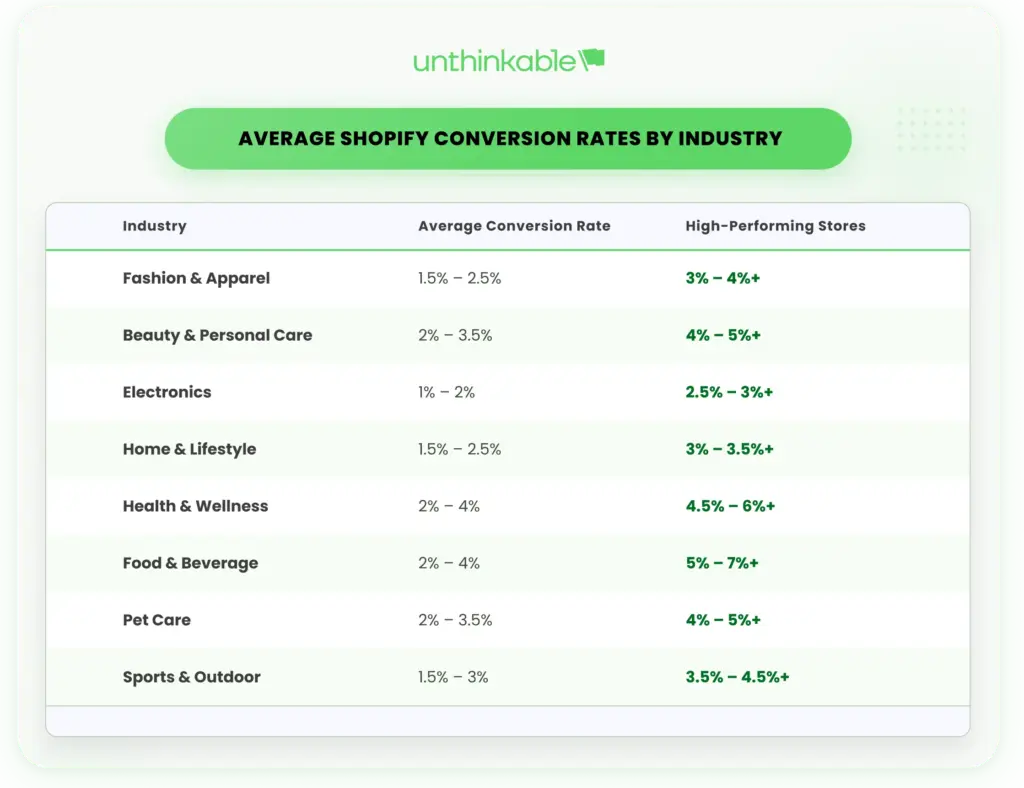
*Source: Aggregated from Shopify analytics benchmarks and CRO studies, including Growth Suite (2026), Launchtip (2026), and EasyAppsEcom (2026).
Common Patterns Across Industries
- Lower-priced, repeat-purchase categories such as beauty, food, and wellness generally convert at higher rates
- High-consideration purchases like electronics convert lower but often deliver higher order values
- Fashion and home categories sit in the middle due to sizing concerns, shipping complexity, and return expectations
Key Variables That Influence Conversion
- Device: Mobile conversion rates are usually 20–40% lower than desktop
- Traffic Source: Email and returning visitors convert significantly higher than paid traffic
- Customer Familiarity: Returning customers often convert 2–3x higher than first-time buyers
The Problem With Shopify Conversion Rate Benchmarks
Benchmarks are useful for understanding the market, but they can become misleading when used as direct performance goals. Since every Shopify business operates differently, comparing one store’s conversion rate against a broad average often oversimplifies the real performance picture.
Why Benchmark Comparisons Can Mislead
- Businesses operate with different pricing structures and margins
- Traffic quality varies across acquisition channels
- Customer behavior differs across categories and markets
- Purchase frequency and buying intent are rarely consistent
What You’re Really Comparing
- Business model efficiency
- Product pricing strategy
- Customer purchase behavior
- Store economics and profitability
Why Conversion Rate Alone Doesn’t Tell You Much
Conversion rate is often treated as the most important e-commerce metric, but it only reflects one outcome. It combines multiple behaviors into a single number, making it difficult to understand what is actually influencing customer decisions.
What Conversion Rate Doesn’t Show
- Where customers drop off in the buying journey
- Why customers decide to purchase or leave
- Whether the sale is profitable
- How repeat purchases impact revenue
Why This Matters
- Two brands can share identical conversion rates and generate very different results
- Revenue quality matters more than raw transaction volume
- Optimization decisions based only on conversion can lead to poor investment choices
Where Conversion Actually Happens in Ecommerce Funnels
Conversion is not one action but a sequence of buying decisions. The part of the funnel that matters most depends on the business model, pricing strategy, and purchase behavior of your customers.
For Low Average Order Value Stores
- Product bundles increase basket value
- Free shipping thresholds encourage additional purchases
- Upsell placements influence revenue directly
For High-Consideration Purchases
- Product pages build trust and reduce hesitation
- Clear pricing and value explanation improve confidence
- Reviews and proof points reduce buying friction
For Repeat-Purchase Businesses
- Retention matters more than first-time purchase
- Subscription and replenishment flows improve customer lifetime value
- Post-purchase experience drives future conversions
Why Most Shopify CRO Efforts Fail
Many Shopify stores invest in optimization, yet conversion rates often remain flat. Exploring real-world case studies of digital products and growth optimization can provide clearer insight into what actually drives measurable results. The issue is rarely a lack of effort; it is usually a lack of focus. When teams attempt to improve every part of the site at once, achieving meaningful business outcomes becomes harder.
Common CRO Activities
- Homepage redesigns
- Checkout optimization
- Product page testing
- Offer and promotion changes
Why These Often Fail
- Too many variables are changed simultaneously
- Teams optimize for activity instead of constraints
- Real bottlenecks remain unidentified
Behavior Matters More Than Design
Design affects perception, but customer behavior determines conversion. Customers buy when the path to making a decision feels easy, predictable, and low risk.
What Drives Customer Decisions
- Clear and justified pricing
- Predictable shipping and delivery expectations
- Convenient payment methods
- Strong trust signals
Why Behavior Is Different for Every Store
- Audience expectations vary by market
- Product types influence decision-making
- Competitor tactics are not universally effective
Your Shopify Data Is More Useful Than Benchmarks
Industry benchmarks offer context, but your own Shopify data provides better operational insight. Leveraging data analytics and AI-driven insights can help uncover patterns that benchmarks alone cannot reveal. Internal performance patterns reveal what drives growth and where conversion performance begins to weaken.
Metrics Worth Tracking
- Conversion by traffic source
- Conversion during pricing or promotion changes
- Returning customer purchase behavior
- Funnel drop-off points
What This Helps You Identify
- Normal conversion patterns for your business
- Revenue-impacting performance changes
- The real areas for optimization
A Better Question to Ask About Conversion Rate
Instead of focusing on what the average Shopify conversion rate should be, businesses should focus on understanding how conversion impacts revenue and profitability. Better questions produce better optimization decisions.
Replace This Question
- What is a good Shopify conversion rate?
Ask These Instead
- Where will conversion growth come from?
- Will higher conversion improve revenue quality?
- Which funnel stage creates the biggest business constraint?
E-commerce Conversion Trends for 2026
Conversion is becoming more difficult to standardize as customer expectations, attribution models, and market behavior continue to evolve. This makes generalized benchmarks less useful than they once were.
Key Trends Shaping E-commerce Conversion
- Rising customer expectations around speed and trust
- Privacy changes are reducing attribution visibility
- Increased importance of customer retention
- Higher acquisition costs are impacting conversion economics
What Will Matter More
- Margin efficiency
- Repeat purchase behavior
- Customer decision drivers
Quick Conversion Rate Audit
Before investing in conversion optimization, ecommerce teams need to understand whether they are solving the right business problem.
Questions to Ask
- Do we know where valuable customers drop off?
- Do we understand why customers convert or leave?
- Will improved conversion increase profitability?
- Are we solving a clear bottleneck?
Final Thought
Shopify conversion rate benchmarks are useful for reference, but they should not become targets. Real conversion growth comes from understanding how your business generates value and removing the constraints that limit it.
One Place to Start
- If your conversion rate increased tomorrow, what would actually improve?
- Would profitability increase or just order volume?
- Which business constraint matters most right now?
About Author