
Jun 05, 2026
Top AI Trends in 2026: What’s Actually Shipping
TLDR;
- AI in 2026 has to earn its spot on the roadmap. If it doesn’t save time, cut mistakes, or bring in money, it gets cut.
- Agentic AI is the big shift. Systems now plan steps, use tools, and finish tasks instead of just answering questions.
- The model race stopped mattering as much. The advantage now comes from the systems built around them.
- Governance moved from a slide deck to an engineering problem. Only 21% of companies have mature controls for the agents they’re already running.
- Legacy systems, not weak models, are what kill most AI projects before they scale.
Top AI trends that will rule 2026
AI in 2026 feels less like a breakthrough and more like “okay, who owns this in production?” A year ago, teams wanted a chatbot because everyone else had one. Now they want something that saves time, cuts mistakes, or stops staff from answering the same question 200 times a day. Here’s the blunt truth. AI keeps getting cheaper to try and more expensive to run well. Anyone can spin up a model and get a decent prototype. Then reality hits: bad data, weird edge cases, legal questions, security reviews, latency, and the awkward moment when the model confidently makes something up in front of a customer.
So which AI trends in 2026 actually matter? The ones that survive contact with the real world. Six of them stand out. Read on to find more about them.
1. Agentic AI: systems that do the work, not just talk about it
A chatbot answers a question. An agent completes a task. That’s the whole shift in one line. When Anthropic launched Claude Opus 4.7, the headline wasn’t smarter answers. It was a “task budget” feature that lets the model decide how much compute to spend before it wraps up a job. When OpenAI shipped GPT-5.5, they led with agent reliability rather than benchmark scores. Every lab reached the same conclusion: the next race is about which agent finishes the job, not which model sounds smartest.
What this looks like in 2026:
- One workflow per agent, with tight permissions. Drafting replies, filling forms, pulling policy data, and routing tickets. Approvals still belong to humans.
- Built-in checks for small mistakes. Customer tiers, missing attachments, stale inventory, and invoice mismatches.
- Narrow lanes beat “do everything.” Claims intake, HR onboarding, procurement. A vertical agent with one job outperforms a general one trying to handle five.
- Finance teams running accounts payable end-to-end. Support queues are triaged before a human looks. Inventory rebalancing on its own.
The numbers are real now, and they have names attached. JPMorgan Chase is running over 450 AI use cases in production, spanning back-office automation, client services, and risk mitigation, with plans to expand to 1,000 by 2026. More than 200,000 of its employees use the bank’s proprietary LLM Suite daily.
Klarna is the cautionary tale. Their experience highlights the trade-offs involved in large-scale AI adoption. After acknowledging customer experience challenges in 2025, the company moved toward a hybrid model that combined AI automation with human support, even as it continued reporting substantial productivity gains from its AI initiatives.
Both stories point in the same direction. JPMorgan, Klarna, Morgan Stanley, and Walmart didn’t deploy agents to experiment. They deployed them to hit a specific number. The pattern across verified deployments is consistent: scoped use cases with connected data and a defined metric beat broad experimental rollouts every time.
Agentic systems can become very confident chaos generators if you let them run loose. The fix is dull, and that’s good. Give the agent limited permissions, log everything, and force checkpoints. If it can spend money, change data, or contact a customer, it needs a gate. The hard part isn’t the model. It’s the asynchronous execution, the memory, and the failure handling that have to work when nobody’s watching.
2. Governance: now an engineering problem, not a policy meeting
This one feels like paperwork because it is paperwork. It’s also the reason AI projects survive security review, legal review, and the first upset customer.
Here’s the uncomfortable truth. Most teams push agents to production before the guardrails exist. Deloitte’s 2026 State of AI report found that only 11% of companies have agents in production, despite 38% piloting them. That gap is where things break.
When an agent makes calls on its own, the question stops being “can it do the job?” and becomes “can we prove it did the job right?” In healthcare and finance, that question has legal teeth. A loan denial or a clinical flag with no traceable reasoning is a real liability.
What this looks like in 2026:
- Continuous monitoring replaces periodic audits. You can’t review thousands of decisions an hour by hand.
- Immutable audit trails on every action, plus human checkpoints that trigger on risk instead of on every step.
Governance feels annoying until the day it saves you. And that day always comes. Add it on after launch, and you get fragility. Build it into the stack from day one, and it just works in the background.
3. The “best AI” question is the wrong question
Look at what’s actually shipping. GPT-5.5 leans into reliable task execution. Gemini 3.1 Pro wins on multimodal video and costs the least of the three. DeepSeek shipped V4 with open weights at a fraction of the price. These models are genuinely different. So teams stopped picking one. They route across several, depending on the task.
MIT Sloan Management Review tracks the same move: away from general-purpose models, toward task-specific, fine-tuned ones. IBM’s 2026 outlook says it plainly. The competition won’t be on models. It’ll be on the systems around them.
What this looks like in 2026:
- Finance: models tuned on internal policy, transaction history, and regulatory guidance. Built to flag risk and explain decisions, not generate freely.
- Healthcare: clinical support trained on curated literature and standardized terms like SNOMED CT and ICD-10. Precision beats breadth when a wrong answer has consequences.
- Legal: systems tuned to specific jurisdictions and contract libraries. A hallucination here isn’t a quirk. It’s a risk.
The question “which model is best?” is becoming redundant. The real question is “which model, for which task, in which system, under which constraints?” Teams that get this build a router. Everyone else keeps re-litigating the GPT vs. Claude debate and shipping nothing.
4. AI is reshaping how software gets built, not just written
The “AI writes code faster” framing undersells it now. Leading AI coding platforms now support multiple foundation models and regularly update the models available to developers. GitHub Copilot, for example, provides access to models from providers such as OpenAI and Anthropic. The focus has shifted from model selection to how effectively these tools integrate into the software development lifecycle.
McKinsey reports high-performing teams hit 31-45% gains in software quality with AI. The teams getting those numbers don’t just write more code. They embed AI across the whole lifecycle.
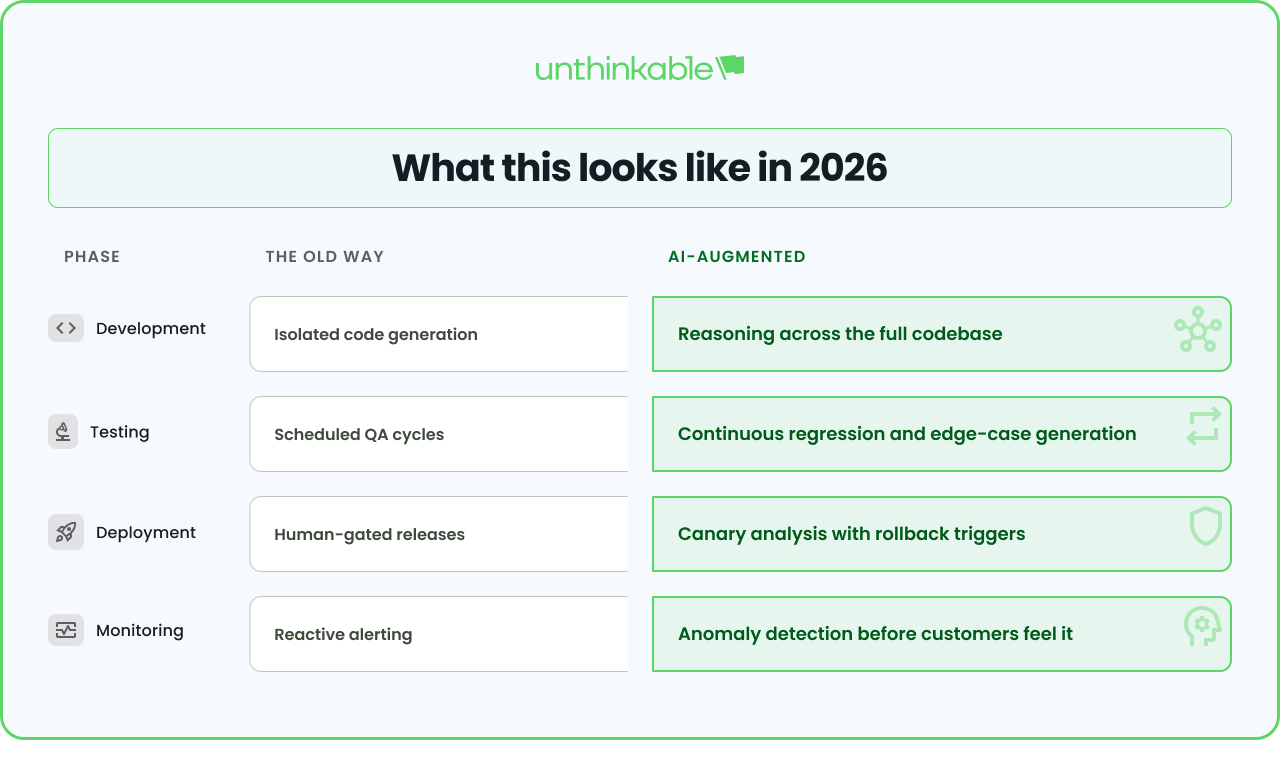
Faster code generation exposes weak foundations. Generate code without testing and review, and you just pile up risk. The quality gains come from AI across testing, security, and deployment, not from a model spitting out functions faster.
5. Legacy systems are the real blocker
Modern agents expect real-time data. They query across systems and act on fresh signals. Old monolithic systems with siloed databases and overnight batch jobs do the opposite. This is why pilots that shine in a demo die before they scale. The model isn’t the problem; the plumbing is.
Gartner notes teams are shifting spend toward tactical efficiency wins, but those wins vanish when the underlying data is fragmented. Clean, reachable data is the entry ticket, not a nice-to-have.
What this looks like in 2026:
- API-first architecture bridges old systems and new AI. Wrap a legacy data source in a clean API, a nd an agent can use it without a full rebuild.
- A three-step path that works: audit which systems hold the data you need, expose them through APIs, then set data quality and access rules before you scale.
- Most of the real work is unglamorous. API modernization, pipeline cleanup, and observability upgrades.
The teams moving fastest aren’t building the fanciest AI. They cleared the architectural junk early, so their systems actually work when they ship. Nobody puts “data pipeline cleanup” in a launch post, but it’s the thing that decides whether you make it to production.
6. Multimodal is the baseline now, not a feature
Text-in, text-out is over. Most AI models today handle text, images, audio, and structured data in one reasoning loop. This isn’t a launch headline anymore. It’s the floor. Real work doesn’t start with a clean prompt. It starts with a screenshot, a dashboard, a voice note, a PDF, and a spreadsheet from five systems. Multimodal AI is built for that mess.
What this looks like in 2026: a field team uploads photos of broken equipment, attaches sensor data, and adds a voice note. One system reads the damage, checks maintenance history, and recommends a fix. Pair multimodal with agents, and you go from understanding to action. A quality issue shows up across call audio, product images, and usage logs. The agent spots the pattern, opens the ticket, notifies the team, and suggests the fix.
This really changes how you design software. Interfaces stop being form fields and start being context aggregators. The AI becomes the glue between inputs that used to need separate tools and separate people.
One place this is already playing out at the infrastructure level is commerce. Google’s Universal Commerce Protocol, backed by Shopify, Walmart, Stripe, and Visa, is building the machine-readable layer that lets AI agents move from product discovery to completed checkout without a human clicking through anything. If you want to understand what protocol-driven, agent-ready systems look like in practice, our breakdown of UCP architecture and what it means for commerce teams is worth a read.
What this means for you
These six trends don’t run in isolation. They stack. Agents need governance. Governance needs clean data. Clean data needs modernized systems. Multimodal and tuned models extend what’s possible once the base is solid.
Five things worth doing now:
- Map your workflows to agent candidates. Pick the ones that happen a lot and hurt a little every time. If it happens twice a month, AI won’t save you. It’ll just be another thing to maintain.
- Build governance into the stack, not onto it. Retrofitted compliance is fragile compliance.
- Treat legacy data debt as the real blocker. Disconnected systems don’t just slow projects. They corrupt outputs silently.
- Use AI across the whole build, not just code generation. That’s where the quality gains live.
- Stop asking which model is best. Ask which model, for which task, in which system.
Wrapping up
2026 won’t be remembered for one model drop. The releases come every few weeks now, and each one matters a little less than the last. What matters is whether you built systems that can actually run AI. The teams seeing real returns aren’t chasing the newest model. They’ve got clean data, composable architecture, governance that runs in real time, and AI woven through the whole delivery process.
The flashy phase is fading. The “ship it, run it, govern it” phase is here. The gap between teams that pull this off and teams stuck in pilot mode is increasing every day.
Building AI that survives production is harder than picking a model. Talk to the team here at Unthinkable about getting from pilot to something that actually runs.
About Author