May 26, 2026
Introduction
A 400-person retail company implements a leading HRMS. The first six months look good: attendance tracked, leave digitized, and payroll cleaner. Leadership calls it a success.
Eighteen months later, there are three parallel Excel sheets, WhatsApp approval chains, and an HR team that spends more time managing the software than managing people.
The HRMS didn’t fail; it’s just that the business outgrew it. This is the pattern almost every scaling company hits, and almost none of them budget for it. The license fee is visible, but the operational cost of working around a rigid system isn’t.
This post breaks down where off-the-shelf HRMS actually breaks down, what it costs when it does, and how to evaluate alternatives before you’re locked in.
Why HRMS Problems Don’t Appear Immediately
The first 6–12 months of any HRMS implementation are almost always a win. That’s by design, not deception. Let’s look at what people tend to get right and where they miss the mark.
What goes right early:
- Manual chaos gets eliminated. Spreadsheets, WhatsApp approvals, and email chains disappear.
- Standardized workflows force process discipline that the org didn’t have before.
- Leadership gets visibility into HR operations for the first time.
What gets missed:
- Evaluations take place at the company’s most straightforward operational moment: pre-growth, pre-expansion, pre-acquisition.
- Demos test whether the system works today. No one asks what happens when the business changes.
- Workarounds start small and invisibly. One spreadsheet. One WhatsApp group. One manual reconciliation.
By the time the problem is obvious, it’s already seeped deep within the org system. The org has built operational habits around the software’s limitations and called it a process. The business doesn’t break the HRMS, rather the HRMS stops fitting the business.
Where Off-the-Shelf HRMS Starts Breaking
Off-the-shelf HRMS is built for the median company. The moment your operations diverge from the median, the friction begins.
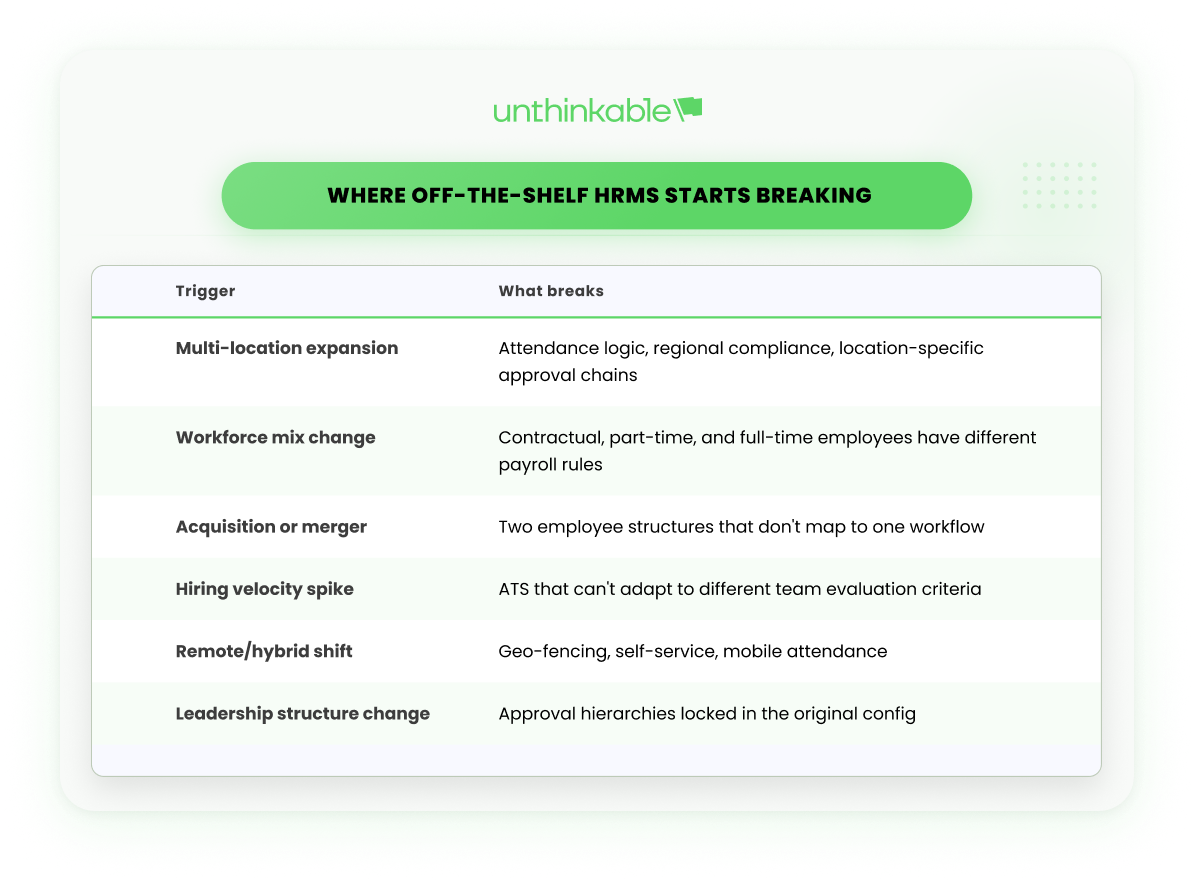
What the workarounds look like:
- Parallel Excel sheets for reporting the HRMS “technically” cover
- WhatsApp groups for approvals, because the system is too slow
- Manual payroll reconciliation because exceptions aren’t handled
- External ATS notes because the platform can’t capture the hiring context
- Recruiter shadow-trackers because pipeline stages don’t reflect reality
Individually, these are minor annoyances. Collectively, they add up to hundreds of wasted operational hours per month. The org isn’t failing, it’s compensating, and that cost never appears on the HRMS invoice.
The Operational Cost Nobody Accounts For
Most HRMS cost models show: license fee, implementation, training, and support. That’s the visible number.
The invisible number includes:
- HR headcount added to compensate for process gaps that the software should eliminate
- Recruiter hours are spent manually screening because the ATS logic is too generic
- The payroll team spends time reconciling exceptions outside the system every month
- Compliance exposure while waiting for the statutory updates, the vendor hasn’t shipped yet
- Re-training costs every time the vendor pushes a UI update on their timeline, not yours
At 500 employees, paying ₹400/month per employee on SaaS HRMS: ₹24L/year on the license. Add the hidden operational cost, a conservative estimate of 10–15 HR team hours per week on workarounds, and the real number is significantly higher by year 2.
The compounding problem: These costs don’t scale linearly with headcount. They scale with operational complexity. A 200-person org can absorb friction. A 2,000-person org across multiple locations cannot.
According to Gartner, AI solutions are poised to augment all parts of HR service delivery and perform up to 50% of HR tasks currently handled by HR team members by 2030. That potential only materializes if the underlying HRMS can support adaptive workflows. Rigid platforms can’t deliver it, and the gap between what’s possible and what the system allows becomes a direct operational cost. (Source: Gartner: Maximizing HR Technology’s Investment Impact)
Why Workflow Rigidity Becomes Expensive at Scale
Standardized workflows are an asset for 200 employees, but they become a liability at 1,000.
What rigidity costs at scale:
- A leave workflow that works for HQ breaks for store teams on shift schedules
- A performance review structure designed for salaried roles doesn’t map to hourly workers
- A recruitment pipeline built for tech hiring fails for bulk seasonal hiring
- A single approval chain can’t handle 12 business units with different authority structures
The deeper problem is that most platforms are feature-complete but operationally inflexible. The recruiter who needs AI-assisted screening tied to role-specific criteria doesn’t need a new feature; she needs a workflow that reflects how her team actually evaluates candidates. The HRMS has the module. It just can’t be configured to match reality. This is the distinction that matters: feature-rich doesn’t necessarily mean operationally flexible.
A platform may support 20 modules. If those modules can’t be customized to match how the business actually operates, they’re overhead, not infrastructure.
The SaaS Pricing Trap Nobody Calculates Early
Zylo’s 2026 SaaS Management Index reports that annual enterprise SaaS spend rose 8% year over year, with the average organization spending $55.7M annually, even as application portfolios flattened. (Source: Zylo 2026 SaaS Management Index) The growth isn’t more software. It’s the same software, costing more due to usage, AI features, and consumption-based pricing that compound within existing contracts.
The comparison that rarely gets made:
- 5-year SaaS cost at 500 employees (with conservative escalation): ₹1.3–1.6 crore
- Custom HRMS build: ₹25–35L one-time + ₹3–5L AMC/year = ₹40–60L over 5 years
The upfront number is higher. The 5-year number usually isn’t. Most companies never model this because the purchase decision is made on year-1 pricing.
Why AI Is Changing What Companies Expect From HRMS
AI has shifted the benchmark for what HR systems should do, and most off-the-shelf platforms are struggling to keep up.
What companies expected 5 years ago:
- Digitize HR records
- Automate leave and attendance
- Process payroll accurately
What companies expect now:
- Employees resolve queries without contacting HR
- Resumes are screened and ranked against role-specific criteria automatically
- HR chatbot answers policy questions instantly, at 11 PM, from a field location
- Predictive analytics on attrition, performance, and workforce planning
- Approval chains that adapt dynamically to org structure changes
The gap between these two lists is where off-the-shelf HRMS is getting exposed. Most platforms have added AI features, but as modules, add-ons, or roadmap promises rather than embedded operational capability.
In one HRMS discussion, we observed that a prospect noted that the AI recruitment features being demonstrated already existed in their current system. The issue wasn’t availability. It was configurability. Could the AI screening logic be tied to their specific evaluation rubric? Could the chatbot be trained on their actual policies rather than generic HR content? Does the approval routing adapt when the org structure changes? The answer, with their existing platform: no. The feature existed. The flexibility didn’t.
The shift in the buying question:
- Old: “Does this HRMS have [feature]?”
- New: “Can this HRMS evolve as our operations evolve?”
When Off-the-Shelf HRMS Is Actually the Right Choice
Let’s take a look at a few cases where off-the-shelf HRMS might work for a company:-
When SaaS HRMS is correct:
- Under 300 employees with standardized workflows and single-location operations
- Moving off spreadsheets for the first time, any structured system is a step forward
- HR team prioritizes speed of deployment over deep customization
- Operational structure is predictable for the next 2–3 years
Over-engineering at this stage is counterproductive. Customization before operational maturity creates complexity without any value-add.
When the calculus shifts:
- Multi-location with divergent attendance, compliance, or approval requirements
- Workforce mix is complex: contractual, part-time, full-time, on different rules
- Growth velocity is high: the business in 18 months looks very different from today
- Recurring workarounds have already started appearing
- The vendor’s roadmap doesn’t match your operational needs
The trigger isn’t company size, it’s operational variance. When the business can no longer standardize to fit the software, customization stops being a preference and becomes a requirement.
What a Real HRMS Transformation Actually Looks Like: A Real World Success Story
Most HRMS vendors show polished demos. Very few show what the system looks like once it is running across hundreds of locations, thousands of employees, payroll cycles, transfers, exits, approvals, and day-to-day operational chaos. V2 Retail had crossed 10,000 employees across 300+ stores.
The business had scaled quickly. The HR infrastructure had not. Attendance was being tracked store by store with no centralized visibility. Payroll operations depended heavily on spreadsheets. Recruitment workflows varied across locations. Transfers, promotions, and exits were handled through disconnected manual processes.
Like many growing companies, V2 Retail evaluated multiple off-the-shelf HRMS platforms. The problem was not missing features. Most platforms could handle attendance, payroll, onboarding, and employee records reasonably well.
The real issue was operational fit. A 300-store retail chain does not operate like a standard corporate workforce. Different stores function differently. Workforce movement is constant. Hiring spikes seasonally. Payroll complexity increases across states. Store-level operations need flexibility without losing centralized control.
V2 Retail needed the system to adapt to the business’s existing operating model. So the HRMS was built around the workflow itself. The rollout included:
- A centralized employee management system for 10,000+ employees across all locations
- Geo-fenced attendance linked to store locations through Google Maps integration
- Automated multi-state payroll with PF, ESI, TDS, and finance-level approvals
- AI-assisted recruitment workflows with resume parsing and candidate scoring
- Performance-linked incentive management connected directly to payroll
- Digital exit workflows with automated full-and-final settlement calculations
- Role-based dashboards for HR, managers, finance teams, employees, and leadership
- Conversational AI support for employee queries, HR analytics, and recruitment assistance
For the first time, employee operations across all store locations were housed in a single system. HR, finance, recruitment, payroll, attendance, and workforce workflows stopped operating as disconnected layers.
This is what a custom HRMS built around your workflows looks like in production, not a product you adapt to, but a system built for how you work.
Read the full V2 Retail case study here.
The Future of HRMS Is Operational Flexibility, Not More Features
Today, Most HRMS vendors are competing on features. Companies using those platforms are increasingly frustrated by the lack of customization. Based on our experience, here are a few scenarios where an HRMS is deployed successfully in a company:
What the successful HRMS deployments have in common:
- Built around how the company actually operates, not adapted to the vendor’s template
- Configured to evolve as the org structure, compliance, and workforce mix change
- AI that reduces operational load on HR, not AI that adds dashboard complexity
- Switching cost is controlled by the customer, not the vendor
The best HRMS isn’t the one with the longest feature list. It’s the one that doesn’t force the business to work around it, be that on day 1 and on day 1,000.
If your HRMS is making your team work around it, you’re probably missing out
Most companies are running HR on platforms built for someone else’s workflows. The result is predictable: parallel Excel sheets, WhatsApp approval chains, and an HR team spending more time managing software than managing people.
There’s a different model. One where the HRMS is built around how your business actually operates, not the other way around.
V2 Retail runs it across 10,000+ employees and 300+ stores. American Embassy School uses it for dual-currency payroll across US and Indian compliance structures. CPCL and Noida Metro run statutory compliance and workforce management on it at scale.
All of them made the same switch: from renting a generic platform to owning a system built for their exact workflows.
If you’re evaluating HRMS options or you’ve already bought one that’s not a good fit for your workflow, book a 30-minute call with our HRMS team. Let’s have a direct conversation about whether a custom build makes sense for your company’s size, structure, and budget.
Unthinkable has built custom HRMS for retail chains, fintech firms, schools, and infrastructure companies across India. Every deployment is owned outright by the client, with no recurring per-employee fees and no vendor lock-in.
About Author