Success Story
About the Client

Our client is a 501(c)(3) non-profit digital health organization based in the United States, working to break the cycle of poor health outcomes, medical inaccessibility, and chronic disease recurrence. The organization supports underserved, uninsured, and marginalized individuals by providing the digital tools and resources they need to navigate the healthcare system with confidence. Its services include telehealth access, digital health insurance enrollment, health literacy programs, care navigation training, and ongoing patient support, with the broader mission of reducing preventable hospitalizations and closing persistent gaps in healthcare access.
Business Situation
The client’s request was straightforward: “We need a platform to manage our clients and our billing.” But the real challenge ran deeper.
They were already operating active programs across addiction recovery, housing, and mental health. Care managers handled clients daily; billing teams chased claims across multiple managed care plans. The problem wasn’t demand; it was the absence of a system built to support any of it.
Operations ran on spreadsheets, shared drives, and disconnected workflows. Intake, assessments, care plans, encounter notes, and billing data each lived in a different place, with no single source of truth. Three structural gaps emerged:
Operations were entirely manual. Intake, assessments, and billing moved through separate, unconnected processes. Recuperative care clients required daily tracking with no efficient way to consolidate documentation.
Billing was the most painful area. Each managed care plan: Kaiser, Health Net, and PHC had its own assessment forms, documentation standards, and billing rules. Claim rejection rates were high due to inconsistent documentation, missing fields, and coding errors. There was no audit-ready trail for resubmissions or compliance reviews.
Plus, the platform needed to handle sensitive Protected Health Information for a vulnerable population, making privacy, role-based access, and audit trails non-negotiable from day one. The client didn’t just need a portal. They needed a technology partner to help define their processes, structure their workflows, and build a compliant system that their entire operation could run on.
Key requirements were:
Build a comprehensive web platform covering care management, billing management, and reporting
Support a multi-tenant architecture with super admin, system admin, and tenant-level admin controls
Automate the full client journey: intake, onboarding, assessment, care plan creation, and execution
Support multiple managed care plans (Kaiser, Health Net, PHC) with MCP-specific assessment forms and billing logic
Integrate with Office Ally as the clearinghouse for claims submission, remittances, and eligibility checks
Enable interaction recording and transcription for client conversations during intake and assessment
Build configurable reports and dashboards for inbound, approved, and rejected claim volumes
Align with HIPAA, CalAIM, DHCS, and CMS billing standards through audit logs, RBAC, and structured data capture
The Solution
Unthinkable approached this as a healthcare operations transformation problem rather than a conventional portal build. The objective was to take a non-profit running on spreadsheets and disconnected workflows and give it a single platform that could run intake, care, and billing in a structured, compliant, and auditable way, without disrupting the clinical and administrative work the team was already doing.
Before writing code, we worked with the client to define and document their internal processes. Many workflows around intake, assessment, and billing were ambiguous and varied between team members. We helped translate these into clear, role-based flows that could be automated. As a result, we built a multi-tenant web platform built around four interconnected layers: a tenant and access management layer, a client lifecycle layer, an MCP-aware billing engine, and a reporting layer, supported by AI-driven transcription and care plan generation.
Here are some of the key modules we developed for our client:
Designing a Multi-Tenant Foundation with Role-Based Access
Because the platform was envisioned as a scalable solution that could eventually serve other non-profits and healthcare providers, we built tenant management as the first layer. A super admin or system admin can create and configure tenants, define tenant-level settings (including whether assessment forms are MCP-specific or generic), assign tenant admins, and activate or deactivate tenants as needed.
Tenant admins inherit a focused subset of super admin capabilities, allowing each person on the platform to manage its own users, configurations, and data without affecting others. This separation also keeps client data isolated by tenant, which was important from a privacy and compliance standpoint.
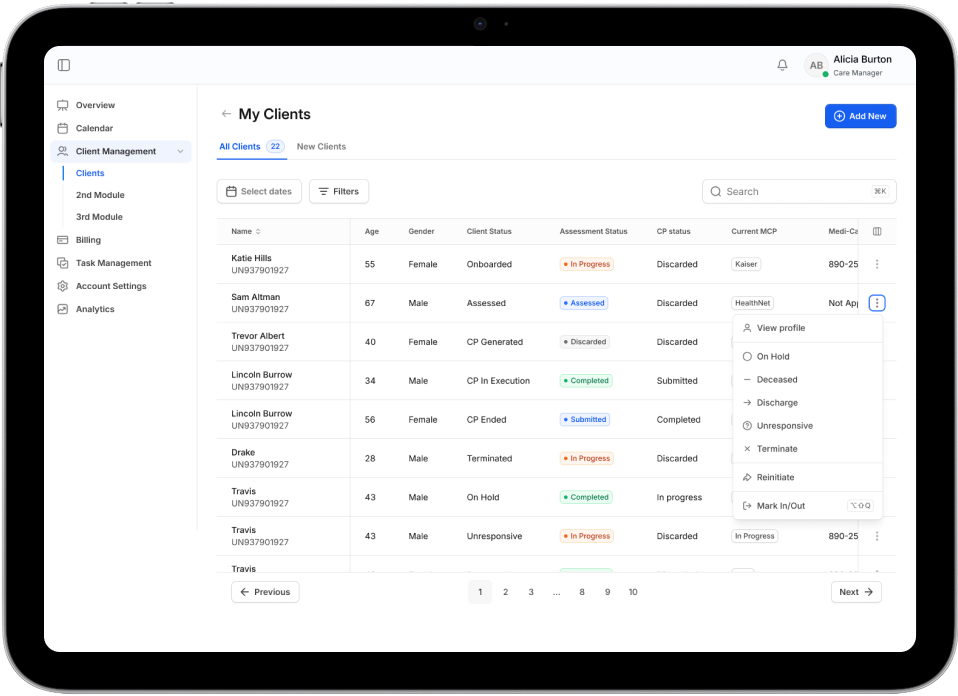
Structuring the Patient Lifecycle: Onboarding, Assessment, and Care
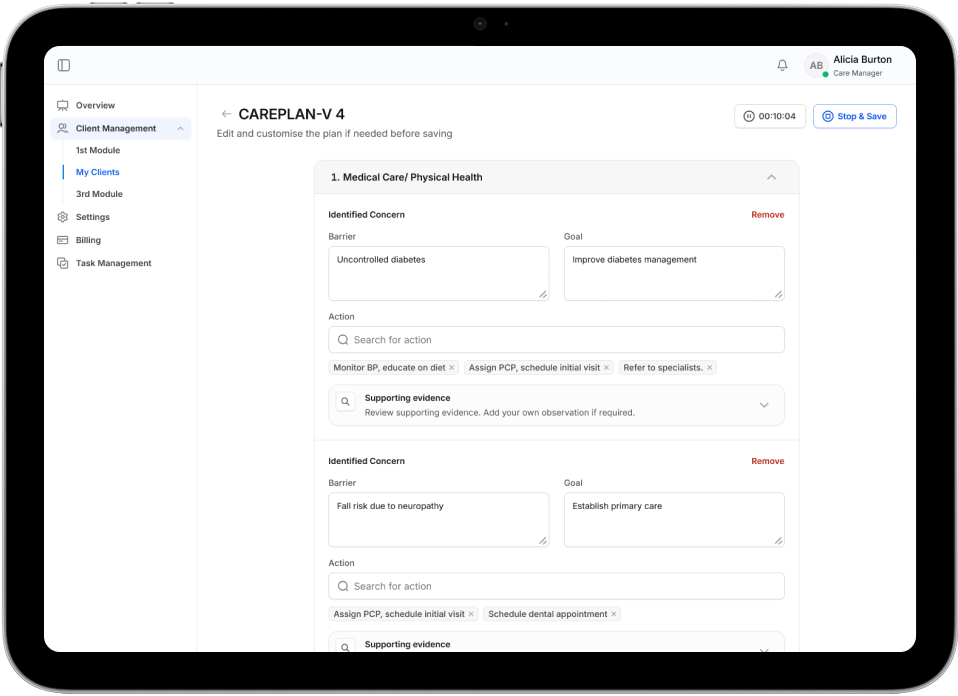
Patient management was the heart of the platform. We split it into two clearly defined stages, owned by different roles, so that handoffs were explicit and accountability was clear. The intake coordinator is responsible for client onboarding. From their dashboard, they can launch an onboarding form that captures structured data across eight sections: client identity, demographics, contact information, current address, emergency contact, identifications, eligibility, and essential items.
More importantly, the form is paired with an in-app interaction recorder. The coordinator can start, pause, resume, and stop a recording of the intake conversation, with explicit consent captured before recording begins. This solved a long-standing problem in which intake conversations were either lost or summarized inconsistently.
Building an MCP-Aware Billing Engine with Office Ally Integration
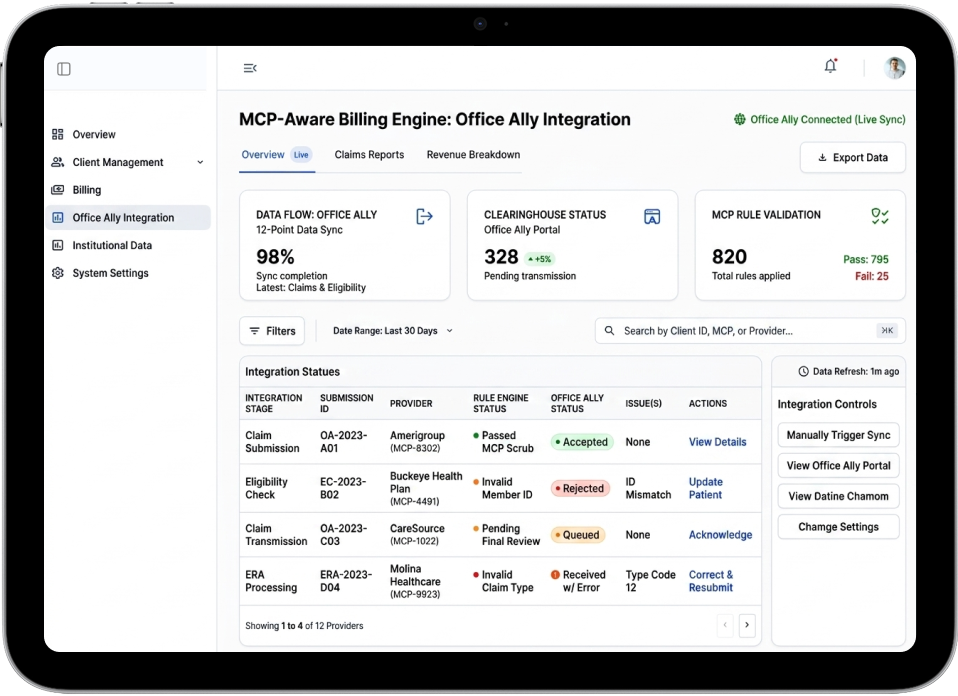
Billing was the most operationally painful area for our client, and we focused the most engineering effort there. The platform’s billing module is designed to account for the fact that each MCP has its own rules. Assessment forms, eligible service codes, documentation requirements, and billing cadences differ between Kaiser, Health Net, and PHC. We built a configurable billing engine that defines these rules per MCP and applies them automatically when claims are generated.
Reducing AI Costs with Self-Hosted Transcription and Care Plan Generation
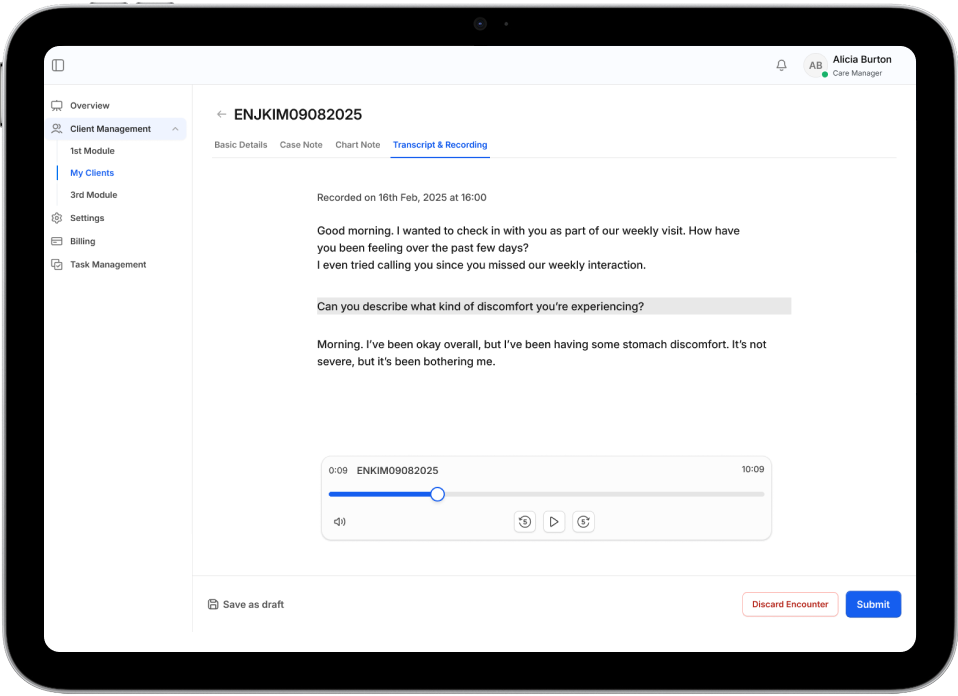
Two AI capabilities were core to the platform: transcription of recorded client interactions and assistance with care plan generation. Both were initially scoped against third-party APIs, but at the volumes the organization was projecting, third-party costs would have grown into a meaningful operating expense over time.
We proposed a self-hosted approach. For speech-to-text, we deployed Whisper on the client’s infrastructure, enabling the team to obtain accurate transcription of intake and assessment conversations without per-minute API charges. For care plan drafting, we integrated Gemini into a controlled flow in which care managers receive a structured, suggested plan based on assessment data, which they can then review, edit, and finalize. The combination kept clinical control firmly in the care manager’s hands while removing the blank-page problem that slows documentation. Hosting these models internally also strengthened the privacy posture, as recordings and assessment data did not have to leave the client’s environment for processing.
Driving Data-Backed Insights Across Care and Billing
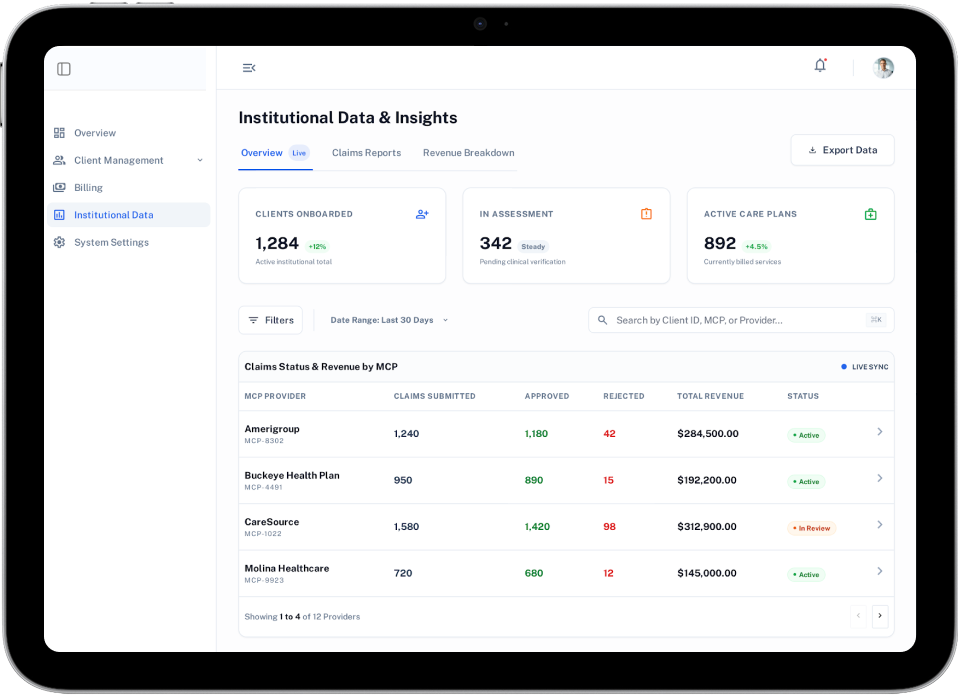
Before the platform, generating any kind of report meant pulling data from spreadsheets and shared drives by hand. We built a reporting layer that gives leadership real-time visibility into the metrics that matter most: number of clients onboarded, clients in assessment, active care plans, claims submitted, claims approved, claims rejected, and revenue by MCP. The reporting layer ships with a baseline set of dashboards and supports customized views, where users can select the data and metrics relevant to a specific funder report or internal review.
This was important for the non-profit context, where reporting requirements differ by funder and grant.
The Impact
We gave our client a single system to run its re-entry healthcare operations. Through its healthcare initiative, intake coordinators, care managers, and billing teams now work within a structured, role-based environment rather than stitching together spreadsheets and shared drives. Client onboarding and assessment moved from manual, inconsistent paperwork to a guided, MCP-aware workflow with consent-captured recordings, automated transcription, and AI-assisted care plan drafts.
This reduced documentation time per client and gave care managers more space to focus on care itself rather than data entry. On the billing side, the MCP-specific rules engine, pre-billing readiness checks, and Office Ally integration replaced a manual, error-prone process with an auditable claim lifecycle. The team now has clear visibility into every stage of every claim, with structured workflows for resubmissions and denials, directly addressing the high rejection rates that were earlier leaking revenue.

9
Distinct user roles operationalized
3
Managed care plans supported (Kaiser, Health Net, PHC)
1
Unified platform for intake, care, and billing