

Business Situation & Requirements
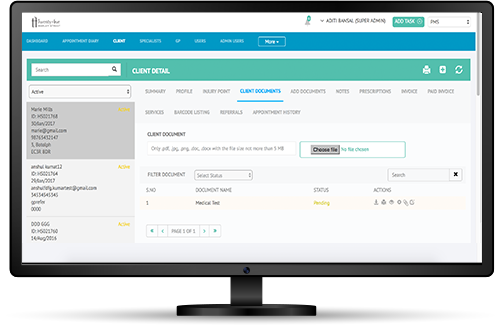
As healthcare networks expand across multiple locations, managing clinical and administrative operations through fragmented systems becomes increasingly complex. For a leading UK-based healthcare provider operating more than 30 clinics and serving over 100,000 patients annually, the absence of a unified practice management system was creating operational inefficiencies and limiting visibility across its network. The organization needed a centralized multi-clinic Practice Management System (PMS) to streamline and automate workflows for clinical staff, general practitioners (GPs), and consultants while ensuring consistency in care delivery across all locations.
The client had previously partnered with an outsourcing vendor to develop an initial PMS; however, the engagement did not deliver the expected outcomes. While a foundational system existed, it required significant restructuring and enhancement. Having already invested considerable time and resources, the client aimed to rebuild and modernize the solution by reusing the existing codebase wherever possible.
They were therefore looking for a technology partner with deep healthcare domain expertise and a strong understanding of medical operations to transform the system into a scalable, secure, and future-ready platform. Unthinkable was selected for its proven experience in developing robust healthcare applications and its ability to deliver reliable, mission-critical solutions aligned with industry standards.
The key requirements were:
Conduct detailed discovery and requirement analysis to assess the existing PMS codebase, map clinical workflows across departments, identify operational gaps, and define a scalable implementation roadmap.
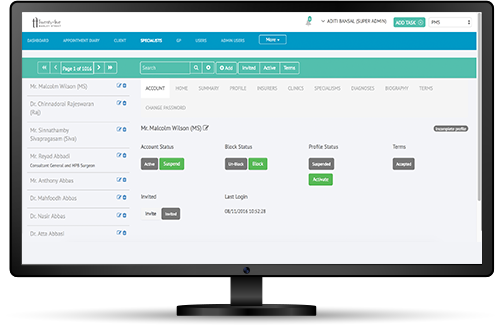
Develop a role-based medical Practice Management System (PMS) with differentiated access controls, enabling clinical staff, general practitioners (GPs), and consultants to manage day-to-day clinical operations and patient data efficiently.
Build and integrate core functional modules, including appointment scheduling, patient record management, stock and inventory management, and a referral management system to ensure seamless coordination across multiple clinics and departments.
Integrate the PMS with third-party software systems and medical hardware such as pathology analyzers, Picture Archiving and Communication Systems (PACS), billing systems, and barcode scanners to enable real-time data exchange and streamlined workflows.
Ensure HL7 compliance to facilitate standardized and secure transfer of clinical and administrative data between various healthcare applications and external providers.
Design a secure, scalable, and multi-clinic architecture that supports increasing patient volumes, centralized reporting, and operational visibility across the entire clinic network.