

Business Situation and Requirements
Urban planning and environmental organizations often face the challenge of sustaining greenery in city environments. While trees in rural areas can thrive for decades, urban trees frequently have significantly shorter lifespans due to factors such as limited space, pollution, soil degradation, and infrastructure pressures. This creates difficulties in maintaining healthy urban ecosystems and achieving long-term environmental goals.
Green City Watch wanted to help city trees live longer by using geospatial AI, which combines ecological technology, machine learning, and remote sensing. Their goal was to create an AI-based solution that gives urban foresters a complete overview of all the trees in Amsterdam and Boston. With this tree inventory, foresters could get useful, real-time insights to better manage and improve green spaces in the city.
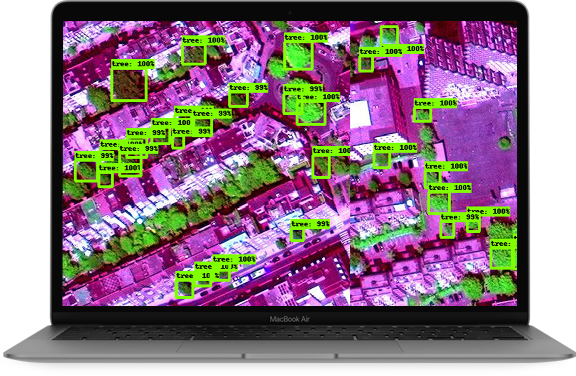
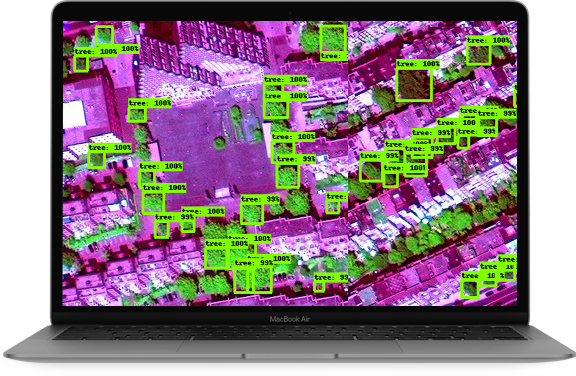
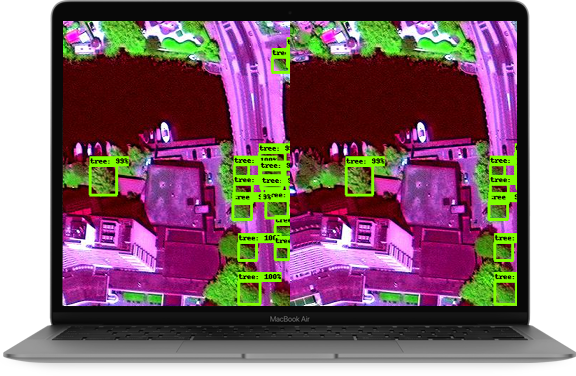
To create the tree inventory and calculate NDVI values, Green City Watch used high-resolution geospatial data in TIFF format captured by WorldView-1 and WorldView-3 satellites, featuring 30 cm spatial resolution and eight spectral bands. To turn this vision into a functional software product, Green City Watch partnered with Unthinkable, leveraging our AI expertise to develop an advanced solution for analyzing and mapping urban green spaces.
Keeping their aim in mind, their key requirements include:
AI-Powered Green Space Identification: Conceptualize, design, and build a solution that identifies green areas and provides a high-resolution, comprehensive view of large regions using data from multiple sensors.
Tree Detection Accuracy: Detect 80–90% of trees in a given area with an error margin of up to 3 meters.
Geo-Coordinate Mapping: Determine the precise geographic coordinates of each detected tree for accurate mapping and analysis.
Crown Area Calculation: Measure and calculate the crown area of each tree in square feet to assess canopy coverage.
NDVI Calculation: Compute the Normalized Difference Vegetation Index (NDVI) for each area, providing a reliable measure of vegetation health and biomass.
Integration of Multi-Sensor Data: Utilize geospatial data captured in TIFF format from WorldView-1 and WorldView-3 satellites across multiple spectral bands to deliver accurate and actionable insights.