

Feb 03, 2026
Fast, But Not Fragile — Why Your Team Slows Itself Down (And Why They’re Right To)
The Real Problem
Your team knows what needs to be tested.
Personalized search. Dynamic pricing. Better product discovery. The ideas that actually move conversion.
But they won’t touch them.
Not because they’re cautious—but because the last time they tried, something broke.
Search optimization took the site down during peak traffic. Checkout failed. Cart abandonment emails stopped sending.
So they shift to safer work.
Email templates. Footer redesigns. Blog pages. Changes that won’t blow up production.
Slowly, quietly, the highest-impact areas become no-go zones.
We see this constantly at the $20M–$50M stage. Teams have the right instincts about what matters—but architecture has made those areas too dangerous to touch. Platforms that started clean now run on dozens of tightly coupled plugins. Change one thing, something unrelated breaks.
The team isn’t slow because they lack ambition.
They’re slow because moving fast in a fragile system is reckless.
The real problem isn’t speed.
It’s that your highest-leverage areas are architecturally fragile—so your team avoids them.
The False Trade-off
The conversation usually sounds like this:
“Move fast and break things? Or build it right and move slow?”
That’s the wrong framing.
The real distinction isn’t speed versus stability.
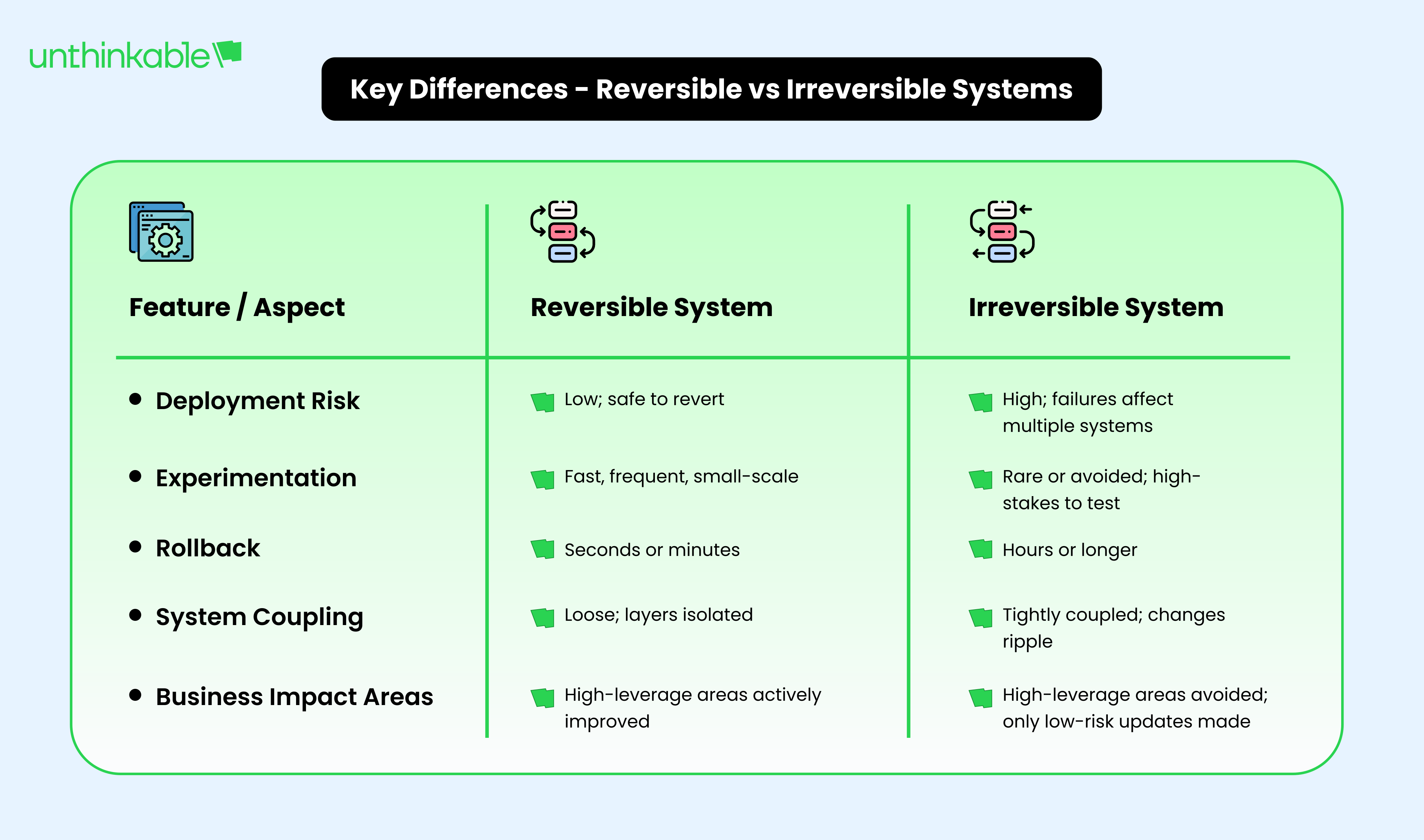
It’s reversible versus irreversible.
Teams that move fast sustainably aren’t more disciplined. They’re designed so mistakes are cheap to undo.
Consider a D2C brand doing roughly $35M in revenue. Their commerce platform is monolithic and tightly coupled. Every deployment goes live everywhere. If something breaks, rollback takes hours and risks downtime.
The result?
High-risk areas like search and discovery haven’t been touched in over a year.
A competitor at similar scale with smaller team takes a different approach. Changes deploy behind feature flags. Experiments start with a small slice of traffic. If something looks off, they flip a switch and revert in seconds.
Same experiment.
One team avoids it entirely.
The other runs it before lunch.
The difference isn’t process or discipline.
It’s whether the architecture makes the change reversible.
What Makes Systems Reversible
Reversibility isn’t about undoing everything.
It’s about isolating the blast radius and buying time to learn.
Pattern 1: Separate what changes frequently from what must remain stable
In fragile systems, customer-facing changes are entangled with core transaction logic. Every experiment touches the engine.
A pattern that works is separating the presentation layer from the commerce engine. The backend continues handling inventory, pricing, and payments—but what customers see becomes independent.
The effect is immediate:
- Product page tests affect only the frontend
- Search iterations don’t touch checkout
- UI experiments deploy in minutes, without backend risk
The engine doesn’t become stable because it’s rewritten.
It becomes stable because teams stop touching it for experiments.
Pattern 2: Configuration over code for revenue-linked logic
When business rules live in code, every experiment requires a deployment—and every rollback becomes expensive.
When those rules move to configuration, teams can test instantly and undo just as fast. This isn’t about making everything configurable. It’s about making revenue-linked decisions easy to change and easy to reverse.
Pattern 3: Feature flags as safety rails
Deploying behind flags decouples release from impact. Teams can ship, observe, and revert without panic.
Reversibility doesn’t prevent mistakes.
It makes mistakes survivable.
Why Teams Build Protective Layers
When architecture is fragile, teams compensate.
You’ll hear things like:
- “VP Engineering approves every deploy.”
- “Only two engineers can touch checkout.”
- “We release every two weeks in fixed windows.”
This isn’t mistrust or bureaucracy.
It’s self-defense.
If rollback takes hours, every deploy is high-stakes.
If checkout touches six systems, only experts are allowed near it.
If individual changes are risky, teams batch everything together.
Process hardens because the system can’t absorb mistakes.
In the D2C example above, approvals disappeared and ownership widened once customer-facing changes were isolated. The same team went from bi-weekly releases to deploying 4-5 times per day.
Same people.
Same incentives.
Different architecture.
When teams are careful, it’s usually because the system leaves them no choice.
Fragility Dictates Strategy
Here’s the real cost of fragility:
The business starts avoiding its highest-leverage areas.
That D2C team knew search and discovery were conversion bottlenecks. Customer feedback said it. Analytics showed it. Competitors invested heavily there.
But the team avoided search entirely. Too interconnected. Too risky.
So effort shifted to safe work—emails, layout tweaks, low-impact optimizations.
Not because those mattered more.
Because those were survivable.
Architectural fragility quietly dictated business strategy.
We see the same pattern across marketplaces, SaaS pricing engines, and logistics platforms. The highest-impact area is often the one teams are most afraid to touch.
Once fragility was removed from the customer-facing layer, that D2C brand ran more than 20 experiments in six months. Conversion climbed from 2.1% to 3.4%. Revenue increased by over $4M annually—not from one breakthrough idea, but from finally being able to test what mattered.
Fragility doesn’t just slow you down.
It redirects effort toward low-impact work because high-impact work feels too dangerous.
The Diagnostics
We ask three questions in discovery. The answers almost always reveal the same pattern.
1. What’s the last change your team hesitated to ship?
Not what broke—what felt risky even if it never shipped.
2. Why was it risky?
Listen for phrases like “touches multiple systems” or “hard to roll back.” That’s coupling talking.
3. What business metric could it have improved?
Conversion. Retention. Revenue per order.
Here’s the pattern:
The scariest changes are usually tied to the most important KPIs.
If fragile areas were low-impact, fragility would be annoying but tolerable.
But when fragile areas sit in your conversion funnel or core workflow, architecture directly caps growth.
This isn’t a speed problem.
It’s an architecture prioritization problem.
You don’t need to make everything fast and reversible.
You need to make your highest-leverage areas fast and reversible.
Right now, those are probably the areas your team avoids the most.
What Comes Next?
You’re at an architectural wall.
Architecture determines velocity.
Velocity without reversibility is chaos.
Teams that break through don’t rebuild everything. They make change safe in the areas that matter most.
In the D2C case above, we didn’t replace the backend. We helped isolate the customer-facing layer so experiments became fast, safe, and cheap to undo.
Six months later:
- 3× more experiments
- ~60% conversion improvement
- Multiple deploys per day
Once change is safe, speed becomes abundant.
The real constraint becomes deciding where to apply it.
Most companies answer that question poorly. They chase competitor features instead of removing leverage-blocking constraints.
That’s why roadmaps often make architecture problems worse—not better.
That’s what the next article tackles.
Your team’s hesitation isn’t a lack of ambition.
It’s that architecture has made the most important work too risky to attempt.
That’s solvable.
Action Items
Ask your team this week:
- What change did we last hesitate to ship?
- Why was it risky?
(Listen for: “touches multiple systems,” “hard to rollback,” “not sure what breaks”) - What KPI could it improve?
If your scariest areas are your highest-impact areas, you don’t have an execution problem.
You have an architecture prioritization problem.
The next article addresses that.
About Author