


Jan 13, 2026
Why Software Architecture Is the New Marketing?
Why Small Teams Are Outperforming Large Organizations
In the last article, we talked about the $20M Architecture Wall — the point where growth suddenly feels harder.
Not because demand disappears. Not because teams stop working hard. But because the systems that once enabled speed quietly start resisting change.
Here’s the next, often-missed realization:
That same architecture doesn’t just slow engineering — it directly limits how fast you can grow.
In today’s market, architecture is no longer a backend concern. It is a first-order business and marketing lever.
Growth Doesn’t Break at Scale — It Breaks at Speed
Early growth is forgiving.
You ship fast. You fix things manually. You tell yourself you’ll “figure it out later.”
As businesses mature, growth becomes less about effort and more about learning velocity.
How fast can you:
- test a new offer?
- experiment with pricing?
- change onboarding flows?
- personalize journeys?
- respond to market feedback?
Every one of these is a marketing activity. And every one is constrained — or enabled — by architecture.
When Marketing Ideas Start Waiting
Modern marketing isn’t campaigns. It’s continuous experimentation.
Yet in many organizations:
- Business logic is hardcoded
- releases are bundled
- Deployments are risky
- Experimentation depends on engineering availability
We’ve seen enterprise retailers managing hundreds of stores where even small promotional changes required IT tickets. Seasonal discount strategies waited for release cycles. A/B tests missed their window because coordination took weeks.
Meanwhile, competitors with far smaller teams were testing offers daily through configuration changes — enabling flash sales in minutes, killing underperforming experiments quickly, and learning while others were still waiting.
Same market conditions. Radically different learning velocity.
In another case, a D2C brand wanted to test personalized recommendations during peak season. The idea sat in backlog for six weeks. When it shipped, the season was over. A faster competitor validated and scaled the same concept within that window.
So what happens when architecture creates friction?
Marketing ideas don’t fail — they wait.
And waiting is the most expensive failure mode in competitive markets.
The 10 vs 100 Team Reality
This is where the illusion of scale starts to crack.
We increasingly see this pattern:
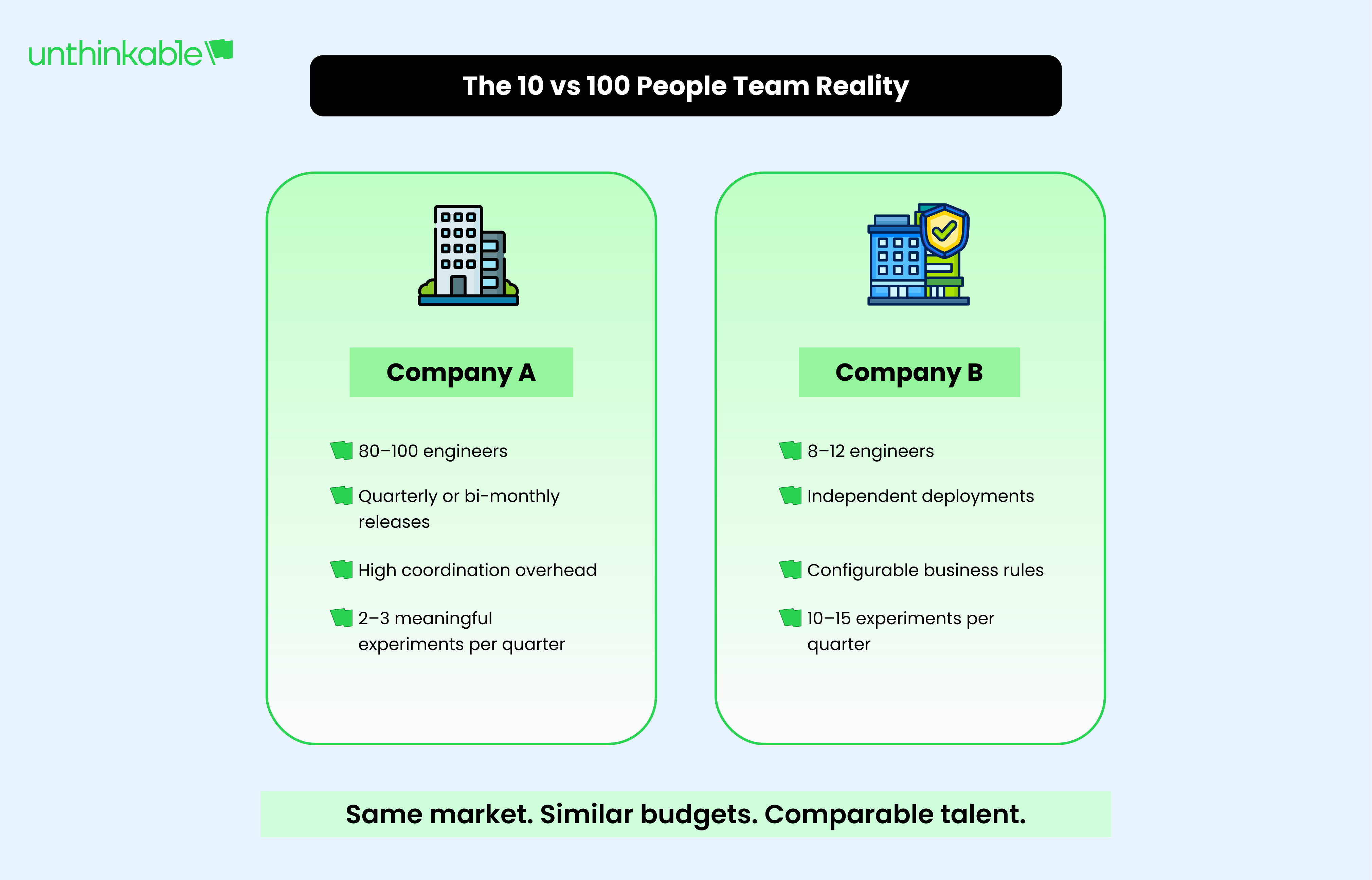
After 12 months, Company B appears to be “better at marketing.” Lower CAC. Higher conversion. Tighter product–market fit.
What actually happened?
They learned faster. They ran more experiments. They killed bad ideas quickly instead of defending them for quarters.
That advantage doesn’t come from instinct or creativity. It’s architectural leverage showing up in the P&L.
This is the architecture pattern we implement.
When we build commerce platforms—whether for retailers managing 30 lakh SKUs across 300+ stores or D2C brands scaling nationally—the design goal is consistent: small teams should move independently, deploy safely, and learn continuously.
Not as an aspiration. As operational reality.
The systems we architect run as modular monoliths, where each domain (catalog, pricing, promotions, checkout) deploys independently. Blue/green patterns make experimentation operationally cheap. Event streams answer business questions without engineering tickets.
This isn’t infrastructure for infrastructure’s sake. It’s deliberate structural design that makes the 10-15 experiments per quarter possible—even at enterprise scale.
Architecture as a Force Multiplier
Founders often respond to slow growth by:
- hiring more people
- adding new processes
- buying more tools
But when architecture is the constraint, headcount becomes negative leverage.
More people introduce:
- more coordination
- more dependencies
- more risk per change
We’ve seen 40-person teams take longer to ship than they did at 15 — not due to weaker talent, but because systems weren’t designed for independent movement. Every change ripples. Every deploy requires synchronization. Every experiment needs alignment.
You hire to move faster. You slow down instead.
Bad architecture forces you to scale people. Good architecture lets small teams scale outcomes.
That’s why a well-designed 10-person team can outperform a 100-person organization that is structurally slow.
What Speed-Enabling Architecture Actually Looks Like
Speed isn’t about specific technologies. It’s about architectural characteristics that reduce the cost of change.
Business logic lives as configuration, not code
Pricing rules, promotions, and eligibility criteria change frequently — so we treat them as data, not deployments. Marketing teams can test and roll back ideas without engineering bottlenecks. This isn’t a “no-code platform” promise. It’s deliberate separation: what changes often lives separate from what changes rarely.
Deployments are routine and low-risk
Blue/green patterns and feature flags separate deployment from release. Changes validate with real traffic and reverse instantly. Experimentation becomes operationally cheap, not a coordinated event. Testing a hypothesis is Tuesday morning work, not a weekend war room.
Observability answers business questions by default
Event streams capture user actions and outcomes continuously. When teams ask “what changed after we did X?”, the data already exists. That feedback loop—minutes, not weeks—is what enables 10-15 experiments per quarter instead of 2-3. It’s not about more analysts. It’s about having the right data structured for questions you know will be asked.
Modules evolve independently
We default to modular monoliths because they balance autonomy with operational simplicity. Teams ship without waiting on each other. When scale genuinely demands it—traffic patterns, performance isolation, different deployment cadences—individual modules can break out into services without rewriting the platform.
These aren’t abstract patterns. They are the design choices that let small teams operate at enterprise scale.
Speed-to-Market Is the Real Moat
Brands can be copied. Features can be replicated. Pricing advantages erode.
What doesn’t copy easily?
The ability to move from idea to production faster than competitors can respond.
That speed is architectural.
Systems either absorb change cheaply or tax every decision. There is no neutral middle.
Teams that deploy independently consistently run 4–6× more experiments per quarter than tightly coupled teams. Over time, that gap becomes insurmountable — not because of one breakthrough idea, but because of hundreds of small, validated course corrections.
The Metric Leadership Teams Rarely Track
Most dashboards focus on:
- CAC
- ROAS
- Conversion rates
- Revenue growth
Very few track the metric that predicts all of them:
Average time from approved idea to live in production
Not best case. Not theoretically. In reality — including coordination and deployment friction.
We ask clients this question during architecture assessments. Companies under $10M often measure this in days. At $50M+, it’s often months.
That gap is the architecture wall showing up in financial results before it’s recognized as a technical problem.
If the answer is measured in months, adding more people won’t fix it. It will make the wall thicker.
Closing the Loop from the $20M Wall
The $20M Architecture Wall isn’t just a technical ceiling. It’s a growth ceiling.
The companies that break through it don’t do so by:
- working harder
- spending more on marketing
- hiring aggressively
They redesign systems so that:
- Small teams move fast
- Experimentation is cheap
- Failure is safe
- learning is continuous
That’s why architecture is no longer relegated to the background.
It sits directly on the growth path.
The $20M wall isn’t inevitable — but breaking through it requires recognizing that architecture and growth are the same conversation, not adjacent ones.
About Author