
Mar 03, 2026
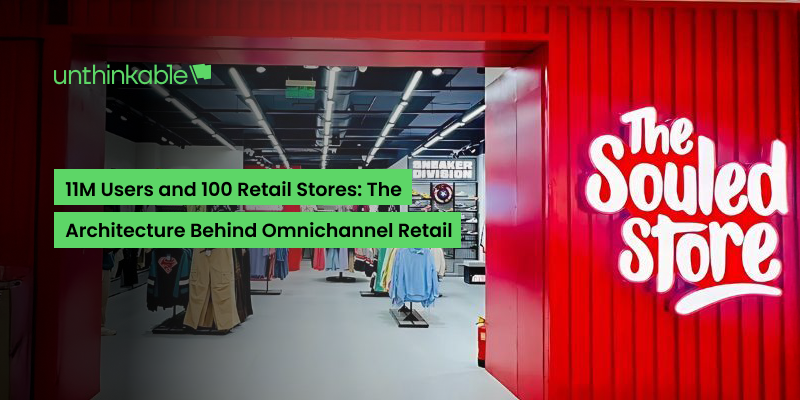
11M Users and 100 Retail Stores: The Architecture Behind Omnichannel Retail
The Turning Point: When E-Commerce Architecture Meets Physical Retail Scale
With more than 11M digital users, over 69 operational stores, and a roadmap targeting 100 retail locations, The Souled Store had reached a structural inflection point. What began as a high-growth, digital-first fashion brand was evolving into a distributed retail network. And distributed retail changes everything about system design. Traditional e-commerce architecture is built around centralized assumptions:
- Inventory lives in warehouses.
- Orders originate from a single fulfillment source.
- POS operates independently
- Loyalty is app-first
- Stores function as transaction endpoints.
That model works for digital-native brands. It does not hold when physical expansion accelerates. As monthly online order volumes crossed 4.22k, architectural friction became visible:
- Inventory discrepancies between online and stores
- Third-party POS systems limit unified pricing and loyalty.
- Fragmented customer profiles across channels
- Warehouse-first fulfillment logic is unable to leverage store inventory
- Limited native support for BOPIS and BORIS
On a smaller scale, these are operational inefficiencies. At a distributed scale, they become architectural risk. In 2026, retail leaders understand this clearly: An omnichannel platform is not a customer interface strategy. It is a unified commerce infrastructure strategy.
The Structural Challenges of Omnichannel Retail
Brands operating in a phygital model, blending digital commerce with physical retail, encounter systemic constraints that legacy commerce platforms were never designed to solve.
1. Real-Time Inventory Management Across Distributed Nodes
When inventory is centralized, synchronization is straightforward. When inventory spans dozens of retail stores:
- Each store holds unique stock.
- Each store executes transactions.
- Each store processes returns.
- Each store affects global availability.
Without a centralized inventory service powering the omnichannel platform:
- Overselling risk increases
- Availability lags across channels.
- Reservation conflicts multiply
- Store-level inaccuracies degrade trust.
Inventory is no longer a static field in the database. It becomes a distributed state management problem. Modern unified commerce architecture requires:
- Real-time inventory synchronization
- Reservation locking mechanisms
- Event-driven stock updates
- Centralized inventory authority
2. POS Systems as Architectural Bottlenecks
Most third-party POS systems are optimized for in-store transactions, not API-first integration within a unified commerce ecosystem. When POS operates as a loosely integrated tool:
- Pricing logic fragments
- Loyalty points fail to sync in real time.
- Cross-channel returns require manual reconciliation.
- Inventory propagation becomes delayed.
In a scalable omnichannel platform, POS must:
- Publish transaction events instantly.
- Consume centralized pricing and promotion rules.
- Sync inventory in real time
- Update unified customer profiles.
Stores cannot operate at the edge of the system. They must function as active nodes within a distributed commerce architecture.
3. Loyalty and Rewards as Infrastructure, Not Marketing
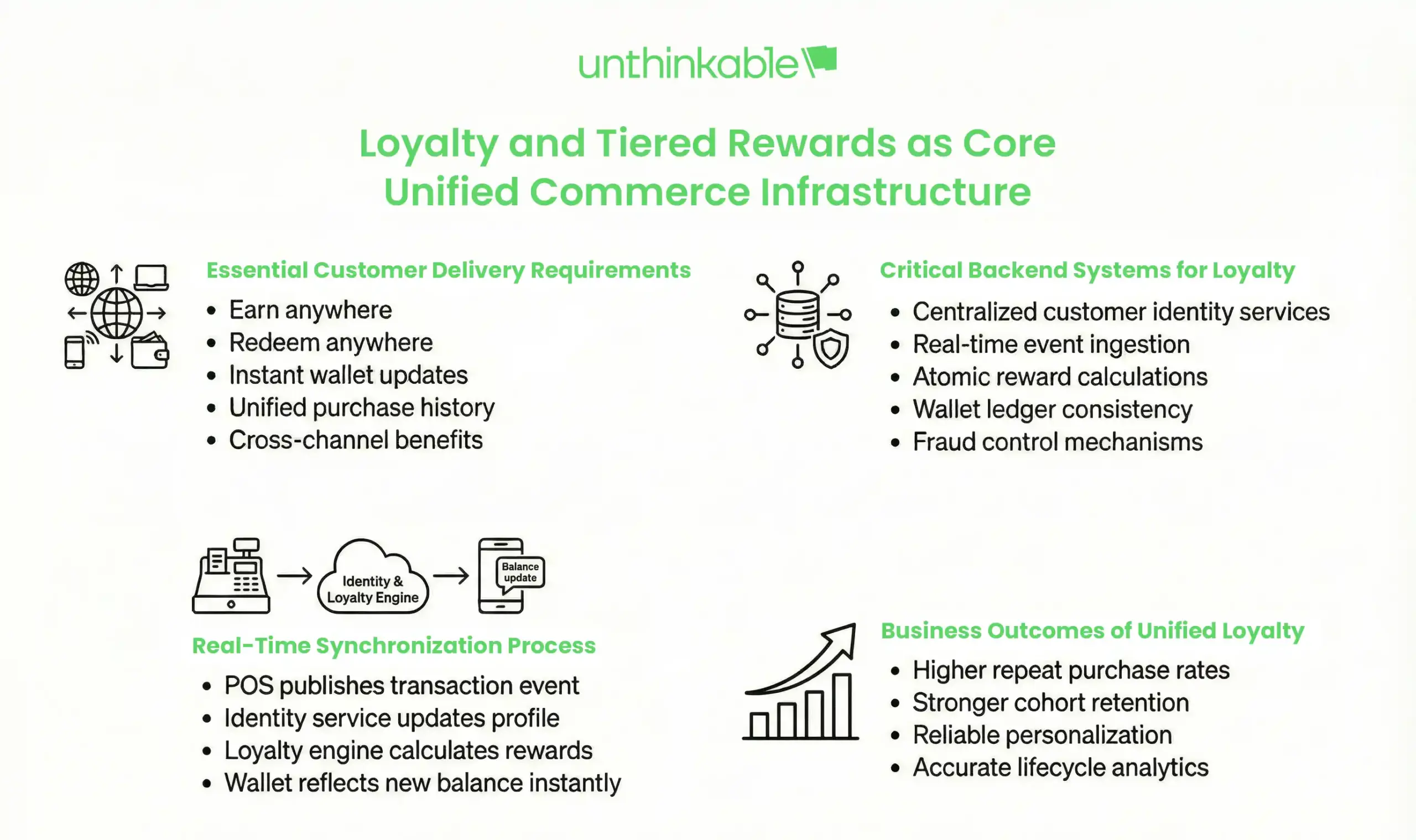
In modern retail, loyalty programs are not engagement overlays. They are a retention infrastructure. Customers expect:
- Earn anywhere
- Redeem anywhere
- Instant wallet updates
- Unified purchase history
- Cross-channel benefits
Delivering this requires:
- Centralized customer identity services
- Real-time event ingestion
- Atomic reward calculations
- Wallet ledger consistency
- Fraud control mechanisms
Without a unified commerce infrastructure, loyalty becomes fragmented. With it, loyalty becomes a durable retention engine.
4. Fulfillment Built for Networks, Not Warehouses
Legacy e-commerce architecture assumes fulfillment originates from centralized warehouses. Omnichannel retail requires:
- Store-based fulfillment
- Split-order routing
- Hyperlocal same-day delivery
- BOPIS (Buy Online, Pick Up In Store)
- BORIS (Buy Online, Return In Store)
- Store-to-store inventory transfers
This transforms fulfillment from an operational function into a whole layer within the omnichannel platform. At scale, fulfillment logic is infrastructure logic.
The Architectural Reset: Designing a Unified Commerce Foundation
Scaling an omnichannel platform requires structural redesign, not incremental upgrades. The core challenge is not simply enabling interactions between web, app, and store. It is designing a unified commerce architecture where inventory, identity, loyalty, fulfillment, and POS systems operate as a coordinated backbone.
As digital-first brands transition into distributed retail networks, architecture must evolve from centralized commerce models to distributed system design. Four architectural principles define modern omnichannel platforms.
For an expanded view on scalable e-commerce system design and best practices, see our guide on building e-commerce architectures that scale.
1. Single Source of Truth for Inventory
All transactional systems, web, mobile, POS, and fulfillment, must read and write through a centralized inventory management service.
This service:
- Maintains authoritative stock state
- Handles reservation logic
- Publishes real-time availability updates
- Prevents overselling under concurrency
- Resolves conflicts across store and warehouse nodes
Inventory ownership must be centralized. Duplication introduces systemic drift. Drift introduces customer-visible inconsistency.
At a distributed scale, inventory is no longer a database field. It is a controlled state across multiple nodes.
2. POS as a Fully Integrated System Component
Replacing a detached third-party POS with a deeply integrated system transforms stores from transaction endpoints into computational nodes within the unified commerce architecture.
An integrated POS enables:
- Real-time transaction publishing
- Unified pricing enforcement
- Instant loyalty synchronization
- Immediate inventory propagation
- Cross-channel returns without reconciliation delays
When store systems participate directly in event streams, pricing logic, and customer identity updates, the retail network behaves as a single coordinated system. POS is no longer peripheral infrastructure. It becomes a core participant in commerce orchestration.
3. Event-Driven Commerce Architecture
Every transaction, whether online or in-store, generates structured events. Those events trigger:
- Inventory updates
- Loyalty recalculations
- Customer profile synchronization
- Analytics ingestion
- Fulfillment routing decisions
However, not all events require the same consistency model. Strong consistency must be enforced for:
- Inventory reservation
- Wallet deduction
- Reward redemption
Eventual consistency is acceptable for:
- Reporting dashboards
- Marketing analytics
- Performance insights
Modern omnichannel platform design requires clarity around consistency trade-offs. Over-enforcing strong consistency introduces latency. Under-enforcing it introduces instability. Architectural maturity lies in knowing where each applies.
4. Fulfillment as Orchestration Infrastructure
Legacy e-commerce platforms treat fulfillment as a warehouse function. Unified commerce treats fulfillment as a distributed orchestration problem. Order placement initiates real-time decision logic:
- Which node holds stock?
- Which location is closest to the customer?
- Which store has processing capacity?
- What is the SLA requirement?
- What is the cost implication?
The orchestration engine evaluates these variables and selects the optimal fulfillment node in real time. This enables:
- Split-day delivery
- Hyperlocal routing
- Multi-node fulfillment
- Store-based micro-warehousing
- Store-to-store inventory balancing
Reported operational impact in distributed retail environments has included a 28% improvement in efficiency, driven by:
- Reduced warehouse dependency
- Faster order processing
- Lower last-mile delivery costs
- Improved inventory turnover
At a distributed scale, fulfillment becomes competitive infrastructure.
5. Mobile-First Experience Layer on Scalable Infrastructure
Mobile commerce is no longer complementary to digital commerce. It is primary. In high-growth retail environments, mobile sessions drive:
- Discovery
- Conversion
- Loyalty participation
- Repeat purchasing
The architecture must support:
- Personalized product discovery
- Intelligent filtering and search
- Real-time wallet transactions
- Seamless cart state persistence
- Live order tracking
- High-concurrency checkout flows
This layer cannot be built as a frontend wrapper over unstable backend services. It must sit atop scalable infrastructure capable of handling concurrency spikes without degrading experience. When Unthinkable partnered with Powerlook, one of India’s fastest-growing apparel brands, this principle became central.
Powerlook’s existing web platform was functional, but mobile engagement lagged behind evolving user expectations. The mandate was not to replicate web features inside an app. It was to design a scalable mobile commerce architecture capable of supporting aggressive growth and physical expansion plans targeting 50 stores by 2027. Within a 10-week execution window, the mobile platform was engineered using Flutter for cross-platform parity while maintaining backend continuity with existing systems.
The architecture incorporated:
- Intelligent product discovery algorithms
- AI-driven personalized recommendations
- Advanced cart state management
- Integrated wallet infrastructure
- Real-time order management
- Secure payment gateway synchronization
Most importantly, the system was engineered for scalability, not feature duplication.
To understand how m-commerce solutions integrate with scalable backend systems, explore our ecommerce app development services.
Loyalty Points and Reward-based customer tiering: The role of Unified Commerce
The custom Powerlook Wallet illustrates a critical architectural principle. Wallets and loyalty systems cannot operate as peripheral marketing modules. They must function as transaction-aware ledgers integrated deeply with:
- Identity services
- Order management systems
- Pricing engines
- Promotion logic
- Fraud control mechanisms
In both distributed retail networks and mobile-first commerce ecosystems, wallet synchronization requires consistency. A reward was issued twice. A balance was deducted incorrectly. A delay in redemption. Each impacts customer trust immediately. Loyalty in unified commerce architecture becomes infrastructure supporting revenue durability, not simply engagement uplift.
At 11M+ digital users, identity resolution for Souled Store became crucial. A unified commerce platform requires:
- Centralized customer identity services
- Cross-channel transaction history
- Real-time wallet ledger updates
- Promotion rule engines
- Fraud monitoring controls
When a store purchase occurs:
- POS publishes the transaction event
- Identity service updates profile
- The loyalty engine calculates rewards.
- The wallet reflects the new balance instantly.
Fragmented systems delay rewards. Unified systems preserve trust. This enables:
- Higher repeat purchase rates
- Stronger cohort retention
- Reliable personalization
- Accurate lifecycle analytics
Loyalty becomes infrastructure supporting revenue durability.
Metrics That Validate Technical Infrastructure
Key scale indicators include:
- 11M+ digital users
- 4.22k monthly online orders
- 22+ stores scaling toward 100
- 35% operational efficiency improvement
- 50-60% user base shifted to mobile after the app launch
These metrics are not marketing outcomes. They are stress tests of the underlying e-commerce architecture and unified commerce infrastructure. Without structural alignment, growth introduces instability with architectural coherence, and growth compounds.
What Happens Next for Omnichannel Retail?
As store density increases:
- Inventory contention rises
- Regional demand diverges
- Network variability increases
- Loyalty concurrency expands
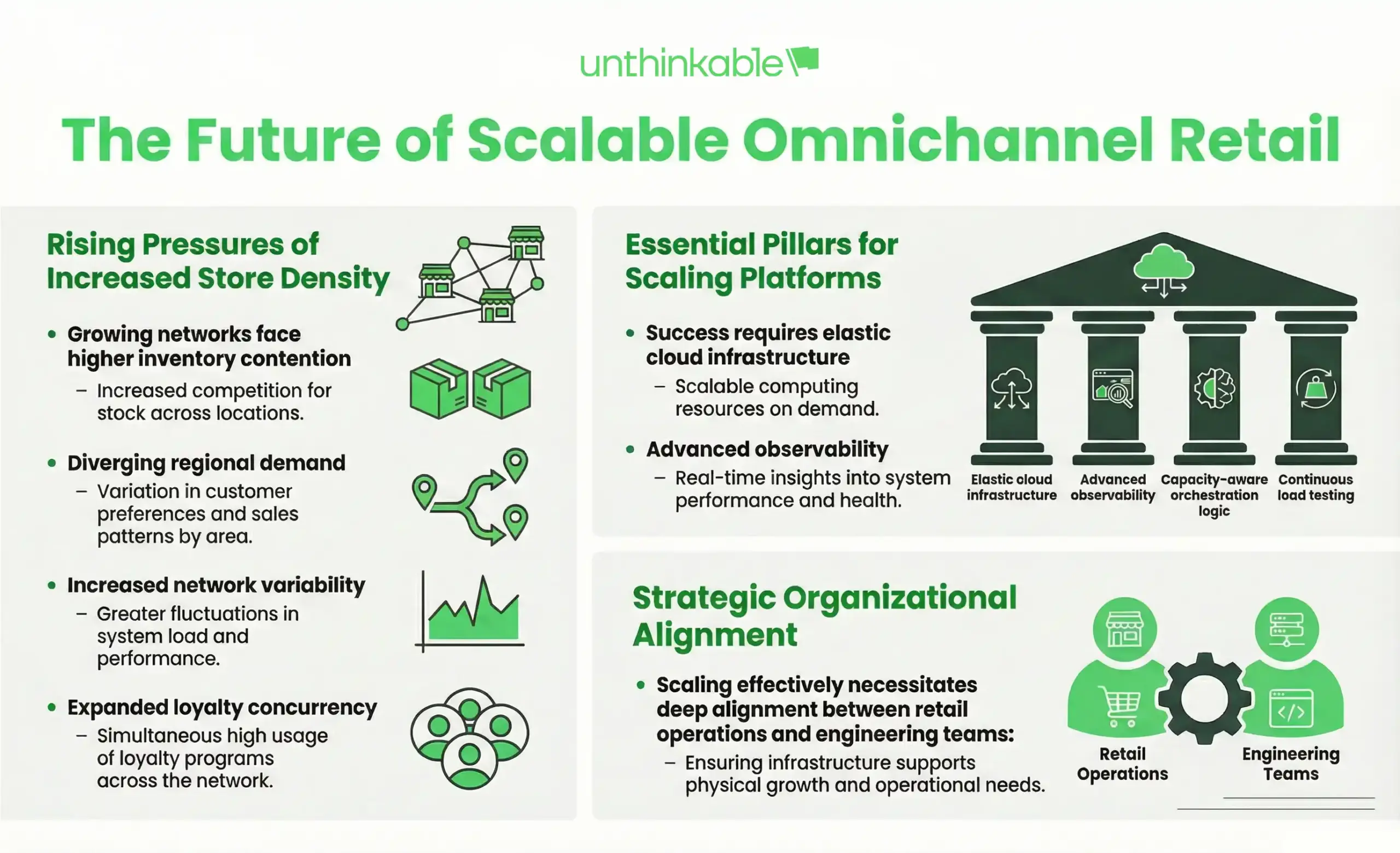
Scaling an omnichannel platform requires:
- Elastic cloud infrastructure
- Advanced observability and monitoring
- Capacity-aware orchestration logic
- Continuous load testing
- Organizational alignment between retail operations and engineering
Retail technology infrastructure must evolve with the footprint. Architecture cannot remain static while the store network grows.
How Unified Commerce Architecture Determines Retail Growth
Retail expansion is often attributed to merchandising, branding, and marketing. But at a distributed scale, infrastructure determines durability. Operating across web, mobile, and stores does not automatically create unified commerce. System integration does.
When:
- Inventory is authoritative
- POS operates as an integrated node
- Loyalty functions as a real-time ledger.
- Fulfillment is orchestrated across nodes.
- Identity is centralized
- Events synchronize consistently
The business operates as a single, coordinated system. Scaling from millions of digital users to a 100-store network is not a channel expansion exercise. It is a systems engineering milestone. An omnichannel platform is not a UX feature. It is infrastructure alignment.
Building Scalable Omnichannel Infrastructure
Designing a scalable unified commerce architecture requires more than platform deployment. It requires:
- Distributed systems thinking
- Retail operations alignment
- API-first POS integration
- Real-time inventory synchronization
- Event-driven commerce infrastructure
- Loyalty as ledger architecture
- Fulfillment orchestration design
This is where architecture either constrains growth or enables it.
Wrapping Up
At Unthinkable Solutions, we work with high-growth retail and digital commerce brands to design omnichannel platforms that scale across distributed retail networks. The focus is not on feature delivery. It is structural alignment that ensures inventory, POS, fulfillment, loyalty, and identity operate through a unified commerce backbone. If your company is navigating the transition from digital-first commerce to distributed retail infrastructure, the architectural decisions made today will determine whether scale introduces fragility or resilience. You can explore what that architectural reset looks like in practice by booking a strategy call here.
About Author