Success Story
About the Client

Maharaja Agrasen Medical Education & Scientific Research Society, established in 1998, is dedicated to delivering quality healthcare and advancing medical education. The hospital manages nearly 500,000 outpatient visits annually, serving around 3,000 patients daily. With a strong team of MBBS and postgraduate students, nurses, faculty, and non-teaching staff, it performs an average of 50 major and 90 minor surgeries each day. Despite its scale, all administrative, financial, and clinical records are maintained manually on paper.
Business Situation & Requirements
Healthcare institutions today face increasing pressure to deliver efficient, transparent, and data-driven care while managing complex operational workflows. The client faced significant operational gaps due to the absence of a digital interface for data entry and visualization.
There were no structured records to track hospital inventory or asset utilization. Accounts management processes such as attendance automation, salary calculations, and arrears tracking were handled manually. Critical departments, including the blood bank, pharmacy, and laboratory, operated without automation, resulting in decentralized data, limited transparency, asset overestimation, and poor visibility into departmental workflows.
To address these challenges, the client required a comprehensive, customized Hospital Management System (HMS) to digitize and streamline day-to-day operations. The institution sought an experienced technology partner capable of driving end-to-end digital transformation across administrative, financial, and clinical functions. The client partnered with Unthinkable for its proven expertise in building scalable healthcare IT solutions, including Electronic Health Records (EHR), telehealth platforms, digital pharmacy systems, Hospital Information Systems (HIS), and practice management solutions.
The key requirements were:
Initiate the engagement with a structured discovery phase to map existing hospital workflows, assess high patient footfall scenarios, identify operational gaps, and define system requirements aligned with the hospital’s objectives.
Develop a robust Healthcare Information System that strengthens and supports existing processes without compromising overall efficiency or slowing down daily operations.
Enable simple and intuitive process automation, data entry, and data visualization to ensure smooth functioning and easy adoption by internal members.
Ensure the system is user-friendly and does not create barriers for the predominantly rural patient population served by the hospital.
Design the solution to manage and streamline overall data and process flows across the entire hospital and all respective departments.
Establish a centralized and integrated platform that enhances coordination, transparency, and operational control across administrative, financial, and clinical functions.
Ensure full compliance with DISHA guidelines by implementing robust data security, patient consent management, role-based access controls, encryption, and audit mechanisms to protect sensitive health information.
Solution
Unthinkable designed and developed a comprehensive Hospital Information System (HIS) to digitize operations, centralize data, and improve real-time access to information across the hospital. The solution included a robust web-based platform with integrated modules to manage clinical, administrative, and operational workflows seamlessly. To enhance patient management, a dedicated mobile application with OPD and IPD modules was introduced, enabling efficient handling of appointments, admissions, and treatment records. Additionally, a web-based admin portal was built to manage roles, users, departments, suppliers, and system configurations with complete control and transparency.
Given the complexity and scale of the hospital’s operations, the solution was delivered through a structured, phase-wise development approach. This ensured the gradual adoption of the new system, prioritized critical modules addressing immediate operational challenges, and enabled faster feedback from real users. The iterative rollout minimized disruption, accelerated turnaround time, and ensured the system aligned closely with on-ground requirements.
Requirement Analysis and Documentation
To understand operational gaps, the team conducted face-to-face discussions across departments. Business analysts engaged with doctors, nurses, and administrative staff to map existing workflows, identify pain points, and capture expectations from the new system. Patients were also consulted to improve experiences around consultations, lab tests, and report collection. The insights were documented through workflow diagrams, system flow optimizations, UI/UX designs, and architecture plans, which were reviewed and approved by hospital stakeholders before prototyping.
Development and Implementation
To manage the complexity of the Hospital Information System, a modular development approach was adopted. The application was divided into well-defined modules and sub-modules, enabling focused development and systematic testing. This structure ensured smoother coordination across teams and reduced implementation risks. The phased rollout allowed critical functionalities to go live first, minimized operational disruption, and ensured better performance, scalability, and long-term maintainability of the system.
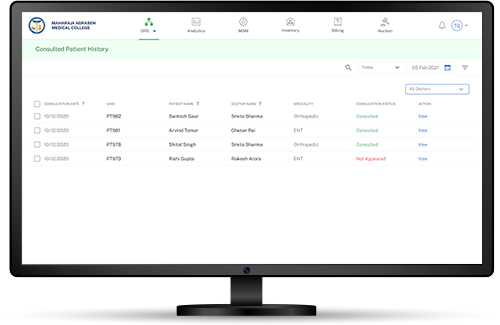
OPD
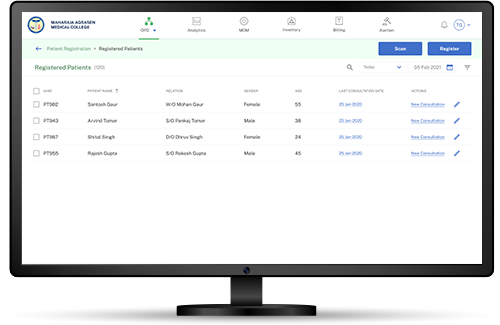
The OPD module streamlined outpatient operations by enabling patient registration, billing, and medicine allocation through a unified digital interface. Barcode-based patient identification ensured accuracy, while laboratory and investigation data were centralized for easy access. This module improved coordination between departments, reduced manual errors, and enhanced overall efficiency in managing daily outpatient visits.
IPD
The IPD module digitized inpatient workflows, including patient admission, bed allocation, and department-wise occupancy tracking. It facilitated patient recovery monitoring, billing management, discharge processing, and record maintenance. By centralizing inpatient data, the system improved transparency, optimized bed utilization, and ensured smoother coordination between medical, administrative, and billing teams.
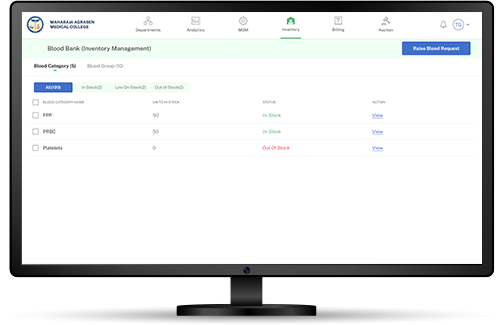
Pharmacy Inventory
This module centralized medicine inventory management across the hospital. It enabled accurate allocation of medicines, QR code-based patient identification, and real-time stock monitoring. Automated alerts for medicine expiry ensured compliance and minimized wastage. The system enhanced visibility into inventory levels and streamlined coordination between pharmacy and clinical departments.
Pharmacy Store
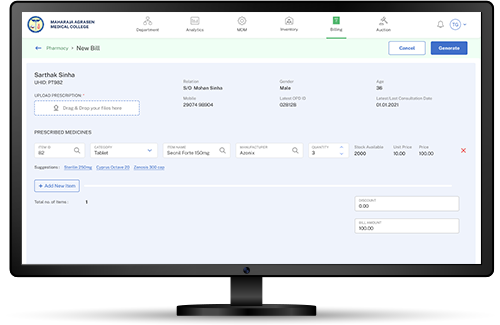
The Pharmacy Store module simplified prescription management by enabling digital prescription uploads and seamless medicine allotment. It automated bill generation and ensured accurate record maintenance. By digitizing the dispensing process, the module reduced errors, improved service speed, and enhanced transparency in pharmacy operations.
Assets Store
The Assets Store module provided centralized tracking of hospital assets with department-wise data management. Departments could raise online asset requests, and approvals and fulfillment were managed digitally. This improved asset visibility, reduced overestimation, and streamlined procurement and allocation processes across the hospital.
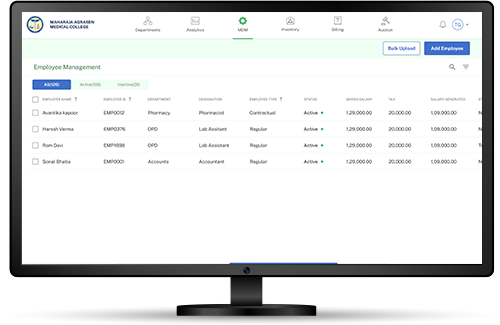
Lab
The Lab module automated laboratory workflows and centralized diagnostic data. It supported barcode-based patient identification and enabled easy retrieval or duplication of reports. This reduced manual paperwork, improved turnaround time for test results, and ensured accurate, accessible records for both patients and healthcare providers.
Vaccination
The Vaccination module automates immunization workflows and centralizes patient vaccination records. It streamlined data entry, tracking, and reporting, ensuring better coordination and compliance. By digitizing the vaccination process, the hospital improved record accuracy, monitoring efficiency, and overall management of immunization services.
Blood Bank
The Blood Bank module digitized donor registration and maintained comprehensive donor and patient records. It improved the traceability of blood units and ensured accurate documentation. Centralized data management enhanced transparency, facilitated quicker access to information, and strengthened operational efficiency within the blood bank.
Accounts
The Accounts module automates salary calculations, attendance tracking, arrears management, and salary slip access for teaching and non-teaching staff. It gradually digitized the entire payroll process, reducing manual dependency and improving accuracy. The system enhanced financial transparency and streamlined administrative operations.
File and Bill Management
This module digitized internal file and bill workflows by enabling online initiation, approvals, and inter-departmental forwarding. It reduced paperwork, minimized delays, and improved tracking of document movement. The centralized system ensured transparency, faster processing, and better accountability across departments.
Admin Panel
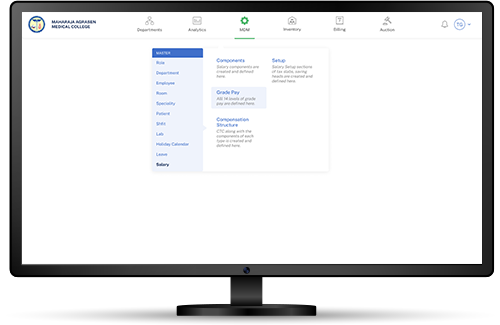
Authorized users were given centralized control over system configuration, user roles, access permissions, and data visibility through a unified interface. The panel enabled efficient management of departments, laboratories, medicines, assets, leave policies, OT masters, and suppliers. To ensure smooth adoption, department-wise onsite training was conducted. Ongoing functional and technical support was also provided under an annual maintenance plan to maintain system stability and uninterrupted performance.
The Impact
The implementation of the Hospital Information System delivered measurable operational improvements across the organization. The hospital achieved 25% cost savings compared to its previous infrastructure, significantly optimizing resource utilization.
Manual administrative efforts were reduced by 50%, enabling staff to focus more on patient care and critical tasks. Additionally, overall operational efficiency improved by 35%, driven by streamlined workflows, centralized data management, and enhanced process automation across departments.

25%
Savings as Compared to Previous Infrastructure
50%
Reduction In Manual Administration Time
35%
Increase in Efficiency