
Sep 25, 2026
10 Microservices Best Practices and Patterns (With Examples)
Introduction
Microservices best practices help teams divide growing applications into independent services without creating difficult dependencies between them. As a product gains more users, features and integrations, different parts of the application may need to change or scale at different rates. For example, an e-commerce platform may need additional capacity for payments, inventory and checkout during a sale without increasing resources across the entire system.
A successful microservices architecture requires more than separating a large application into smaller services. Teams must define clear service boundaries, give each service ownership of its data and choose suitable communication methods. They also need reliable APIs, failure controls, security, automated testing and centralized monitoring. These microservices architecture best practices help services remain independent while still working together across complete business processes.
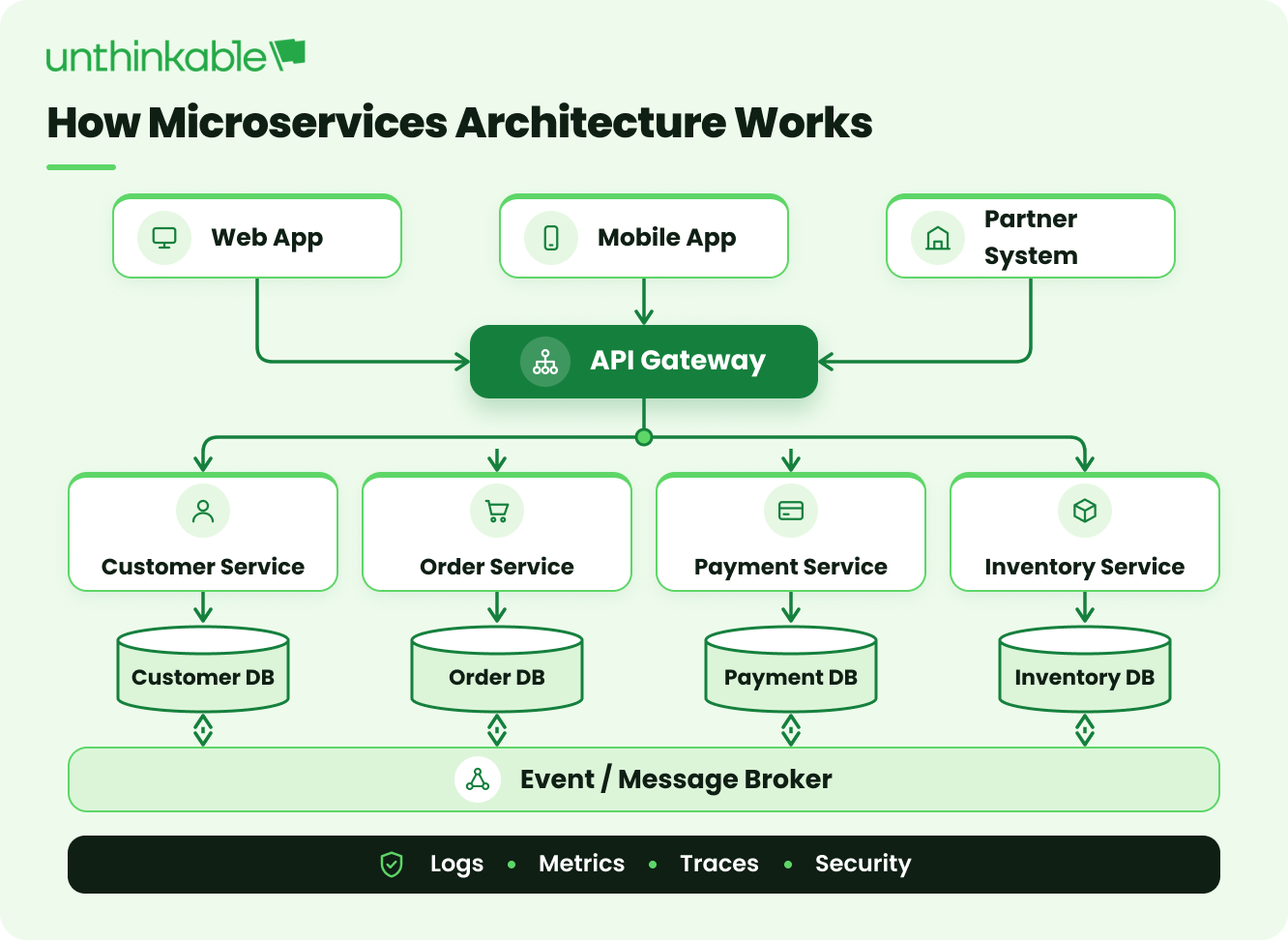
This guide covers 10 important microservices best practices, including service design, database ownership, API management, event-driven communication, failure handling, security, deployment and observability. It also explains the benefits of microservices, compares microservices vs. monolithic architecture, and examines 8 widely used microservices architecture patterns: API Gateway, Database per Service, Event-Driven Microservices, Saga, Service Discovery, Circuit Breaker, Service Mesh, and Backend for Frontend.
Summary at a Glance
- Microservices architecture divides an application into independent services, with each service managing a clear business capability such as payments, orders, inventory or customer accounts.
- Important microservices best practices include defining clear service boundaries, keeping services independent, giving each service ownership of its data and maintaining stable APIs.
- The main benefits of microservices include independent deployment, faster releases, selective scaling, clearer team ownership and better failure isolation.
- In a microservices vs. monolithic architecture comparison, a monolith is built and deployed as one connected application, while microservices can be developed, released and scaled separately.
- Microservices communication may use direct API calls when an immediate response is required or events and messages when work can continue separately.
- Microservices API best practices include clear documentation, consistent request formats, backward-compatible changes, versioning and automated contract testing.
- Microservices security best practices include service authentication, controlled permissions, encrypted communication, protected credentials and records of important actions.
- Common microservices architecture patterns include API Gateway, Database per Service, Event-Driven Microservices, Saga, Service Discovery, Circuit Breaker, Service Mesh, and Backend for Frontend.
What Are Microservices?
Microservices are a way of building an application as a group of small, connected services. Each service handles a clear business function, such as payments, customer accounts, inventory or order processing. These services communicate through APIs, events or messages to complete larger workflows.
Unlike a monolithic application, where most features are built and deployed together, a microservices architecture allows teams to develop, update and scale individual services separately. For example, an e-commerce company can increase the capacity of its payment service during a sale without scaling the customer-support service at the same time.
The word “micro” does not mean that every service should contain only a small amount of code. A well-designed microservice should be large enough to manage one complete business responsibility but separate enough to change without affecting the entire application. Clear service boundaries, independent ownership and reliable communication are therefore central to effective microservices best practices.
Microservice Example:
After a major database failure in 2008, Netflix began rebuilding its technology for the cloud. The company moved from a monolithic application to hundreds of microservices, allowing teams to release changes independently and expand individual parts of the platform when required.
Netflix completed the migration in 2016, by which time its streaming membership had grown eightfold and the service had expanded to more than 130 additional countries. The company’s cloud-migration account shows how microservices supported its growth, while also noting that the transformation took seven years and required major changes to its technology and working processes.
Benefits of Microservices Architecture
The main benefits of microservices architecture come from separating an application into services that can be owned and changed independently. However, these benefits depend on clear service boundaries and strong development and operating practices.
- Independent development: Teams can build and update separate services without changing the complete application.
- Faster releases: Individual services can be tested and deployed separately, allowing smaller changes to reach users sooner.
- Selective scaling: Businesses can increase resources for high-demand services without scaling the entire system.
- Better failure isolation: A problem in one service is less likely to affect the full application when failures are handled correctly.
- Clear team ownership: Each team can manage the development, deployment and maintenance of specific services.
- Technology flexibility: Teams can choose suitable technologies for different services when business or technical needs require it.
- Easier modernization: Teams can gradually replace older parts of an application instead of rebuilding the entire product at once.
Microsoft’s microservices architecture guidance also identifies independent deployment, resilience and selective scaling as important advantages. It warns, however, that microservices introduce challenges involving communication, data consistency, testing and system management.
For this reason, microservices are not automatically the right choice for every product. Their benefits are strongest when an application has clear business areas, multiple development teams or parts that need to scale and change independently.
Microservices vs. Monolithic Architecture
A monolithic application brings most features into one codebase and is usually deployed as one unit. A microservices architecture divides the application into separate services that communicate through APIs or events. Each approach has advantages, and the right choice depends on the product, team and expected growth.
The table below compares monolithic and microservices architecture across structure, deployment, scaling, data, testing and team ownership.
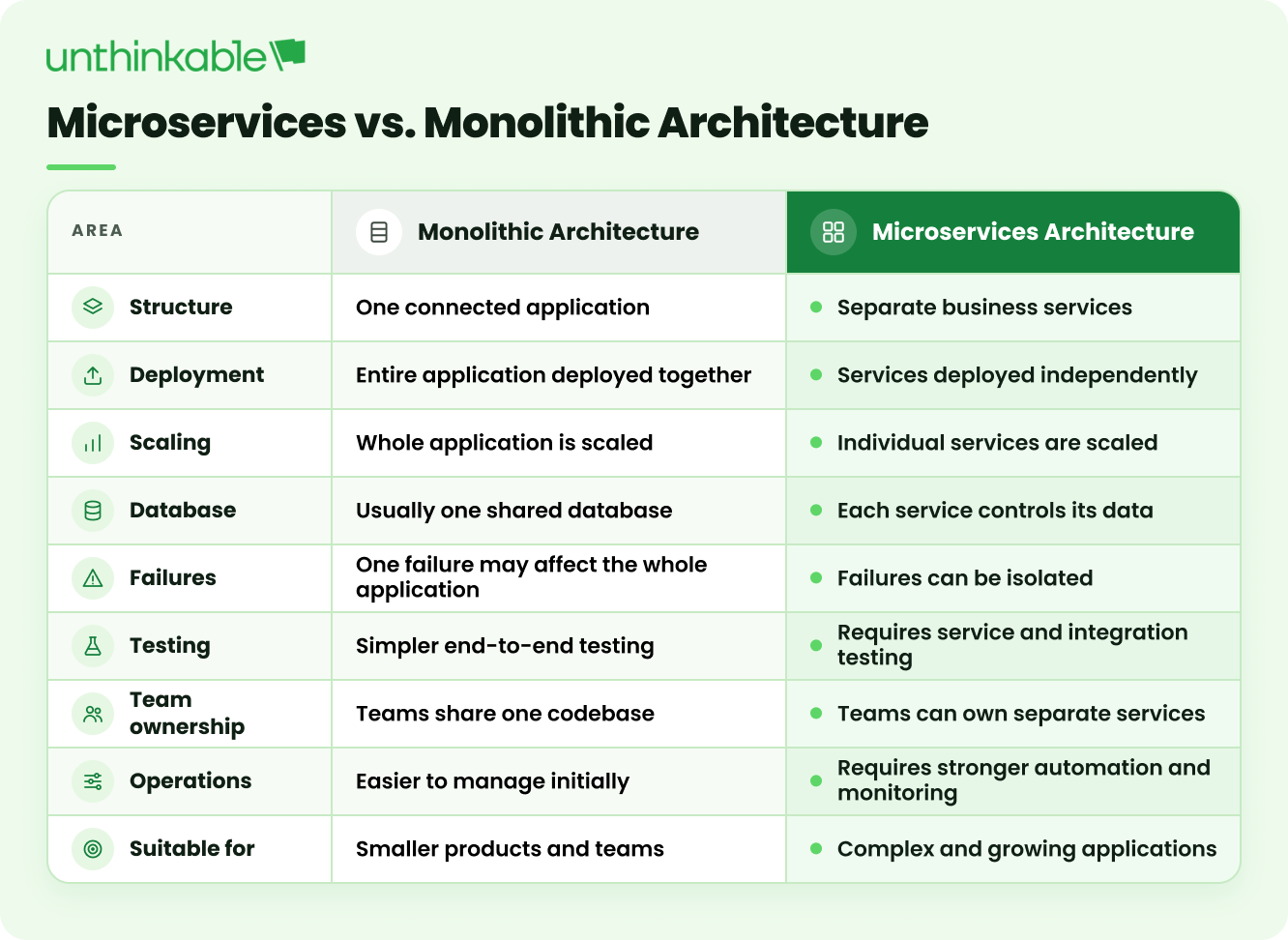
Neither approach is better for every product. A monolithic architecture is often easier to begin with, while microservices may suit products that require independent releases, scaling and team ownership.
Also read: Monolith to Microservices Migration to understand when an existing application should be divided into independent services and how the transition can be planned.
10 Microservices Best Practices & Patterns Pros Swear By
Microservices architecture is not only about dividing a large application into smaller services. Each service needs a clear purpose, controlled access to data and a reliable way to communicate with other services. Teams also need to plan how services will be tested, released, protected and monitored.
The following microservices best practices cover the main decisions involved in designing and managing services in production.
1. Design Microservices Around Business Capabilities
A microservice should support a clear business function, such as orders, payments, inventory, customer accounts or shipping. It should not be created simply because one technical function can be moved into a separate service. This approach helps teams set clear service boundaries. An order service can manage order creation, cancellation and status, while a payment service manages payment approval and refunds. Each service contains the rules and data related to its own business area.
Domain-Driven Design is often used to identify these boundaries. It involves studying how the business works and grouping related processes. The aim is to create services that match real business responsibilities instead of dividing the application by screens, database tables or technical layers.
A well-defined business service should have:
- A clear purpose
- Related business rules
- Defined data ownership
- One responsible team
- Limited dependence on other services
Example: As Uber added more microservices, connections between them became difficult to manage. The company introduced Domain-Oriented Microservice Architecture to group related services into business domains. This gave teams clearer ownership and reduced the number of service connections they needed to understand.
Also read: 7 Pillars of Architecture-Led Software Products to explore the architecture decisions that affect how software evolves as the business grows.
2. Give Every Service One Clear Responsibility
Each microservice should manage one connected responsibility. An order service may create orders, update their status and process cancellations because these functions belong to the same business area. It should not also manage payments, warehouse stock and marketing messages. This approach follows the Single Responsibility Principle, which recommends giving a software component one clear responsibility and one main reason to change.
However, this microservices design principle does not mean creating a separate service for every small function. Services that are too small increase the number of APIs, network calls and deployments that teams must manage. A simple user action may then depend on several services working at the same time.
A service may be too large when unrelated teams need to change it for different reasons. It may be too small when it cannot complete a useful task without immediately calling several other services. The right size depends on the business responsibility, not the amount of code.
Example: An online retailer can use one order-management service to create, cancel and track orders. Payment processing remains in a payment service, while stock updates stay in an inventory service. Each service has a separate purpose, but related order functions remain together.
3. Keep Services Independent
A microservice should be developed, tested, deployed and scaled without requiring the entire application to be released. If every change requires several teams and services to coordinate, the system may still behave like a monolith even though it has been divided into smaller parts.
Independent services require clear ownership and controlled connections. Each service should have its own release process and should not directly change another service’s data. Communication should happen through documented APIs or events.
Teams can support service independence by:
- Giving each service a clear owner
- Maintaining separate deployment pipelines
- Avoiding shared database tables
- Reducing unnecessary shared libraries
- Keeping service contracts stable
- Allowing services to scale separately
Independence does not mean that services never communicate. It means that one service can change without forcing several other services to change at the same time.
Example: An online marketplace may keep product search separate from checkout, payments and customer accounts. During a major sale, the search service can receive more resources and release search improvements without redeploying the checkout and payment services.
Also read: Fast, But Not Fragile – Why Your Team Slows Itself Down to understand how tightly coupled architecture can make releases risky and slow down product changes.
4. Give Each Service Ownership of Its Data
Each microservice should control the data needed for its business function. Other services should request that information through an API or receive updates through events. They should not directly read or change the service’s database tables.
For example, the customer service should own customer profiles, the inventory service should own stock records and the payment service should own transaction information. This separation prevents one team from making a database change that unexpectedly breaks another service.
The database per service approach does not always require a different physical database server for every microservice. Services may use separate databases or separate areas within shared infrastructure. The important rule is that one service controls the structure and use of its data.
A business process may still involve several services. When a customer places an order, the order, inventory and payment services may all need to update their records. Teams must plan how incomplete steps will be handled when one part of the process fails.
Example: The order service creates the order, the inventory service reserves the products and the payment service records the transaction. Each service updates its own data. If the payment fails, the workflow can cancel the order and release the reserved products without one service changing another service’s database.
5. Choose the Right Communication Method
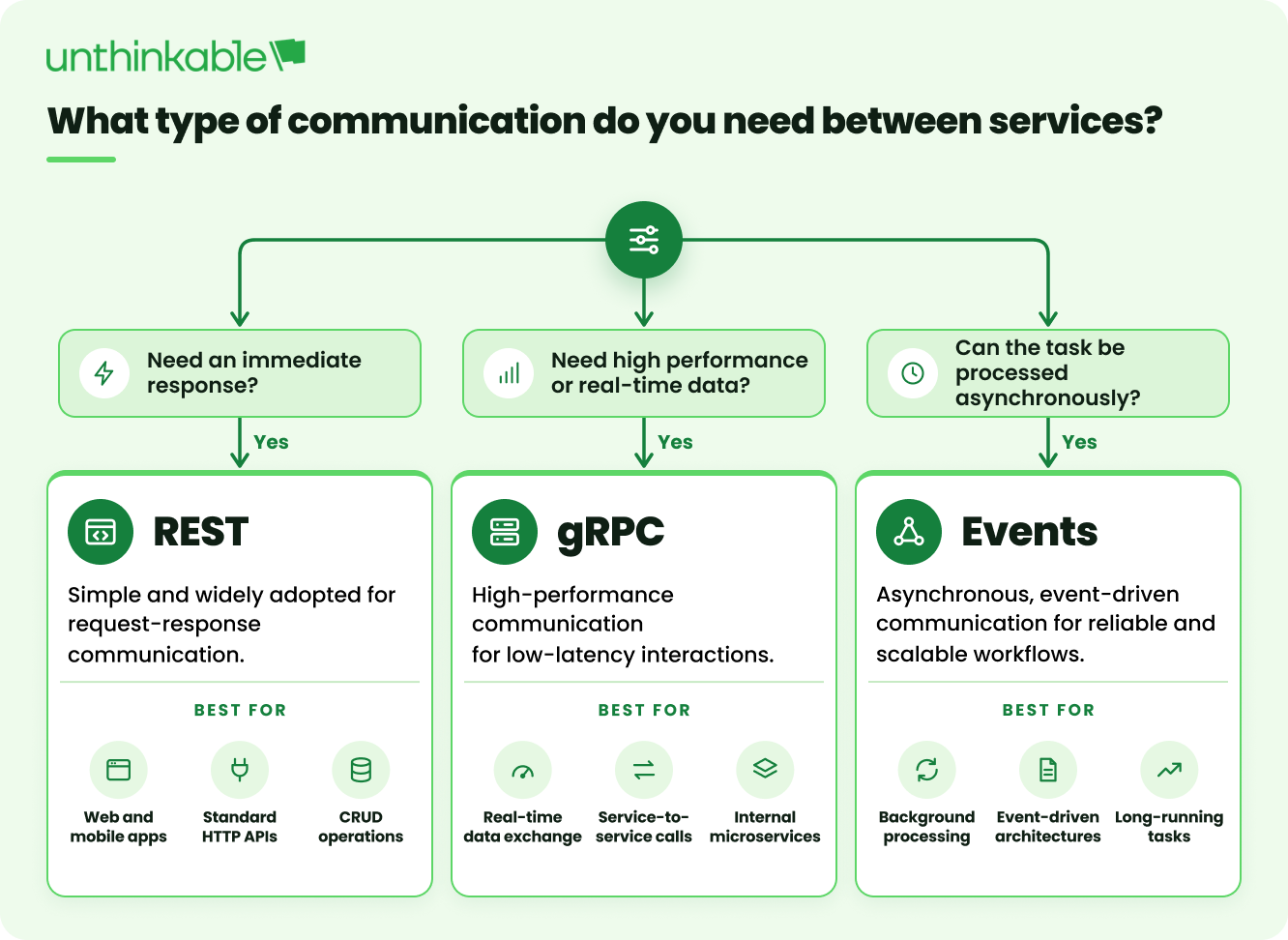
Microservices can communicate through direct API requests or messages and events. The right method depends on whether the service needs an immediate response. With direct communication, one service sends a request and waits for an answer. REST and gRPC are commonly used for this type of communication. It is suitable when the next step cannot continue without the result, such as checking a current price or approving a payment.
With message-based communication, a service sends an event and continues without waiting for every later task to finish. This method is useful for sending notifications, updating reports or starting fulfilment after an order has been placed.
Teams should avoid long chains of direct service calls. If one request must pass through several services before the user receives an answer, one slow service can delay the complete process. Event-driven communication can reduce this dependence, but teams must still handle delayed, repeated or failed messages. The right communication method depends on whether a service needs an immediate response, low-latency communication, or asynchronous processing. The following comparison shows where REST, gRPC, and events typically fit.
A well-designed system often uses both methods:
- Direct calls for actions requiring an immediate result
- Messages or events for work that can happen later
- An API gateway for routing requests from external applications
- A message broker for delivering events between services
The Confluent explanation of event-driven microservices describes how services can respond to business events without waiting for direct requests.
Example: LinkedIn developed Apache Kafka to move large volumes of events between its systems. Kafka allows a service to publish an event while other services process it separately, making it useful when an immediate response is unnecessary. LinkedIn reports using Kafka for workloads such as updating search indexes, tracking paid services and measuring activity in real time.
6. Maintain Clear and Backward-Compatible APIs
APIs and events are contracts between microservices. These contracts define what information a service accepts, what it returns and how it reports errors. If a team changes an API without considering the services that use it, several parts of the application may stop working. Microservices API best practices include using consistent names, documenting requests and responses, and explaining possible errors. Teams should also record which services use each API so they know who may be affected by a change.
Where possible, new API changes should be added without removing existing fields. Adding an optional field is generally safer than changing the name or format of a field that other services already use. Automated contract tests can check whether an API still returns the information expected by connected services. Tools such as Pact and Spring Cloud Contract are commonly used to automate this kind of contract testing, catching breaking changes in CI before they reach production.
When a change will break existing users, teams should:
- Create a new API version
- Continue supporting the old version for a defined period
- Inform the teams using the old version
- Monitor usage during the move
- Remove the old version only after consumers have changed
Example: Stripe allows customers to keep using the API version associated with their integration while the platform continues to change. Its versioning system applies the required changes when preparing a response for an older API version. This approach, described in Stripe’s API versioning case study, reduces the risk that an update will suddenly break existing integrations.
7. Design for Failures
Failures are expected in a distributed application. A service may become unavailable, a network connection may be interrupted or a third-party provider may respond slowly. Microservices architecture best practices must therefore include controls that stop one problem from affecting the complete application.
Common failure controls include:
Timeouts: Stop waiting after an agreed period.
Limited retries: Repeat a temporary failure only a few times.
Circuit breakers: Pause calls to a service that repeatedly fails.
Bulkheads: Separate resources so one overloaded service cannot use everything.
Fallbacks: Provide a reduced experience when a supporting service fails.
Health checks: Confirm whether a service is ready to receive traffic.
Resilience4j and Hystrix (now in maintenance mode, with most teams migrating to Resilience4j) are commonly used libraries for implementing circuit breakers in application code, though a service mesh, covered later in this guide, can apply the same protection without changes to individual services.
Retries need particular care. If several services repeatedly call an unhealthy service, they can increase the load and make the failure worse. Requests such as payments and order creation should also be designed so repeated requests don’t create duplicates.
Example: If an online store’s recommendation service stops working, the product page can display popular items instead of personalized suggestions. Customers can continue shopping while the affected service recovers. The failure of a supporting feature does not stop the main buying journey.
Make Retryable Operations Idempotent
In a microservices system, the same request may be received more than once because of retries, network delays or repeated message delivery. Idempotency ensures that processing the same request multiple times produces the same result as processing it once.
This is especially important for operations such as payments, order creation, refunds and inventory updates. For example, if a payment request times out after the transaction has already been completed, the client may send the request again. Without idempotency, the customer could be charged twice.
Teams can make important operations idempotent by:
- Assigning a unique idempotency key to each request
- Recording requests that have already been processed
- Checking for duplicate events before processing them
- Returning the previous result when the same request is received again
- Designing database updates so repeated operations do not create duplicate records
Idempotency does not prevent retries. It makes retries safer by ensuring that repeated requests or messages do not accidentally repeat the same business action.
8. Protect Communication and Data
Microservices increase the number of APIs and connections that need protection. Security must cover requests from users, third-party systems and other internal services. Authentication confirms the identity of the user or service making a request. Authorization controls which data or action that identity can access. A service should receive only the permissions it needs for its responsibility.
Microservices security best practices include:
- Encrypting data while it moves and while it is stored
- Verifying communication between services
- Applying role-based or policy-based access
- Storing keys and passwords outside the application code
- Rotating credentials regularly
- Validating all incoming information
- Limiting repeated API requests
- Recording important security actions
- Checking libraries and container images for weaknesses
An API gateway can apply common controls, but individual services should still protect sensitive actions. Internal traffic should not be treated as trusted simply because it comes from inside the system.
Example: An order service may check whether a payment has succeeded, but it should not be allowed to change completed transaction records. The payment service controls that data and exposes only the information and actions required by other services.
9. Automate Testing and Deployment
Microservices create more applications to build, test and release. Manual processes become slow and inconsistent as the number of services increases. Microservices development best practices therefore include automated testing and a separate delivery pipeline for each service.
Testing should cover:
- Individual functions
- Business rules within the service
- API and event contracts
- Database and message-queue connections
- Important workflows across services
- Security and performance under realistic conditions
Mock servers generated from API contracts, using tools such as Prism or Mockoon, let consumer teams build and test against a service before it is fully implemented.
Once the tests pass, a CI/CD pipeline can build and deploy the approved version. Containers can help keep development, testing and production environments consistent. A container-management platform may support scaling and recovery when the number of services justifies its use. Teams should release small changes that can be reversed quickly. Canary releases send limited traffic to a new version before a wider release. Blue-green deployment keeps the previous environment available while the new one is introduced. Feature flags allow a team to disable a new capability without releasing the complete service again.
Example: From Our Engineering Experience
While reengineering the OLX Cash My Car application, our engineering team introduced automated QA and structured test cases to identify issues earlier in development. Reusable components were also used to reduce repeated development work and support faster releases.
The results:
~20% reduction in repetitive testing effort
40-50% estimated reduction in development time through reusable components
47% increase in lead conversions
Engineering takeaway: Automation delivers more value when it is built into the development and release process rather than introduced only at the final testing stage.

10. Centralize Logs, Metrics and Traces
A user request may pass through several microservices before it is completed. If every service stores information separately, teams may struggle to understand where a delay or failure began.
Microservices observability brings together three types of information:
- Logs record events, errors and service activity.
- Metrics measure traffic, response time, errors and resource use.
- Traces follow a request as it moves between services.
Every request should carry a trace or correlation ID. Each service includes this ID in its records, allowing teams to connect activity across the complete workflow. Centralized logging should use a consistent format so teams can search information from different services in one place. Monitoring dashboards should show important customer journeys, such as checkout completion or payment success. Alerts should focus on problems that require action rather than reporting every small infrastructure change.
Strong microservices monitoring also requires clear ownership. When an alert appears, the responsible team should know which service is affected and what action to take. The OpenTelemetry observability primer explains how logs, metrics and traces provide a connected view of distributed applications.
Example: A customer’s request moves through the order, inventory and payment services. A shared trace shows that the payment service waited too long for an external provider and reached its timeout. The trace ID allows the support team to locate the problem without searching each service separately.
These 10 microservices best practices work together. Clear boundaries support independent ownership, separate data reduces hidden dependencies, reliable communication limits failures, and observability shows how the complete system behaves. The goal is not to create as many services as possible, but to build services that teams can change and manage without losing control of the wider product.
Types of Microservices Architecture Patterns
Microservices architecture patterns provide tested ways to solve common problems involving service communication, data ownership, failures and client requests. A single application may use several patterns together because each one addresses a different part of the system.
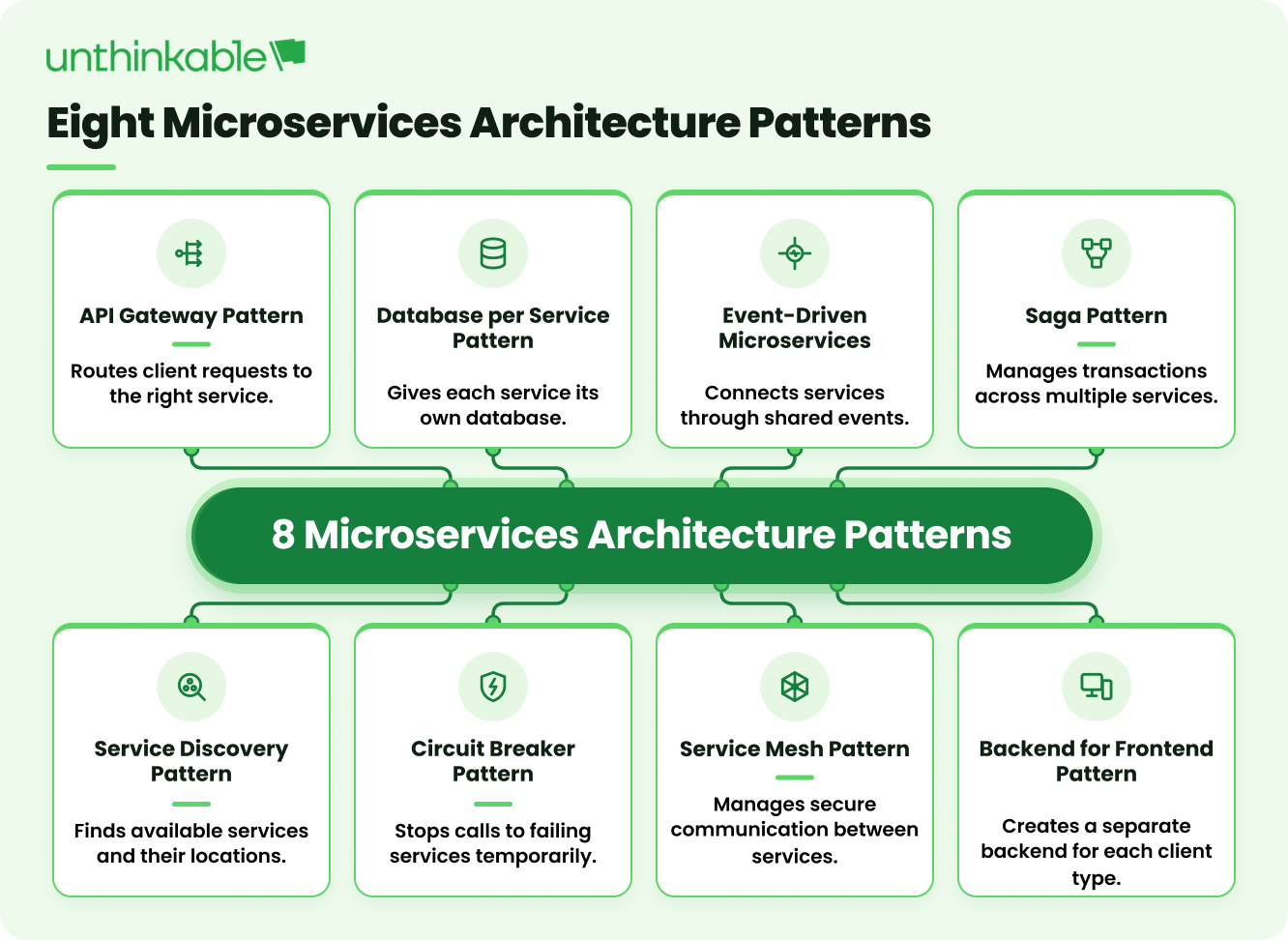
The following are 8 widely used microservices patterns:
1. API Gateway Pattern
The API gateway provides one entry point for requests coming from a website, mobile application or external system. Instead of connecting directly with several microservices, the client sends its request to the gateway. The gateway identifies the required services, collects their responses and returns the result. It can also manage common tasks such as authentication, request routing, traffic limits and response formatting. However, business rules should remain inside the relevant microservices rather than being moved into the gateway.
Kong, NGINX, and AWS API Gateway are commonly used implementations of this pattern.
For example, when a customer opens a product page, the API gateway may collect the product details, price, stock availability and customer reviews from separate services. The customer receives one response instead of the application making several visible requests.
Best suited for:
- Applications with many microservices
- Web and mobile applications
- Systems serving external partners
- Products needing one public API
- Platforms with common access controls
Main limitations:
- Adds another component to maintain
- Can become overloaded during high traffic
- May delay requests if poorly designed
- Can create a central point of failure
- May become too complex if it contains business logic
2. Database per Service Pattern
The database per service pattern gives each microservice ownership of its data. Other services cannot directly read or change that database. They must request information through the service’s API or receive it through an event.
The services do not always need separate physical database servers. They may use different databases or separate tables and schemas, provided that ownership and access remain clear. This separation allows a team to change one service’s data structure without forcing changes across the whole application.
Best suited for:
- Services requiring clear data ownership
- Systems developed by independent teams
- Applications that need separate scaling
- Products using different database types
- Platforms with frequently changing services
Main limitations:
- Cross-service reports become harder to create
- Data may be repeated across services
- Updates may not appear everywhere immediately
- Multi-service transactions require more planning
- Several databases increase maintenance work
3. Event-Driven Microservices
In event-driven microservices, a service publishes an event when an action takes place. Other services receive that event and complete their own work without needing a direct request from the first service. This approach reduces direct dependencies between services and supports tasks that do not need an immediate response. However, teams must track events carefully and prepare for delayed, repeated or incorrectly ordered messages.
For example, when an order is placed, the order service can publish an “Order Created” event. The payment service processes the payment, the inventory service reserves the item and the notification service sends confirmation. Each service responds to the same event independently.
Best suited for:
- Order-processing workflows
- Notifications and background tasks
- Real-time data updates
- Systems with changing workloads
- Services that can work independently
Main limitations:
- Events can be delivered more than once
- Messages may arrive in the wrong order
- Errors are harder to trace across services
- Data may take time to become consistent
- Event formats must be managed carefully
4. Saga Pattern
The saga pattern manages a business process that requires updates across several microservices. It divides the process into a sequence of smaller transactions. Each service completes its part and then triggers the next step. If one step fails, the system uses a compensating action to reverse an earlier step where possible. A saga may be controlled by one central service, or each participating service may trigger the next action through events.
For example, a travel booking may involve flight, hotel and payment services. If the payment succeeds but the hotel is unavailable, the saga can start a refund and cancel the flight reservation. This prevents the process from remaining only partly completed.
Best suited for:
- Ecommerce order fulfilment
- Travel and ticket bookings
- Payment and refund processes
- Workflows involving several databases
- Long-running business processes
Main limitations:
- Reversing an action may be difficult
- Several failure paths must be planned
- Workflows become harder to test
- Data may be temporarily inconsistent
- Tracking every step requires clear records
5. Service Discovery Pattern
Microservice locations can change when service instances start, stop or move. The service discovery pattern maintains a registry containing the current locations of available instances. A service or router checks this registry before sending a request. This removes the need to store fixed addresses in the application. It is especially useful in cloud and container environments, where services may be added or replaced automatically.
Best suited for:
- Cloud-based applications
- Container-based environments
- Systems that scale automatically
- Applications with changing service locations
- Platforms running several service instances
Main limitations:
- The registry must remain available
- Old location records can cause failed requests
- Services must register and update correctly
- Health checks require careful setup
- Discovery adds another system to operate
6. Circuit Breaker Pattern
The circuit breaker pattern stops an application from repeatedly calling a service that is failing or responding slowly. After failures reach a set limit, the circuit opens and further requests are blocked for a short period. During this time, the application can return an error, use saved information or provide a simpler response. After the waiting period, a small number of requests are allowed through to check whether the service has recovered.
For example, if a recommendation service becomes unavailable, an online store could temporarily show popular products. Customers can continue browsing while the affected service recovers.
Best suited for:
- Systems calling external services
- Applications with several service dependencies
- High-traffic digital platforms
- Services with changing response times
- Systems requiring partial availability
Main limitations:
- Failure limits can be difficult to set
- Poor settings may block healthy services
- Fallback responses may become outdated
- It does not repair the failed service
- Circuit status must be monitored
7. Service Mesh Pattern
As the number of services grows, concerns like service discovery, retries, timeouts, circuit breaking, encryption and traffic monitoring start getting implemented separately inside each service. A service mesh moves these concerns out of application code and into a dedicated infrastructure layer. Each service gets a lightweight proxy, often called a sidecar, that handles this traffic on its behalf. The mesh’s control plane then manages routing rules, security policies, and observability data for every service at once, without requiring changes to the services themselves.
This differs from the Service Discovery and Circuit Breaker patterns covered earlier in one important way: those patterns can be implemented inside individual services, while a service mesh applies them consistently across the entire system from one place. Istio and Linkerd are the two most widely used service mesh implementations, with Envoy commonly used as the underlying proxy.
For example, a company running 40 microservices across several teams can use a service mesh to enforce encrypted service-to-service communication and consistent retry behaviour everywhere, without asking each team to implement that logic separately inside their own service.
Best suited for:
- Systems with a large number of services
- Organizations running multiple independent teams
- Platforms with strict security or compliance requirements
- Applications needing consistent traffic control across services
- Teams that want observability without instrumenting every service individually
Main limitations:
- Adds real operational complexity and a learning curve
- Sidecar proxies add a small amount of latency to every request
- Can be unnecessary overhead for systems with a small number of services
- Requires dedicated expertise to operate reliably
- Misconfiguration can affect traffic across the entire system at once
8. Backend for Frontend Pattern
The backend for frontend pattern creates a separate backend for each type of client, such as a website, mobile application or partner portal. Each backend communicates with the required microservices and returns information in a form suited to that client. A mobile application may need smaller responses and fewer requests, while a desktop website may display more information. Separate backends allow both experiences to change without forcing them to share the same interface.
Best suited for:
- Products with web and mobile applications
- Platforms serving different user groups
- Applications with client-specific workflows
- Products with different performance needs
- Systems managed by separate frontend teams
Main limitations:
- Similar code may appear in several backends
- More services must be developed and maintained
- Shared changes may require several updates
- Ownership can become unclear
- It may be unnecessary for simple applications
These microservices architecture patterns help teams organize service communication, manage data, reduce the impact of failures and support different user experiences. By combining the patterns that match the product’s needs, teams can create an architecture that is easier to develop, operate and expand as the business grows.
Tools Used in Microservices Architecture
Microservices teams use different tools to manage communication, deployment, testing, security and monitoring across independent services. The right combination depends on the architecture, number of services and operational needs. Common options include:
- API Management – Kong, NGINX, AWS API Gateway: Route requests, control access and provide a common entry point to services.
- Service Communication – REST, gRPC: Support direct communication when one service needs an immediate response from another.
- Messaging and Events – Apache Kafka, RabbitMQ: Allow services to exchange messages and process events without waiting for each other.
- Containerization – Docker: Packages services with their dependencies so they can run consistently across environments.
- Container Orchestration – Kubernetes: Helps deploy, scale and manage containerized services across infrastructure.
- Contract Testing – Pact, Spring Cloud Contract: Checks whether API changes remain compatible with services that depend on them.
- Resilience – Resilience4j: Supports failure-handling mechanisms such as retries and circuit breakers.
- Service Mesh – Istio, Linkerd, Envoy: Manages service-to-service traffic, security and observability across larger environments.
- Observability – OpenTelemetry, Prometheus, Grafana: Helps teams collect and monitor traces, metrics and system performance across services.
- CI/CD – Jenkins, GitHub Actions, GitLab CI/CD: Automates building, testing and deployment so individual services can be released independently.
A smaller application may only require containers, APIs, automated deployment and basic monitoring, while a system with many services may benefit from orchestration, event streaming, contract testing and a service mesh. The technology stack should grow with the operational needs of the system rather than making the architecture more complex from the beginning.
Conclusion
Microservices can give growing products more room to evolve. Teams can update important features separately, scale services according to demand and limit the effect of a failure to one part of the application. These advantages, however, depend on how well the services are divided, connected and managed.
The best practices covered in this guide help create that foundation. Services should represent clear business capabilities, own their data and remain independent enough to be developed and deployed separately. APIs and events need clear rules, failures must be expected, and testing, deployment and monitoring should be part of everyday development. Patterns such as API gateways, service discovery, sagas and circuit breakers can then be introduced where they solve a specific system problem.
The goal is not to create the largest possible number of services. It is to build an architecture that allows teams to make changes without creating delays or affecting unrelated parts of the product. This requires a clear understanding of current system limits, future traffic, team responsibilities, data flows and long-term operating costs.
For businesses planning a new distributed application or improving an existing system, Unthinkable’s microservices consulting services cover architecture assessment, service planning, system integration and implementation support. Connect with the team to discuss your product requirements and define a microservices approach that supports both current priorities and future growth
About Author