Success Story
About the Client

The client is one of the UK’s leading clinic networks, delivering personalized healthcare supported by a broad range of surgical and medical specialties. With deep expertise in treating serious and complex conditions, the organization operates across more than 30 locations nationwide and provides care to over 100,000 patients annually. By combining clinical excellence with a patient-first approach, the clinic ensures high-quality outcomes and compassionate care at scale.
Business Situation & Requirements
As healthcare networks expand across multiple locations, managing clinical and administrative operations through fragmented systems becomes increasingly complex. For a leading UK-based healthcare provider operating more than 30 clinics and serving over 100,000 patients annually, the absence of a unified practice management system was creating operational inefficiencies and limiting visibility across its network. The organization needed a centralized multi-clinic Practice Management System (PMS) to streamline and automate workflows for clinical staff, general practitioners (GPs), and consultants while ensuring consistency in care delivery across all locations.
The client had previously partnered with an outsourcing vendor to develop an initial PMS; however, the engagement did not deliver the expected outcomes. While a foundational system existed, it required significant restructuring and enhancement. Having already invested considerable time and resources, the client aimed to rebuild and modernize the solution by reusing the existing codebase wherever possible.
They were therefore looking for a technology partner with deep healthcare domain expertise and a strong understanding of medical operations to transform the system into a scalable, secure, and future-ready platform. Unthinkable was selected for its proven experience in developing robust healthcare applications and its ability to deliver reliable, mission-critical solutions aligned with industry standards.
The key requirements were:
Conduct detailed discovery and requirement analysis to assess the existing PMS codebase, map clinical workflows across departments, identify operational gaps, and define a scalable implementation roadmap.
Develop a role-based medical Practice Management System (PMS) with differentiated access controls, enabling clinical staff, general practitioners (GPs), and consultants to manage day-to-day clinical operations and patient data efficiently.
Build and integrate core functional modules, including appointment scheduling, patient record management, stock and inventory management, and a referral management system to ensure seamless coordination across multiple clinics and departments.
Integrate the PMS with third-party software systems and medical hardware such as pathology analyzers, Picture Archiving and Communication Systems (PACS), billing systems, and barcode scanners to enable real-time data exchange and streamlined workflows.
Ensure HL7 compliance to facilitate standardized and secure transfer of clinical and administrative data between various healthcare applications and external providers.
Design a secure, scalable, and multi-clinic architecture that supports increasing patient volumes, centralized reporting, and operational visibility across the entire clinic network.
Solution
Unthinkable’s team of business analysts, technology specialists, and healthcare domain experts combined deep knowledge of software re-engineering with a thorough understanding of medical practice management to build a robust multi-clinic PMS. The team started by auditing the client’s existing system to identify reusable code, refining and integrating around 30% of it into the new platform, which generated substantial time, cost, and development efficiencies. Unthinkable developed a cross-platform, web-based PMS that automates the entire spectrum of daily clinical operations, optimizing workflows for physicians, nurses, and administrative staff.
The system seamlessly streamlines administrative, financial, and clinical processes while maintaining strict patient data confidentiality at every stage of design, development, and testing. In parallel, a secure central database, a patient portal for accessing clinical records, and a scalable multi-clinic architecture were implemented to connect all locations. Together, these features enhance operational efficiency, standardize care delivery, and provide clinicians with actionable insights to improve patient outcomes.
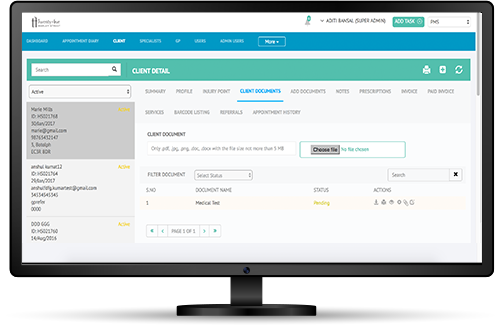
Appointment Booking System
Enables patients to schedule appointments with GPs and consultants across all clinics using an integrated calendar. The system automatically checks physician availability in real time, preventing double bookings and minimizing scheduling conflicts. It also allows administrative staff to manage appointments efficiently, send automated reminders to patients, and adjust schedules based on priority cases, ensuring smooth coordination and improving the overall patient experience while optimizing clinic workflow.
Patient Record Management
Maintains comprehensive electronic medical records for every patient, including profiles, contact details, unique IDs, past medical history, and treatment notes. This module allows clinicians to access detailed patient information quickly, track historical trends, monitor ongoing treatments, and make informed decisions. By digitizing records across multiple clinics, it ensures consistency, eliminates redundant paperwork, and supports better continuity of care across the healthcare network.
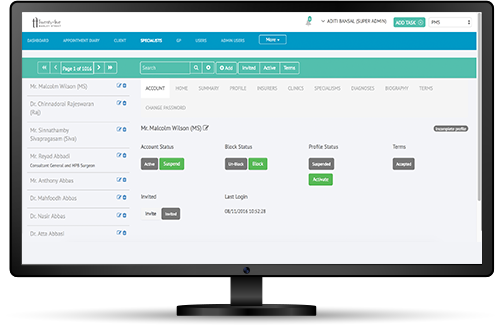
Task Management
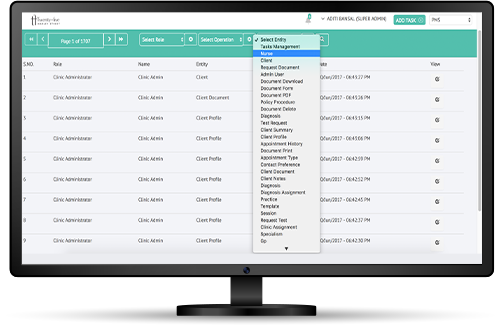
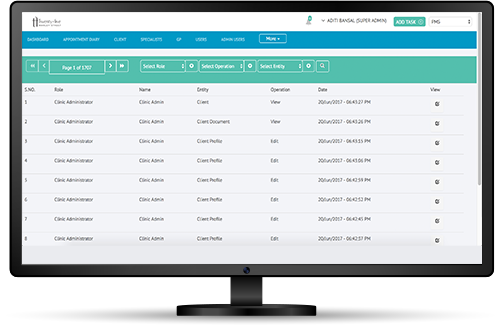
Implements role-based access controls to assign tasks and permissions according to staff, GP, or consultant roles. The module allows each user to view and manage their responsibilities efficiently, ensuring accountability and streamlining workflow. Administrative, clinical, and medical teams can prioritize tasks, track completion status, and collaborate effectively across departments, enhancing productivity and reducing delays in daily operations while keeping sensitive information secure.
Patient Pathology & Imaging
Integrates Laboratory Information Management Systems (LIMS) and medical imaging devices to allow real-time, two-way communication between the PMS and diagnostic equipment. This ensures that lab results, imaging reports, and test data are automatically synchronized with patient records. Clinicians can access accurate and timely diagnostic information from any clinic location, supporting faster decision-making, improving patient care, and eliminating the need for manual data entry or physical record transfers.
Stock Management
Tracks and manages clinical inventory for medicines, supplies, and equipment across all clinics. The module provides clear visibility of available stock levels, predicts future requirements, and generates alerts for low or expiring items. This ensures uninterrupted clinical operations, reduces wastage, and helps in strategic procurement planning. By giving staff a complete overview of resources, it enhances operational efficiency, reduces costs, and maintains smooth day-to-day functioning in the clinics.
Referral Management System
Facilitates seamless referrals between GPs and specialists, allowing patients to be scheduled for consultations efficiently. The system allows GPs to refer patients with all relevant medical history and test results attached, ensuring specialists have full context before appointments. It improves coordination between primary care and specialty services, reduces administrative delays, and enhances the patient journey by providing clear, traceable referral pathways, while maintaining consistent care across multiple clinics.
The Impact
Following the deployment of the Practice Management System across 30+ clinics, the client successfully unified GPs, consultants, and internal staff on a single platform. Patients were routed efficiently to the appropriate GP or specialist, while workflows across multiple departments were automated.
The system integrated seamlessly with third-party software and medical devices, including pathology analyzers, PACS, billing systems, and barcode scanners, providing a user-friendly interface that was highly appreciated by clinical staff.
By reusing over 30% of the existing code, the solution was delivered in just 20 man-months of effort, resulting in a 47% increase in operational efficiency. Centralizing medical practices across the network optimized resource utilization and proved highly cost-effective for the client.

100+
Clinics Integrated
47%
Increase In Efficiency
>30%
Code Reused