Success Story
About the Client
The Reserve Bank of India (RBI) is the central bank of India, responsible to formulate and manage the country’s major monetary policies and to ensure economic stability and growth. Established in 1935 under the Reserve Bank of India Act, 1934, the RBI has since played a significant role in supporting the Government of India’s development strategy. Additionally, it is a member bank of the Asian Clearing Union.
Challenges and Requirements
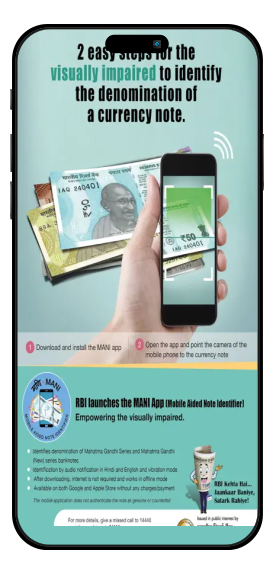
In 2016, the Reserve Bank of India (RBI) introduced a new series of currency notes ranging from INR 10 to INR 2,000, each embedded with distinct features to enable easy identification. For visually impaired users, tactile markers and embossments on the notes acted as visual cues to identify denominations. However, with regular circulation, these tactile features often fade away, creating difficulties for individuals who rely on touch-based identification.
To address this challenge, the RBI sought a technology-driven solution. The key requirement was to develop a mobile application that would enable visually and hearing-impaired users to identify currency denominations using voice/sonic feedback and vibration patterns. Following a rigorous partner selection process, the RBI chose Unthinkable as its technology partner, entrusting the team with both the technical and functional execution of the project.
To successfully develop the currency denomination identifier, Team Unthinkable was expected to deliver the following:
Design an intuitive and user-friendly interface that aligns seamlessly with RBI’s brand identity, ensuring clear messaging and easy navigation for end users.
Leverage advanced artificial intelligence techniques to accurately identify currency denominations, even under varying lighting conditions or when notes are soiled or worn.
Integrate multilingual support to improve accessibility for visually and hearing-impaired users across diverse regions.
Implement robust security protocols to protect the application from vulnerabilities and potential data breaches.
The Solution
At the outset of the project, Team Unthinkable presented a comprehensive technical proposal to the RBI, which included detailed project management strategies, software requirements specifications, high-level and low-level design documents, and user acceptance test cases. These deliverables were thoroughly reviewed and approved by RBI’s technical team, paving the way for the development phase.
Our development process began with a technology stack capable of delivering fast, accurate, and reliable on-device image recognition, also ensuring accessibility and offline functionality. During the AI model training phase, Tesseract OCR was utilized to enable strong text and pattern recognition specifically tailored for Indian currency notes.
For the Android app, Java was chosen as the primary programming language. AI-driven models built using TensorFlow enabled real-time currency denomination recognition, while SQLite provided lightweight and efficient local data storage. The iOS application was developed using Swift and leveraged TensorFlow-based AI models to ensure consistent recognition accuracy and performance across Apple devices.
Image Dataset Training
To ensure seamless offline functionality, the app was created without internet access. As real-time learning was not possible, the AI models were trained specifically for offline recognition. A proprietary dataset with more than 150,000 images of national currency notes was created, covering all denominations.
The dataset included variations in orientation, lighting conditions, partial or folded notes, camera quality, and background environments. These variations ensured consistent accuracy across real-world scenarios. AI-integrated Optical Character Recognition (OCR) processed the images and supplied them to machine learning models. To accelerate development with accuracy, transfer learning techniques were used to feature from pre-trained ImageNet models and adapt them to the custom dataset.
After training, the models were converted into suitable formats for mobile devices, which supported fast and secure offline execution. Automatic flashlight control improved recognition accuracy in low-light conditions, further enhancing accessibility.
Advanced Testing Technology
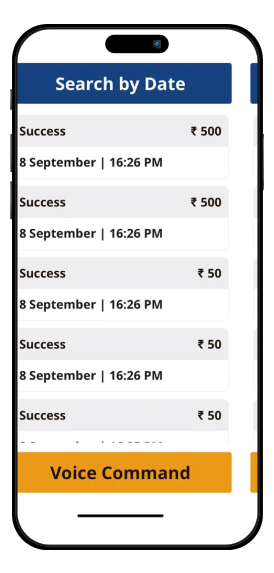
The development plan included strong security measures to protect the application. The app went under thorough testing to confirm reliability, safety, and performance. Security checks helped detect and fix issues at both the code and system levels. Vulnerability assessment and penetration testing (VAPT) and Static application security testing (SAST) helped identify and reduce security risks across the system.
The application was also tested several times under real-world conditions, such as different lighting, half-folded notes, and varied device types. These tests confirmed accurate and stable currency recognition. Secure cloud systems like AWS S3 for image storage, and EC2 for expandable was embedded within the development pipeline, protected through AWS Identity and Access Management (IAM), to balance cost efficiency and performance across model training and validation phases.
Enabling Multilingual Support
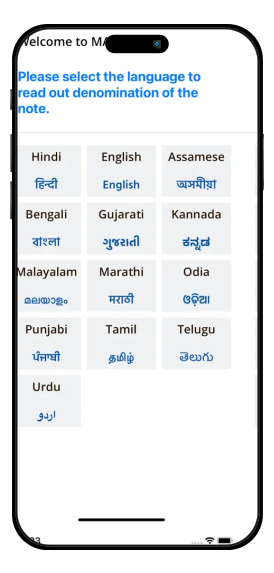
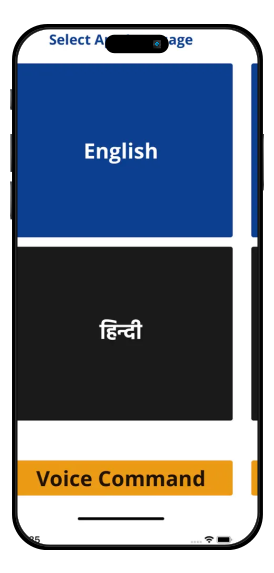
To meet diverse linguistic needs, the solution offers voice commands in 11 regional languages. When users open the app, they are guided through an intuitive menu where all available language options are clearly announced. Users can select their preferred language easily using basic voice instructions.
For instance, a native Punjabi speaker can choose Punjabi as the default language. When a currency note is scanned, the application clearly announces the denomination in Punjabi. This language accessibility feature supports users from different regions, enabling them to navigate and use the application smoothly in the language they are most comfortable with.
Improved Accessibility with Vibration Mode and Guided Support
To further enhance accessibility, the application includes an audio guide that welcomes and instructs visually impaired users on its features and usage. Integrating this audio guide presented a challenge due to its large file size, as maintaining a minimal application size was critical for uninterrupted offline functionality.
The development team resolved this issue through careful optimization, ensuring a seamless user experience while keeping the application compact and fully functional.
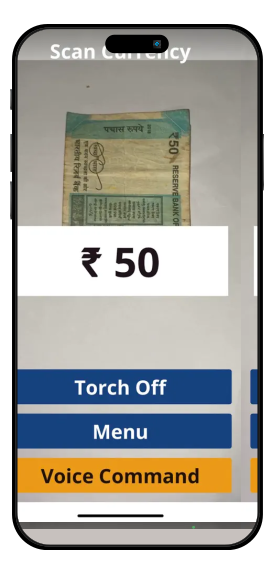
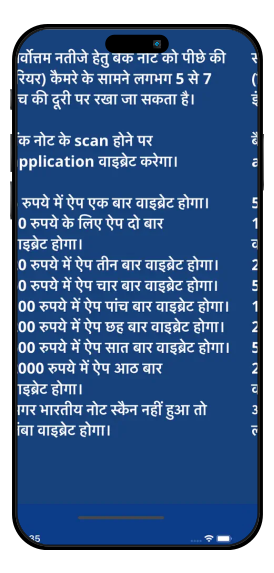
For users with hearing and visual impairments, the app features a vibration-based denomination recognition system. Different numbers of vibrations correspond to specific currency notes: one vibration for ₹5, two for ₹10, three for ₹20, four for ₹50, five for ₹100, six for ₹200, seven for ₹500, and eight for ₹2,000. If the app is unable to recognize a note, it triggers a prolonged vibration and prompts the user to rescan the currency.
Flexible Interaction Options
Recognizing the diverse needs of users, the application includes a “No impairment” option designed for individuals who are partially color-blind or have visual impairments. This feature allows users to enable the TalkBack functionality, offering a simpler and more flexible way to interact with the application regardless of their visual capabilities.
Support and Feedback Setup
The application simplifies user interaction by allowing support requests and feedback submissions through SMS or missed calls, fully integrated within the app by team Unthinkable. A dedicated dashboard was developed to enable the support team to efficiently monitor, track, and address reported issues and suggestions. These insights were consistently used to improve the application’s functionality and enhance the overall user experience.
The Impact
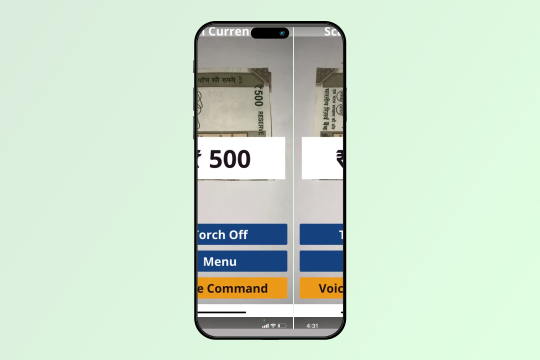
Designed for real-world accessibility at a national scale, the MANI app has delivered measurable impact for visually and hearing-impaired users across India. It accurately recognizes Mahatma Gandhi Series and Mahatma Gandhi (New) Series currency notes,₹10 to ₹2,000, even when scanned from the front, back, or in partially folded conditions, across normal and low-light environments.
Accessibility is strengthened through audio notifications in up to 11 Indian languages and distinct vibration patterns, supporting users with dual sensory impairments. Voice-enabled navigation via Siri and TalkBack allows independent use across devices. The app functions fully offline, with automatic flashlight support for low-light conditions. With recognition speeds under 1.5 seconds, the solution has improved financial independence and confidence, scaling to over one million users with validation from the Reserve Bank of India.
1M+
Downloads
99.9%
Accuracy
150,000
Data Set Images