Success Story
About the Client

V2 Retail Limited is one of India’s leading value fashion retail chains, offering affordable apparel and accessories through a wide portfolio of in-house brands. Founded in 2006, the company has expanded to 300+ stores across India, serving millions of customers with a focus on value, variety, and accessibility. Headquartered in New Delhi, V2 Retail continues to expand its presence across cities to meet changing consumer expectations in the fashion retail market.
Business Situation
When V2 Retail approached us, the problem was framed simply: “We need an e-commerce platform.”
However, a closer look revealed that it was not a standard e-commerce problem.
V2 Retail did not lack inventory. It had significant stock distributed across 300+ stores nationwide. The challenge was that none of this inventory was accessible to online customers, and the existing systems were not designed to support digital commerce. This was not an e-commerce gap. It was a store-led commerce problem. Stores were effectively acting as decentralized warehouses, with inventory and fulfilment distributed across locations.
Secondly, the company operated on a SAP-based ERP that tracked store-level inventory. However, it was built for physical retail operations such as purchase orders, goods receipt, and inter-branch transfers. Inventory data had a 15–30 minute sync lag, and the system lacked support for online reservations, pick-pack-ship workflows, and a mechanism to expose store-specific inventory to a digital storefront. Building directly on top of this would have meant inheriting these limitations.
As a result, three critical gaps emerged. First, inventory remained invisible online. While 300+ stores held all available stock, there was no way to surface it to customers in real time.
Second, there was no fulfillment infrastructure in place. There were no defined pick-pack-ship processes, no scan-based validation, and no task-driven workflows for store staff. Online order execution did not exist at the store level.
Third, store operations were inherently offline-first. With a delayed ERP sync, the e-commerce layer risked displaying incorrect stock levels, resulting in failed orders and a poor customer experience.
To address this, the client needed a technology partner to design a system that could unlock the value of its distributed store network without disrupting existing operations.
Key requirements were:
Build an e-commerce storefront with UPI, COD, and card payment support
Design a fulfilment model leveraging stores as the primary fulfilment source
Develop an Order Management System (OMS) with real-time visibility across all store orders
Build a store-facing Android application for pick, pack, and dispatch with scan-based validation
Integrate with SAP and POS systems without replacing existing infrastructure
Engineer an inventory sync mechanism that accounts for ERP lag without exposing incorrect stock
The Solution
Unthinkable approached this as a distributed commerce infrastructure problem rather than a conventional storefront build. The objective was to enable digital commerce on top of a store-led retail model without disrupting existing ERP workflows or store operations.
We focused on designing an architecture that could handle distributed inventory, offline-first store environments, and real-time customer expectations simultaneously. This required building independent commerce and fulfillment layers while integrating seamlessly with SAP and existing systems.
We built the platform as a set of interconnected systems, including a high-performance storefront, a store-led fulfilment architecture, an inventory sync engine, and operational tools for both headquarters and store staff.
Developing a High-Performance E-Commerce Storefront
We built the customer-facing storefront on a unified commerce platform engineered as a single system rather than a plugin stack. V2 Retail’s target customers in tier-2 and tier-3 cities primarily shop on mid-range Android devices over mobile data connections. A higher load time would directly impact conversion before a customer ever engages with the product catalogue.
To address this, we designed a CDN-first architecture capable of delivering sub-1-second page load times, optimized specifically for bandwidth-constrained environments.
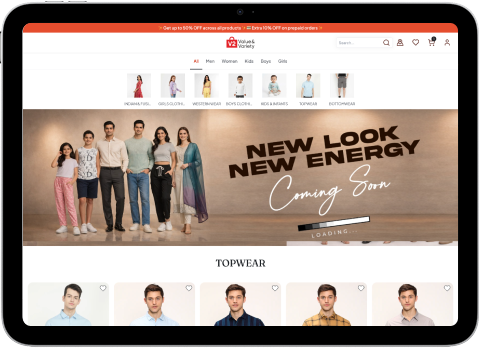
Engineering a Scalable Commerce Infrastructure
The platform delivers sub-1-second page load times through a global CDN and intelligent caching, ensuring a seamless experience for mobile-first users.
It supports seamless UPI, COD, and card payments via Razorpay and PhonePe, eliminating the need for third-party plugins and reducing latency.
To scale catalogue operations, the system uses AI-generated product descriptions and metadata, removing the need to manually catalogue across thousands of SKUs.
It also enables smart collections that dynamically group inventory by season, occasion, and trends such as ‘Festive Kurtis’ and ‘Monsoon Casuals’.
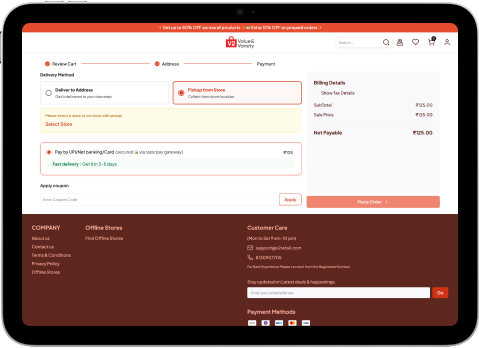
Driving Customer Acquisition & Retention Through Integrated Channels
The platform enables automated customer acquisition through Meta and Google Dynamic Product Ads, where campaigns pull live inventory for real-time retargeting.
It extends the catalogue natively to social channels through WhatsApp Commerce and Instagram Shop integrations, allowing customers to discover products across multiple touchpoints.
To improve conversion and retention, the system incorporates a smart cart with abandoned cart recovery, prepaid discount nudges, and COD-to-prepaid conversion incentives. It further supports RFM-based segmentation, enabling automated loyalty programs and review workflows to drive repeat engagement.
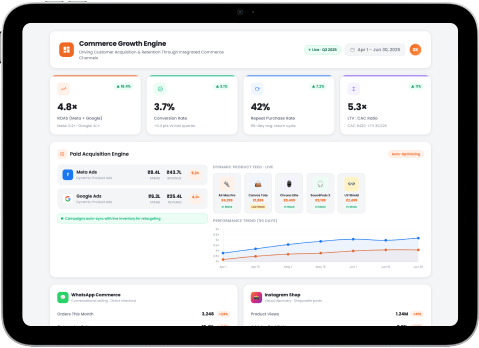
Designing a Store-Led Fulfilment Architecture
This was the most architecturally significant decision in the engagement. Rather than routing online orders through a centralized warehouse, we designed a fulfilment model that treated the store network itself as the fulfilment infrastructure. This approach aligned with how V2 Retail already operated, unlocking speed and cost efficiencies that centralised models could not achieve.
Nearest Store Allocation
When a customer places an order, the system identifies the store with available inventory closest to the delivery pin code and routes the order accordingly. This reduces last-mile delivery time and logistics costs, which is important for a value fashion business operating on thin margins.
BOPIS (Buy Online, Pick Up In Store)
Customers can browse and purchase online and collect orders from their nearest store. With 300+ locations, this creates a fulfilment advantage that pure-play D2C brands cannot replicate.
Hub Fulfilment
For regions with dense store clusters, designated hub stores handle consolidated fulfilment for surrounding locations. This reduces operational complexity while maintaining the benefits of distributed inventory.
Building a Lag-Tolerant Inventory Sync Engine on SAP
The 15–30 minute SAP sync lag was the most critical technical constraint in the system. An e-commerce platform that displays inventory as available even after it has been sold offline results in failed orders and directly impacts customer trust. We designed the inventory layer to be lag-tolerant by default.
Implementing Real-Time Inventory Control Through Intelligent Reservation
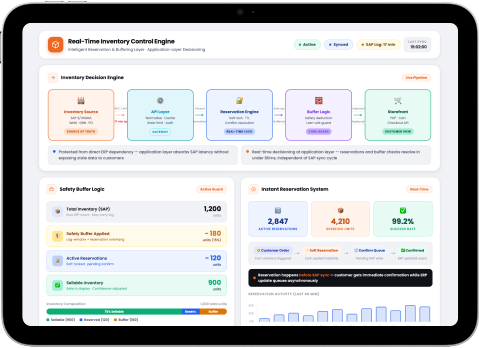
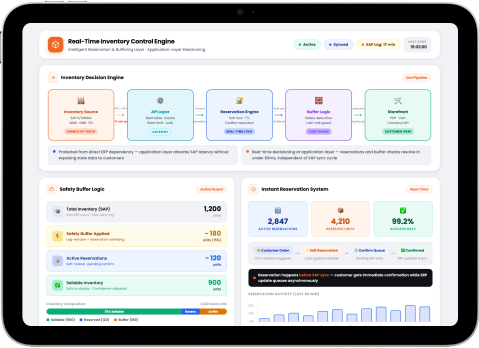
The system ensures inventory accuracy through a buffer-based visibility mechanism that calculates online stock availability using a configurable safety buffer.
To further reduce inconsistencies, a real-time reservation layer is implemented. When a customer places an order, the item is immediately soft-reserved at the application layer before the SAP sync cycle completes.
When conflicts arise, such as an offline sale consuming a reserved unit, the system automatically resolves them by reassigning the unit to the next-nearest store with available inventory. It also implements graceful degradation, where inventory data that exceeds a defined threshold is temporarily hidden from the storefront. All inventory operations are routed through a dedicated API integration layer, ensuring that e-commerce reads and writes remain isolated.
Enabling Centralized Order Visibility Through an OMS
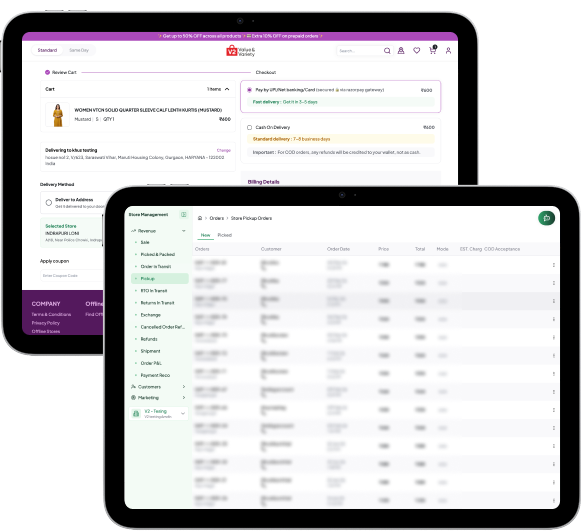
Headquarters needed visibility, and store staff needed execution tools. We addressed these requirements through a paired OMS admin dashboard and a dedicated Android store application.
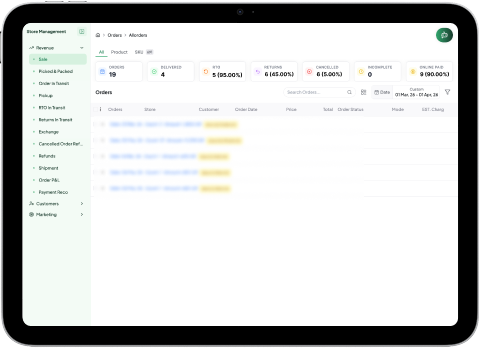
We built a real-time order management system for distributed operations that tracks the order lifecycle across the New, Pickup, Shipment, and Return stages. It enables COD management with delivery attempt tracking and daily reconciliation, along with store-wise dashboards that identify fulfilment bottlenecks.
The system also supports return and exchange workflows with automated refund triggers and includes courier integration to track dispatch status across shipments.
Empowering Store Staff with a Scan-Driven Fulfilment Application
Store staff had no tools to action online orders before this engagement.
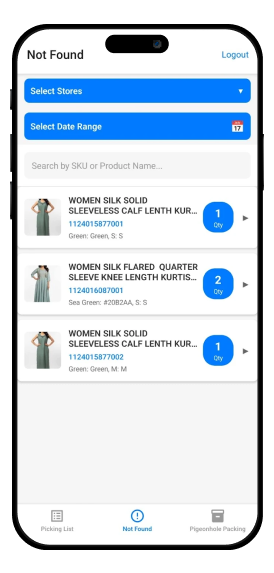
We developed a purpose-built Android application that enables the structured execution of fulfilment workflows from order receipt to handover. The app provides a detailed picking list with product name, SKU, size, and quantity, reducing the need for manual interpretation.
Each picked item is validated through barcode or QR code scanning before packing, preventing dispatch errors. The workflow maintains a clear separation between picked and packed stages, with timestamp logging at each step for operational traceability.
The application also provides courier handover confirmations integrated with logistics systems, ensuring a seamless fulfilment loop.
For BOPIS, it enables in-store pickup verification, where staff confirm customer identity and mark the order as completed.
The Impact
The platform enabled V2 Retail to leverage its 300+ stores as fulfilment nodes, allowing customers to discover, purchase, and receive products online for the first time.
It established a nationwide e-commerce channel with seamless UPI, COD, and card payments, while maintaining sub-2-second load times for mobile users.
Nearest-store fulfilment reduced delivery distances and logistics costs, while structured, scan-based workflows improved store operations and reduced dispatch errors to near zero.
The OMS delivered real-time visibility across all store orders, enabling better control and faster decision-making. BOPIS introduced a cost-efficient fulfilment option through in-store pickups.
Overall, the solution transformed the store network into a distributed fulfilment advantage, preserved SAP stability, and created a scalable foundation for future expansion across locations, channels, and catalogue size.
300+
Stores as Fulfilment Nodes
2s
Storefont Load Time
3
Fulfilment Modes Enabled