Success Story
About the Client

The client is a Japanese multinational company specializing in air conditioning, refrigeration, and chemical solutions. It operates across multiple sectors, including residential and commercial air conditioning, industrial oil and hydraulic systems, and fluorochemicals. With operations in more than 170 countries and over 110 production bases, the company maintains a strong local presence across Europe, Latin America, and Asia to address diverse regional requirements.
Business Situation
The client’s production plant in India relied heavily on manual processes such as real-time tracking of equipment performance, production planning and control, and inventory management. This dependence led to data silos, with each production line operating independently, making it difficult to consolidate and analyze performance metrics across the plant. Machine downtimes were addressed reactively, resulting in unexpected delays, and inventory levels were managed inconsistently. The lack of automated workflows frequently disrupted production schedules, compounding inefficiencies and increasing operational costs.
Recognizing these challenges, the client identified the need for a solution that could deliver real-time visibility into production processes. They envisioned a centralized production management platform capable of automating routine tasks while enabling predictive maintenance to reduce unexpected machine breakdowns.
Their objective was to build a fully integrated, smart production platform that could scale with growing operations while maintaining efficiency, agility, and cost-effectiveness. To achieve this, they required technical expertise in developing advanced production management systems with real-time monitoring and predictive analytics.
After evaluating multiple providers, the client chose Unthinkable for its proven ability to deliver scalable, custom platforms that integrate seamlessly with existing infrastructure. With deep domain expertise and a proprietary architect framework, Unthinkable builds solutions that help accelerate delivery and drive measurable business growth, all with enterprise-grade quality and speed.
Through collaborative brainstorming sessions, the client and Unthinkable defined a comprehensive set of requirements, including:
Strategize the overall development lifecycle by recommending the optimal software architecture and technology stack for an IoT-based production management platform.
Design a dashboard that aggregates real-time data from all production lines, highlighting performance metrics, machine health, and inventory levels.
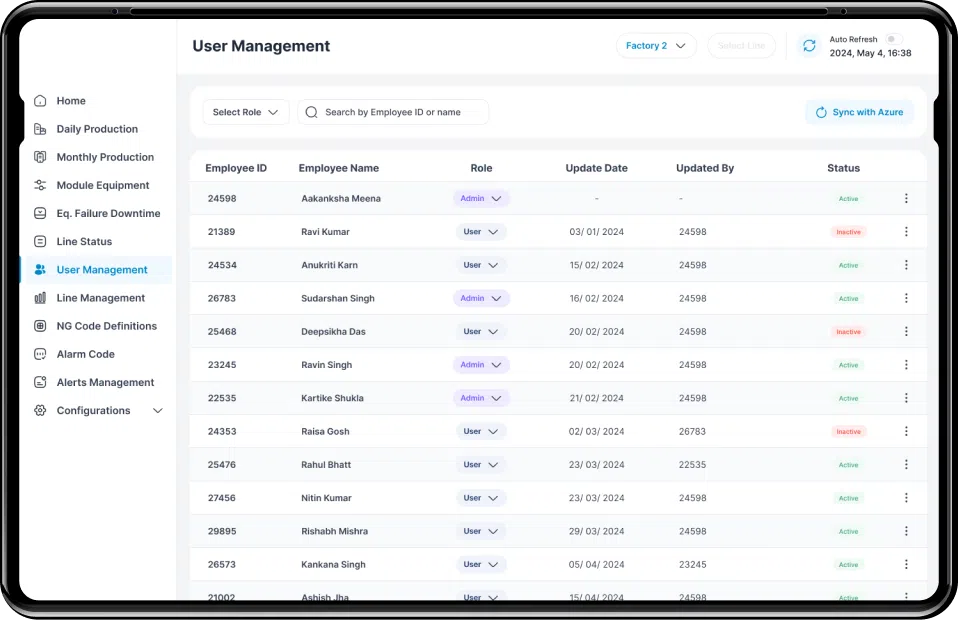
Integrate role-based access control to ensure appropriate access levels based on user roles and responsibilities.
Implement reporting and analytics capabilities to provide real-time insights into plant-wide performance, including machine health, production efficiency, downtime trends, and other KPIs.
Enable mobile access so plant managers and operators can monitor production performance, receive maintenance alerts, and access key metrics.
The Solution
The development of the IoT-based production management platform was executed in multiple stages, each tailored to address specific challenges. IoT sensors were integrated to capture critical real-time data from equipment, enhancing the platform’s reliability and improving fault detection. The data collected from these sensors was visualized on an interactive dashboard, enabling users to effectively monitor machinery status and inventory levels.
For the backend, we utilized .NET Core, offering a modular architecture and performance optimizations essential for handling the real-time data produced by IoT sensors on the production lines. To enhance efficiency and manage increasing data complexities, we recommended migrating from OracleDB to PostgreSQL, ensuring a seamless transition through a structured data migration process that maintained data integrity.
The frontend was developed using AngularJS, leveraging its two-way data binding and component-based architecture to create an interactive dashboard that aggregates real-time data for monitoring key performance metrics, machine health, and inventory levels. Responsive web design principles were applied to ensure accessibility across desktops and smartphones, allowing users to access the platform from multiple devices seamlessly.
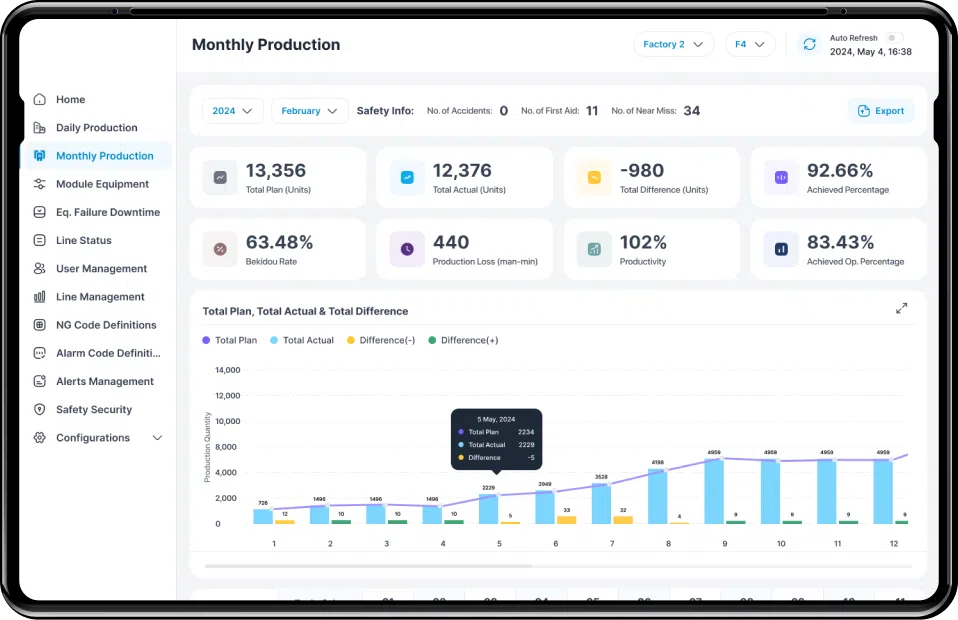
Weekly/Daily/Monthly Production Report:
To enhance production tracking, we developed a reporting module with a visual dashboard. Users could monitor daily, weekly, and monthly progress across all production lines using color-coded bars, grey for planned production, violet for current targets, blue for actual production, and more. The module included filters for customizable views such as plan vs. actual, target vs. actual, or a combined view of all metrics. This functionality enabled accurate monitoring and supported streamlined decision-making to achieve production goals.
Predictive Anomaly Detection:
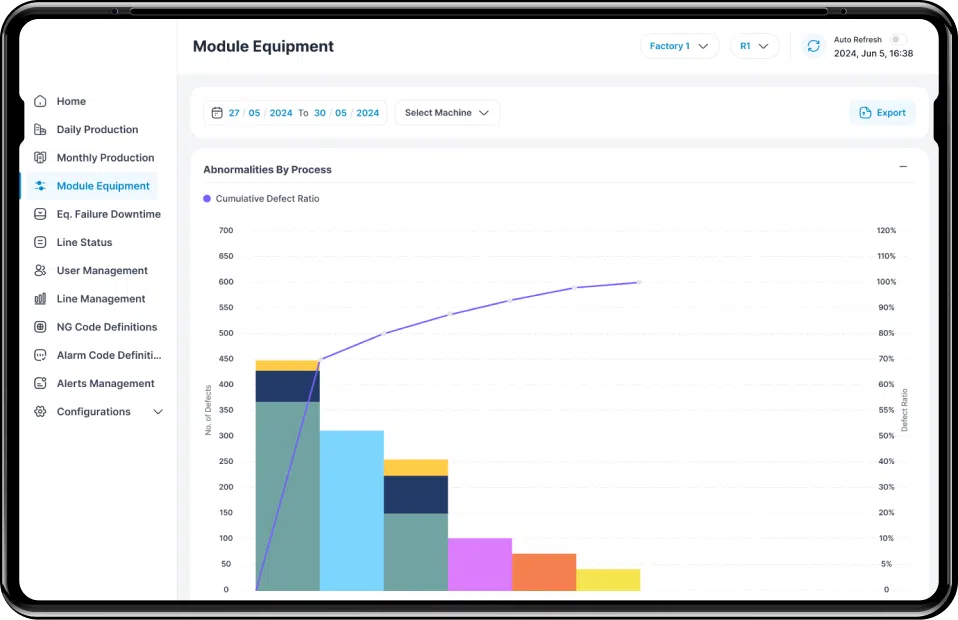
This feature was integrated to help users analyze equipment failures and production data using tools such as scatterplots, Pareto charts, and abnormal content tables. These visualizations provided detailed insights into performance metrics, allowing users to identify root causes of failures, monitor production efficiency, and maintain quality standards. With real-time data integration, users could visualize trends, detect anomalies, and pinpoint areas for improvement. By addressing issues proactively, this module supported efficient operations and optimized equipment performance.
Equipment Failure Downtime:
To minimize disruptions, we implemented an equipment failure downtime feature that provides a detailed table containing key failure information, such as date and time, machine, alarm code, and alarm description, all sourced from IoT devices. The sensors track metrics like temperature and vibration, enabling predictive analytics to detect potential failures early. This proactive approach allows for quick diagnosis and prioritization of maintenance tasks, significantly reducing unplanned downtime, improving productivity, and ensuring consistent output quality.
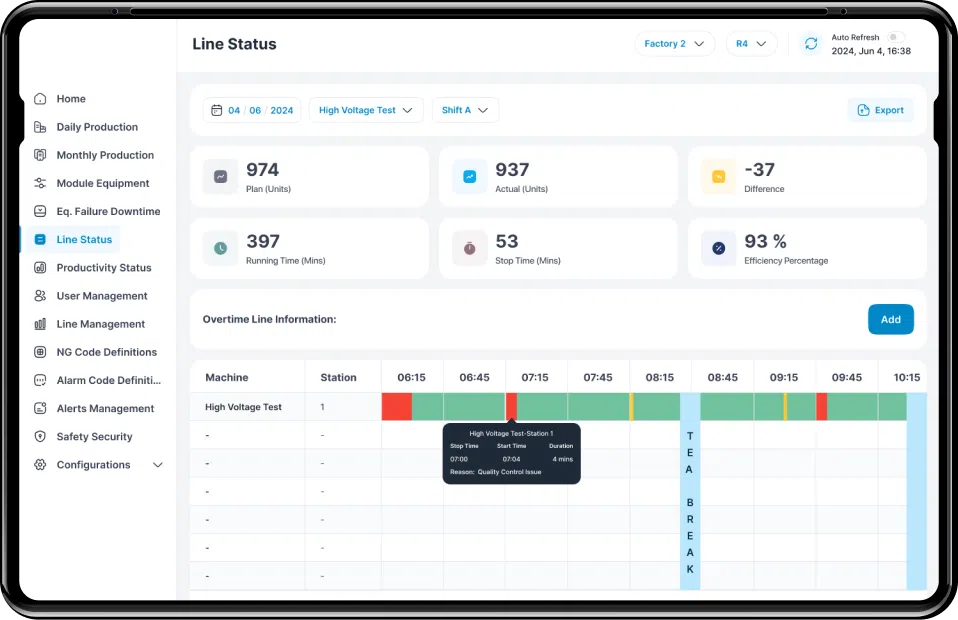
Line Status:
To optimize production line monitoring, we developed a line status feature that tracks the real-time status of each production line using IoT sensors. Accessible via the side menu, the module initially displays the status of all machines for the selected line, providing a clear operational overview. A time-based graph illustrates machine statuses, and users can log reasons for any halts directly from the interface. This functionality ensures production interruptions are documented and addressed efficiently, supporting continuous improvement in operational workflows.
Safety Security Details:
To enhance incident tracking and safety management, we implemented the Safety Security Details feature, allowing users to log and update incident causes efficiently. The page includes a comprehensive table with columns such as date, time, type of incident, reason, and actions (edit/delete). Users can seamlessly update incident information, ensuring accurate and up-to-date records. This functionality helps create a safer work environment by tracking root causes, enabling teams to implement corrective actions, and effectively preventing recurrence.
Line Management:
The Line Management page allows admins to oversee and update line-related information with ease. Admins can view the current list of production lines, add new lines, or modify existing details. This feature ensures that all production lines are accurately documented and up-to-date, supporting improved operational control and providing flexibility to adapt to changing production requirements.
NG Code Definitions:
We implemented the NG Code Definitions feature to help admins efficiently manage production defect codes. The feature provides tools to view, analyze, and update defect codes, including details such as Line, Station, NG Code, and Description. Charts and insights highlight common defect causes, supporting quality control and process optimization. Admins can also add new defect codes to the system, enabling accurate defect tracking, streamlined production processes, and minimized errors.
Production Loss Reason Master:
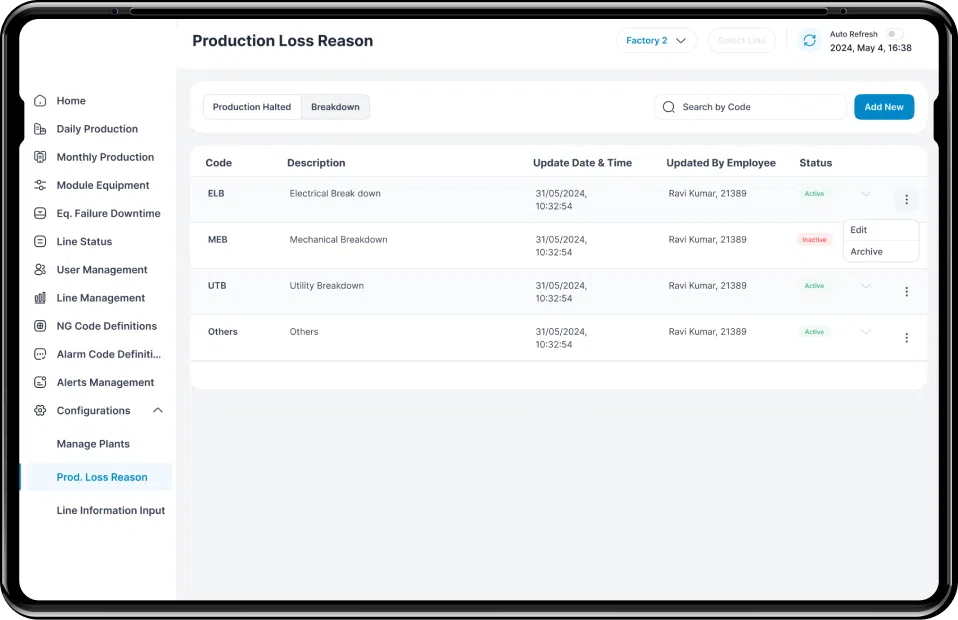
To improve production loss tracking, we introduced this feature to enable admins to register, update, and delete production loss reason codes. These codes are displayed on the Line Status page, providing valuable insights into potential production inefficiencies. This functionality ensures accurate tracking of production losses, allowing admins to implement corrective actions and optimize overall productivity.
Manage Plants:
The Manage Plants feature allows admins to efficiently oversee plant-related data. Admins can update or modify plant details to ensure the system remains accurate and up-to-date. This functionality supports smooth operations and enables easy scalability by maintaining a centralized repository of plant information, fostering long-term growth and operational flexibility.
The Impact
The IoT-based production management platform significantly enhanced the client’s operations at their production plant in India. By automating manual processes and implementing real-time data tracking, the business gained clear visibility into production activities.
This enabled the identification of potential equipment performance issues, supporting proactive maintenance and a substantial reduction in unexpected downtimes. Features like the detailed reporting module and tools for analyzing equipment failures allowed the client to consolidate performance metrics from all production lines in one place.
This consolidation simplified data analysis and strategic planning for decision-makers. Furthermore, mobile access empowered plant managers and operators to monitor critical metrics and respond promptly to issues, improving overall operational efficiency.