Nov 05, 2026
AI in Manufacturing: 8 Use Cases and Adoption Steps
Artificial intelligence (AI) in manufacturing uses AI technologies to analyze factory data, identify patterns, predict problems, and improve production decisions. It helps manufacturers turn data from machines, production lines, quality inspections, and supply chains into actionable insights that can improve efficiency, product quality, and resource utilization.
However, adopting AI involves more than choosing the right technology. In IIoT World’s 2026 Industrial AI Readiness survey of 272 industrial professionals, 54% named data quality and availability as their top barrier to adopting AI, ahead of compute, algorithms, and budget. Reliable, accessible data has to come first when implementing AI across manufacturing operations.
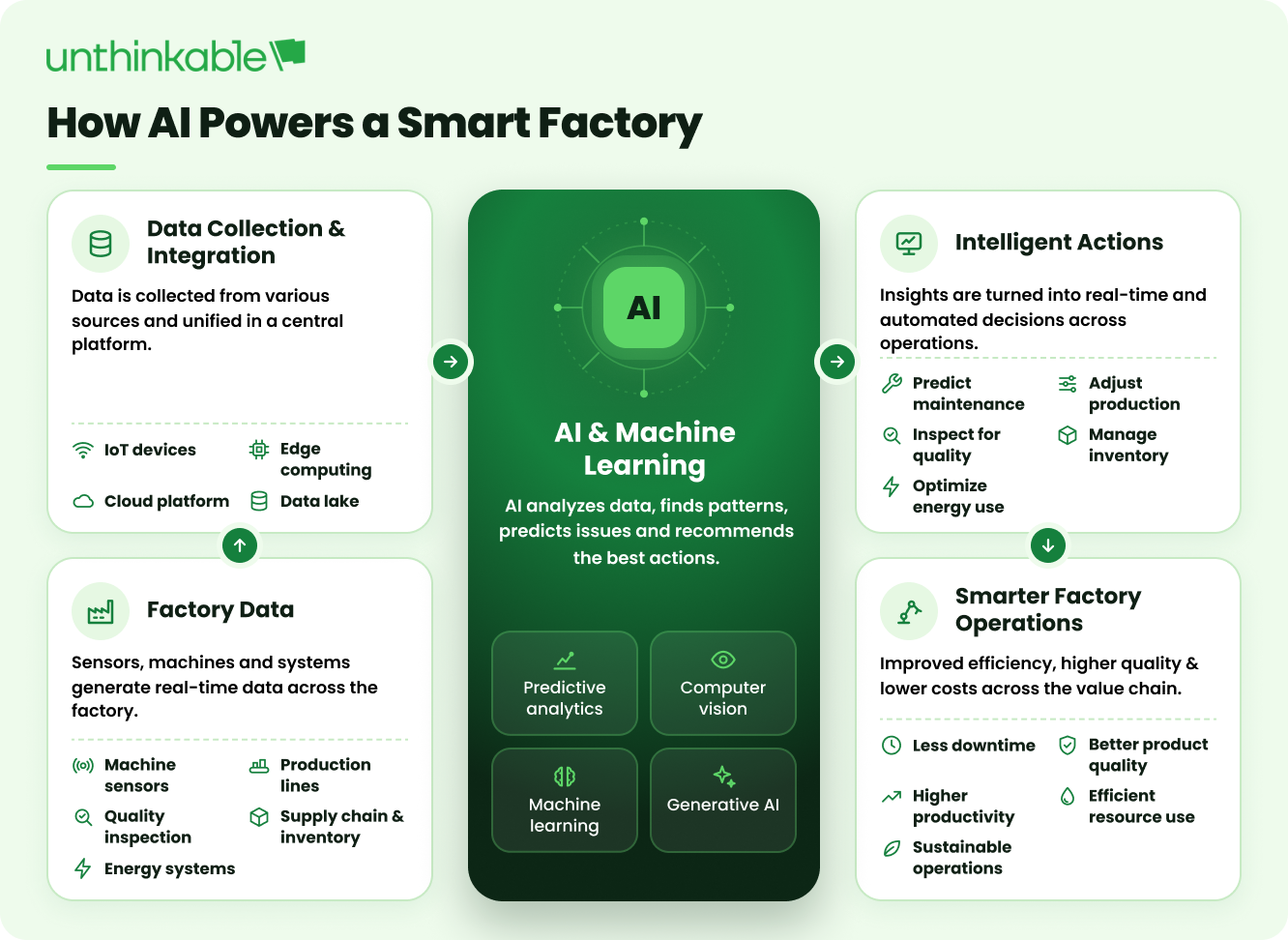
This article explores 8 key use cases and benefits of industrial AI, emerging trends, and practical steps manufacturers can take to adopt AI successfully.
Key Takeaways
- AI in manufacturing improves production efficiency, product quality, and operational decision-making.
- AI use cases in manufacturing include predictive maintenance, defect detection, production optimization, supply chain management, and intelligent robotics.
- Benefits of AI in manufacturing include reduced downtime, lower operational costs, improved resource utilization, and less material waste.
- AI and machine learning in manufacturing enable data-driven decisions through predictive analytics, computer vision, and real-time monitoring.
- Smart manufacturing is evolving through digital twins, generative AI, physical AI, and collaborative AI agents.
- Successful AI adoption in manufacturing requires clear business goals, reliable data, pilot testing, system integration, and employee training.
Benefits of Artificial Intelligence in the Manufacturing Industry
The benefits of AI in manufacturing extend beyond automation to improving efficiency, product quality, and operational decision-making. By analyzing production data in real time, artificial intelligence in manufacturing helps businesses identify inefficiencies, anticipate problems, and make better use of resources.
- Reduced unplanned downtime: AI-powered predictive maintenance identifies early signs of equipment failure, helping manufacturers schedule maintenance before unexpected breakdowns disrupt production.
- Improved product quality: AI applications in manufacturing use computer vision and pattern recognition to detect defects, reduce inspection errors, and maintain consistent product quality.
- Higher production efficiency: AI analyzes production data to identify bottlenecks, optimize workflows, and improve machine utilization, supporting greater manufacturing efficiency.
- Better resource and inventory utilization: AI-driven forecasting helps manufacturers align inventory with demand, reduce excess stock, and minimize material waste.
- Faster, data-informed decisions: AI-generated insights are most useful when teams can understand and act on them confidently. Clear explanations of AI recommendations help operators and managers evaluate outputs and make informed decisions. This is particularly important when designing human-AI interfaces that build user trust.
- Improved energy efficiency and reduced waste: AI-powered manufacturing systems can identify energy-intensive processes and recommend adjustments that reduce unnecessary energy consumption and material waste.
When integrated with existing manufacturing systems, these capabilities can help manufacturers improve operational performance and control costs. The results depend on data quality, implementation, and how effectively AI solutions address specific production challenges.
8 Use Cases of AI in Manufacturing
AI can support a wide range of manufacturing operations, from monitoring equipment health and detecting product defects to optimizing production schedules and managing inventory. By analyzing operational data and identifying patterns that may be difficult to detect manually, AI helps manufacturers improve efficiency, maintain quality, and make better-informed decisions.
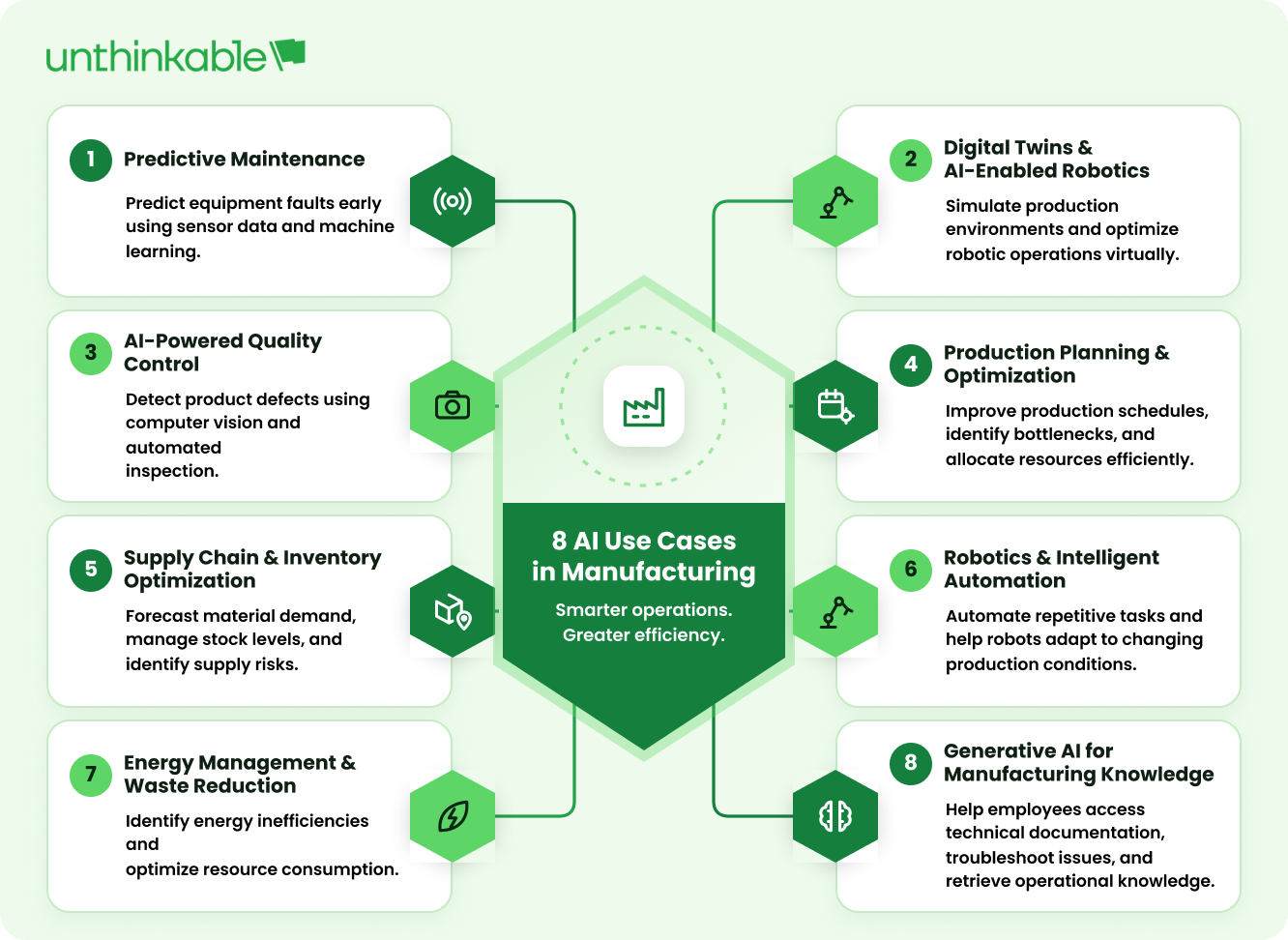
The following are 8 AI use cases in manufacturing along with real-world examples of how businesses are applying these technologies:
1. Predictive Maintenance
Unexpected equipment failures can disrupt production, delay orders, and increase repair costs. Predictive maintenance uses equipment data to identify early signs of faults, helping manufacturers address potential issues before they cause costly downtime.
How Manufacturers Use AI
- Analyzes sensor readings such as vibration, temperature, and pressure.
- Uses machine learning to detect changes that may indicate wear or developing faults.
- Sends alerts when equipment behavior suggests that an inspection may be needed.
- Helps teams prioritize inspections and schedule repairs before a fault disrupts production.
Technologies Used
- Machine learning: Learns patterns from historical and current equipment data.
- Industrial IoT (IIoT): Connects equipment sensors and collects operating data.
- Predictive analytics: Helps assess potential equipment problems.
- Condition-monitoring systems: Track equipment health and make changes easier to investigate.
Client Success
Mechademy is a US engineering firm that provides remote monitoring and troubleshooting for turbomachinery in oil and gas plants. These assets run in remote, harsh conditions, so failures were frequent and teams had little real-time visibility into equipment health. Mechademy wanted to catch faults early and move away from reactive repairs.
Unthinkable built an AI-based monitoring and anomaly detection platform for them. The team connected more than 100 plant sensors through a connector agent, built data pipelines to clean the raw readings, and trained machine learning and deep learning models on historical plant data to flag abnormal behavior. The platform sends prescriptive alerts and shows plant health on dashboards that can be customized for each client.

2. Production Planning and Process Optimization
Poor production planning can lead to machine idle time, bottlenecks, missed deadlines, and wasted resources. AI helps manufacturers adjust production schedules, allocate resources, and respond to changing shop-floor conditions.
How AI Optimizes Production
- Analyzes production data to identify bottlenecks and inefficiencies.
- Forecasts production requirements and helps schedule jobs based on demand and available capacity.
- Uses real-time production monitoring to identify delays and changing machine conditions.
- Updates schedules to help reduce idle time, changeover delays, and production disruptions.
Technologies Used
- Machine learning: Identifies production patterns and potential inefficiencies.
- Optimization algorithms: Help schedule jobs and allocate machines, labor, and resources.
- Manufacturing Execution Systems (MES): Provide production status and shop-floor data.
- Real-time analytics: Helps teams respond to changes in production conditions.
Client Success
A Japanese multinational that makes air conditioning and refrigeration products ran its India plant largely on manual processes. Each production line worked in its own silo, machine breakdowns were handled after the fact, and inventory levels were inconsistent. All of this kept disrupting production schedules.
Unthinkable built a centralized IoT-based production management platform for the plant. IoT sensors feed live data, such as temperature and vibration, into dashboards that show line status, machine health, and inventory levels. The platform includes daily, weekly, and monthly reports that compare planned and actual output, a downtime module that logs failures with alarm codes, predictive anomaly detection, and mobile access for plant managers and operators.
With data from every line in one place, the plant now has clear visibility into production, can plan maintenance ahead of failures, and has seen a substantial drop in unexpected downtime. Managers can track plan versus actual output and respond to issues from their phones.
3. Digital Twins and AI-Enabled Robotics
Digital twins create virtual representations of physical machines, production lines, or entire factories. Combined with AI-powered robotics, they help manufacturers simulate production scenarios, test changes, and improve robotic operations before implementing them on the factory floor.
How AI Supports Digital Twins and Robotics
- Creates virtual models of equipment and production processes using operational data.
- Simulates production changes to identify bottlenecks and test different scenarios.
- Uses AI insights to help optimize robot movements, task sequences, and production workflows.
- Monitors real-time equipment data to compare actual performance with simulated results.
Technologies Used
- Digital twin platforms: Create virtual models of physical assets and production systems.
- Machine learning: Analyzes operational data to identify patterns and predict potential issues.
- Simulation software: Tests production scenarios and robotic movements virtually.
- Industrial IoT (IIoT): Connects physical equipment with digital models through sensor data.
Example
Foxconn uses digital twins built with NVIDIA Omniverse to simulate factory layouts, production lines, and robotic workcells before physical deployment. Engineers can test robot movements, refine tasks such as screw tightening and cable insertion, and optimize automated guided vehicle (AGV) routes in a virtual environment.
4. AI-Powered Quality Control and Defect Detection
Defective products can lead to material waste, customer complaints, and costly rework. Traditional inspections may also miss small or inconsistent defects, especially on high-speed production lines. AI-powered quality control helps manufacturers identify defects earlier and inspect products more consistently.
How AI Detects Product Defects
- Analyzes product images to identify scratches, cracks, dents, and surface irregularities.
- Uses computer vision to compare products against defined quality standards.
- Flags suspected defects for rejection or further inspection.
- Helps quality teams monitor defect patterns and identify recurring production issues.
Technologies Used
- Computer vision: Analyzes images to detect visible product defects.
- Deep learning: Learns to recognize defect patterns from labeled product images.
- Industrial cameras: Capture product images on the production line.
- Edge AI: Processes images near the production equipment when fast inspection is required.
Example
Procter & Gamble (P&G) worked with Siemens to build an AI-based visual inspection system called the Visual Inspection Cockpit. It analyzes live camera images, checks every product on the line at full production speed, and flags defective items for removal.
In September 2026, the two companies announced that the system is being rolled out across P&G’s plants worldwide. Depending on the product, it has cut scrap by 10-20%, and new deployments can be set up 5-10 times faster than traditional custom-built vision systems.
5. Supply Chain and Inventory Optimization
Unpredictable demand, supplier delays, and excess inventory can disrupt manufacturing schedules and increase storage costs. AI helps manufacturers forecast material requirements, maintain appropriate stock levels, and respond to supply chain changes.
How AI Improves Supply Chain Planning
- Analyzes historical sales and order data to forecast material demand.
- Identifies inventory shortages and excess stock across locations, supporting inventory management and demand forecasting
- Identifies inventory shortages and excess stock across locations.
- Recommends stock levels based on demand patterns and supplier lead times.
- Helps teams adjust procurement and replenishment plans as demand changes.
Technologies Used
- Machine learning: Identifies demand patterns using historical data.
- Demand forecasting: Estimates future material and product requirements.
- Inventory optimization algorithms: Help balance stock availability against holding costs.
- Predictive analytics: Helps identify potential supply shortages and inventory risks.
Client Success
Forecasting only works when materials, orders, and work in progress are tracked in one place. That is the problem Suuchi Inc. brought to Unthinkable. Suuchi is a US company that designs and manufactures apparel for major American fashion brands, with a supply chain spread across mills, factories, suppliers, and freelancers. A slow design-to-sample cycle made it hard to keep up with trends.
Unthinkable built Suuchi Grid, a cloud-based platform that automates the manufacturing workflow from costing and raw material planning to procurement, quality control, inventory, production scheduling, and shipment. Brands, suppliers, and factory teams work from one source of truth and track work in progress in real time.
A garment sample now goes from 3D design to a physical piece in 48 hours, which is 20x faster than before. Suuchi cut manufacturing overhead by 28% and order processing time by 46%. The platform connects more than 500 mills, factories, suppliers, and freelancers and tracks over 50 million units a year.
6. Robotics
Repetitive, physically demanding, or precision-sensitive tasks can slow production and expose workers to safety risks. AI-enabled robotics in manufacturing helps automate these tasks, improve consistency, and adapt operations to changing production requirements.
How AI Powers Manufacturing Robots
- Automates repetitive tasks such as assembly, material handling, and packaging.
- Uses computer vision to identify components and guide robot movements.
- Helps collaborative robots work alongside human operators on suitable tasks.
- Adjusts robot operations based on sensor data and changing production conditions.
Technologies Used
- Machine learning: Helps robots adapt to variations in tasks.
- Computer vision: Identifies objects and guides robotic actions.
- Collaborative robots (Cobot): Support workers with repetitive or precision-sensitive tasks.
- Industrial IoT (IIoT): Shares equipment data to support monitoring and coordination.
Example
BMW Group tested a humanoid robot at its Spartanburg plant to handle sheet-metal components for welding. The robot handled sheet-metal parts, positioning them precisely for welding. Over 10 months, it supported production of more than 30,000 BMW X3 vehicles and moved over 90,000 components during approximately 1,250 operating hours.
7. Energy Management and Waste Reduction
High energy consumption, material waste, and inefficient production processes can increase manufacturing costs. AI helps manufacturers analyze operational data, identify inefficiencies, and optimize resource use across production.
How AI Optimizes Energy Use
- Monitors energy consumption across machines and production lines.
- Identifies unusual energy usage and opportunities to reduce waste.
- Optimizes equipment schedules based on production demand and energy requirements.
- Analyzes process data to identify inefficiencies and improve resource utilization.
Technologies Used
- Machine learning: Identifies patterns in energy consumption and production data.
- Industrial IoT (IIoT): Collects real-time data from equipment and energy sensors.
- Predictive analytics: Helps forecast energy demand and detect potential inefficiencies.
- Energy management systems: Track consumption and support energy optimization decisions.
Example
Bosch developed an AI-based energy management system in-house and introduced it at its plant in Changsha, China. With the system in place, the plant cut its annual electricity consumption by 18% and its carbon dioxide emissions by 14%. The World Economic Forum named the plant an Industry 4.0 Lighthouse for its results.
8. Generative AI for Manufacturing Knowledge and Workflows
Manufacturers often store critical knowledge across technical manuals, standard operating procedures, maintenance records, and the expertise of experienced employees. Generative AI in manufacturing helps teams access this information faster, troubleshoot issues, and simplify routine workflows.
How Manufacturers Use Generative AI
- Answers employee questions using technical documents and operating procedures.
- Summarizes maintenance records and troubleshooting instructions.
- Helps workers find relevant information without manually searching multiple systems.
- Captures experienced employees’ knowledge to support training and knowledge sharing.
Technologies Used
- Large language models (LLMs): Understand questions and generate relevant responses.
- Retrieval-Augmented Generation (RAG): Retrieves information from approved company documents to ground responses in internal knowledge.
- AI assistants: Provide conversational access to technical information and workflows. In more complex applications, token-efficient multi-agent systems can help coordinate tasks across multiple AI agents.
- Knowledge management systems: Organize manuals, procedures, and operational records for easier retrieval.
Example
Georgia-Pacific worked with AWS to develop a generative AI assistant called ChatGP, helping factory operators access company knowledge and troubleshoot equipment issues. The system brings together information from documents and experienced employees, helping reduce machine downtime, improve production quality, and preserve operational expertise.
Future Trends of AI in Manufacturing (2027 and Beyond)
The future of AI in manufacturing is moving toward systems that can adapt to changing conditions, coordinate decisions, and handle more complex tasks with less manual intervention. These emerging trends could shape the next phase of smart manufacturing.
1. Physical AI and Adaptive Robotics
Advances in physical AI could help robots understand their surroundings, handle unfamiliar objects, and adapt to changing production environments. This could take manufacturing automation using AI beyond fixed, pre-programmed tasks toward more flexible operations that require less manual reconfiguration.
2. Collaborative AI Agents
AI agents may increasingly work together across production planning, inventory, procurement, and maintenance. AI agents may increasingly work together across production planning, inventory, procurement, and maintenance. Advances in agentic AI and multi-agent systems could help manufacturers coordinate decisions when disruptions occur and adjust operations with less manual intervention.
Instead of optimizing individual processes, these systems could coordinate decisions when disruptions occur, helping AI-powered manufacturing operations respond faster while keeping people involved in critical decisions.
3. Physics-Informed AI for Engineering
Combining AI with physics-based simulations could help manufacturers evaluate product designs, predict material behavior, and test production conditions before physical trials. This could make AI and machine learning in manufacturing more useful in complex engineering tasks where real-world testing is expensive or time-consuming.
4. Self-Orchestrating Factories
Future AI in the manufacturing industry could connect machines, production schedules, and resource planning into more coordinated systems. These factories may adjust workflows as demand, equipment availability, or material supplies change, advancing Industry 4.0 and AI toward more flexible and increasingly autonomous production environments.
Steps to Adopt AI and Machine Learning in Manufacturing
Follow these 4 steps to adopt Artificial Intelligence and machine learning in manufacturing industries, starting with business priorities and moving toward scalable implementation.
Step 1: Identify Business Goals and Prioritize the Right Use Case
Start by identifying production challenges that affect efficiency, quality, or operating costs. These may include unplanned downtime, recurring defects, production bottlenecks, or excess inventory.
- Identify processes where manual work or recurring issues affect performance.
- Define measurable goals, such as reducing downtime, lowering defect rates, or improving production output.
- Evaluate potential use cases based on business impact, feasibility, and expected return on investment.
A clear assessment of business needs and technical feasibility helps determine where AI can deliver practical value before committing resources to development.
Step 2: Assess Data Readiness and Choose the Right AI Technology
AI systems depend on reliable, accessible data. Manufacturers should evaluate existing data sources, equipment connectivity, and infrastructure before selecting an approach. This includes checking how well current systems can support AI integration with existing infrastructure and whether production data is available for the intended use case.
- Check data quality, availability, and consistency across production systems.
- Identify gaps in sensor coverage, data collection, and system connectivity.
- Choose an appropriate technology, such as machine learning for predictive maintenance, computer vision for defect detection, or generative AI for technical knowledge retrieval.
- Assess integration requirements, infrastructure costs, and security considerations.
For example, manufacturers exploring connected production environments may need to combine machine data from industrial IoT systems with analytics models to identify operational patterns and inefficiencies.
Step 3: Run a Pilot, Integrate With Existing Systems, and Measure Results
Test the selected AI solution on a specific machine, production line, or process before expanding its use. A pilot helps establish whether the technology performs reliably under real operating conditions.
- Record baseline metrics before implementation.
- Test the solution against defined performance targets using relevant production data.
- Evaluate accuracy, reliability, and its effect on operational performance.
- Integrate the solution with relevant manufacturing systems and compare results against the baseline.
The pilot should demonstrate measurable value before wider deployment. Manufacturers can then refine the solution based on actual results and address integration issues before expanding it.
Step 4: Train Teams, Establish Governance, and Scale AI Across Operations
Successful implementation also depends on employee readiness, data security, and ongoing monitoring. Once a pilot demonstrates value, manufacturers can prepare teams and establish processes for broader adoption.
- Train operators, engineers, and maintenance teams to interpret AI outputs and use them in daily workflows.
- Establish data access controls, governance policies, and appropriate human oversight.
- Monitor model performance and update systems when equipment, processes, or operating conditions change.
- Expand successful applications to additional machines, production lines, or facilities.
As manufacturers expand successful pilots across production lines, custom AI development can support the development and refinement of solutions to meet evolving operational requirements. Ongoing monitoring, employee training, and appropriate governance help ensure these solutions remain useful as manufacturing needs change.
Turning Manufacturing AI Opportunities Into Action
AI is creating new opportunities for manufacturers to improve efficiency, reduce operational costs, and make faster, data-driven decisions. From predictive maintenance and quality control to intelligent automation, the right AI solutions can help manufacturers address production challenges and build more adaptable operations.
The key is to start with a clear business objective, choose the right use case, and scale solutions based on measurable results. If you’re exploring AI solutions for manufacturing, the Unthinkable Solutions team can help you identify opportunities, develop tailored AI applications, and integrate them with your existing systems.
Connect with Unthinkable Solutions to discuss your manufacturing challenges and explore how AI can support your business goals.
About Author